
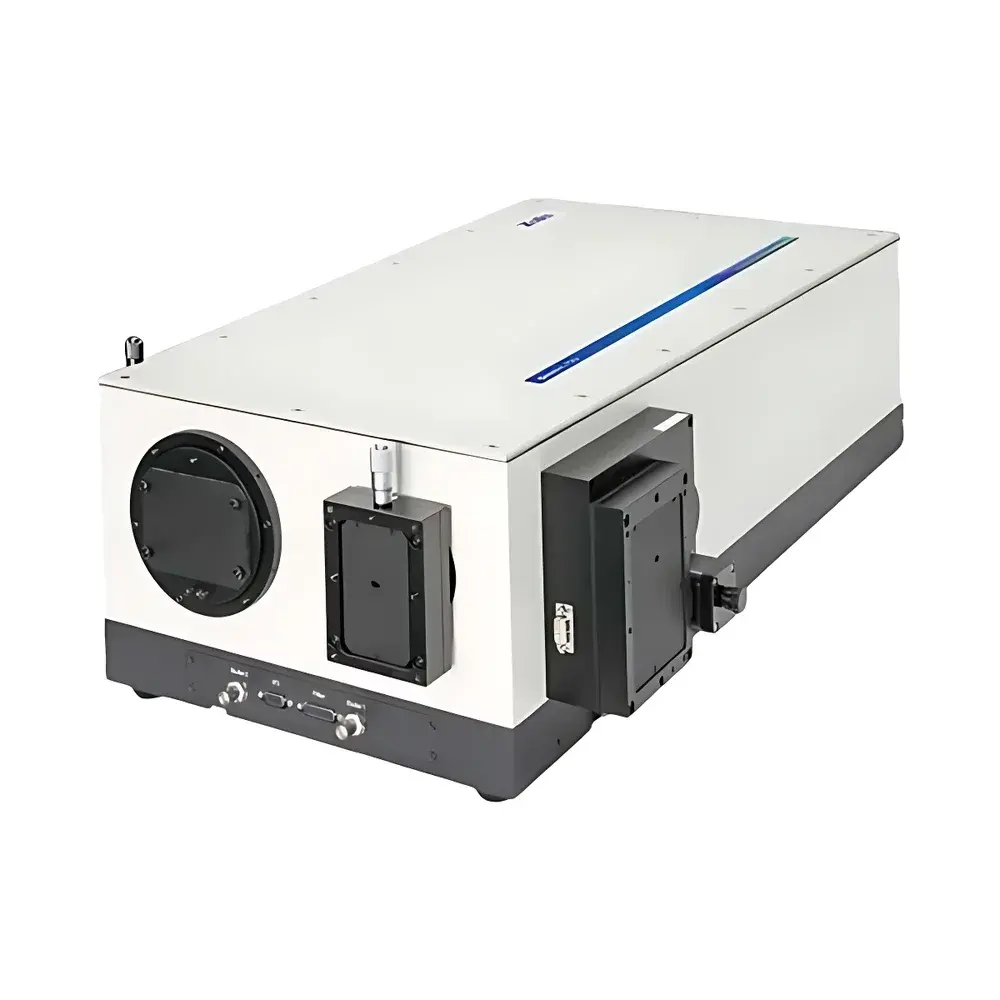
ZOLIX Omni-λ750S Series Imaging Spectrograph Monochromator
| Brand | ZOLIX |
|---|---|
| Origin | Beijing, China |
| Manufacturer Type | Original Equipment Manufacturer (OEM) |
| Product Category | Domestic |
| Model | Omni-λ750S |
| Application System | Universal |
| Grating Capacity | Triple-grating turret |
| Focal Length | 750 mm |
| Optical Design | Czerny-Turner with toroidal image correction |
| Stray Light Rejection | 1×10⁻⁵ |
| Entrance/Exit Options | Dual entrance, dual exit |
| Standard Interface | USB 2.0 |
| Grating Size | 68×68 mm (optional 68×84 mm) |
| Slit Width Range | 0.01–3 mm (manual), motorized slit optional |
| Slit Height Options | 2 mm / 4 mm / 14 mm |
| Focal Plane Dimensions | 30 mm (W) × 14 mm (H) |
| Optical Axis Height | 146 mm |
| Relative Aperture | f/9.7 |
| Minimum Scan Step | 0.0025 nm (with 2400 g/mm grating) |
| Wavelength Accuracy | ±0.1 nm (at 435.83 nm, 2400 g/mm) |
| Wavelength Repeatability | ±0.015 nm (at 435.83 nm, 2400 g/mm) |
| CCD Spectral Resolution (15 µm pixel) | 0.026 nm (2400 g/mm) |
| Single-shot CCD Spectral Coverage | 12.9 nm (30 mm CCD, 2400 g/mm, 435.83 nm center) |
| Infrared Optimization | Gold-coated optics for >1 µm operation |
| UV Optimization | Optional UV-enhanced coatings |
| Power Supply | 24 V DC, peak 100 W |
| Dimensions (L×W×H) | 800 × 338 × 230 mm |
| Weight | 40 kg |
Overview
The ZOLIX Omni-λ750S Series Imaging Spectrograph Monochromator is a high-performance, research-grade Czerny-Turner spectroscopic instrument engineered for precision spectral analysis across the ultraviolet, visible, and near-to-mid infrared (UV-VIS-NIR-MIR) spectrum (190 nm – 12 µm, depending on grating and detector selection). As the direct successor to the Omni-λ750i platform, the Omni-λ750S incorporates an optimized optical path with toroidal image correction to minimize aberrations and significantly improve spatial and spectral fidelity—particularly critical when coupled with array detectors such as scientific-grade CCDs and sCMOS sensors. Its 750 mm focal length and f/9.7 relative aperture deliver high optical throughput while maintaining exceptional resolution and low stray light (<1×10⁻⁵), enabling quantitative measurements in demanding applications including photoluminescence quantum yield (PLQY), Raman mapping, and high-resolution absorption spectroscopy. The monochromator operates on a fully computer-controlled architecture, supporting automated wavelength scanning, grating selection, and multi-port routing via USB 2.0 interface and embedded DSP firmware.
Key Features
- Czerny-Turner optical layout with toroidal mirror-based image correction for diffraction-limited imaging performance across the full focal plane (30 mm × 14 mm)
- Triple-grating turret accommodating up to three 68×68 mm (or 68×84 mm) ruled or holographic gratings—enabling seamless switching between UV, VIS, and IR spectral ranges without realignment
- Dual entrance ports support synchronized optical gating (e.g., electronic shutters) and multi-source excitation; dual exit ports allow simultaneous coupling to both a CCD array and a single-point detector (e.g., PMT or InGaAs photodiode)
- Gold-coated optics standard on IR-optimized configurations (models ending in “15s”, “17s”) for >95% reflectance beyond 1 µm; optional UV-enhanced Al+MgF₂ coatings available for <200 nm operation
- Manual slit (0.01–3 mm width, 2/4/14 mm height) with motorized slit option for programmable bandwidth control and automated spectral acquisition protocols
- High-precision wavelength drive with sub-pico-meter step resolution (down to 0.0025 nm at 2400 g/mm) and repeatability better than ±0.015 nm
- USB 2.0 interface replaces legacy RS-232, enabling plug-and-play integration with Windows/Linux-based spectrometer control software and third-party LabVIEW or Python environments
Sample Compatibility & Compliance
The Omni-λ750S is designed for compatibility with a broad range of light sources (Xe/Hg arc lamps, tunable lasers, supercontinuum sources, LEDs) and detectors (back-illuminated CCDs, EMCCDs, sCMOS, InGaAs linear arrays, MCT, and DTGS). Its modular port configuration supports standardized optical interfaces (e.g., SMA905, FC/PC, or kinematic mounts), facilitating integration into custom-built spectroscopic systems compliant with ISO/IEC 17025 laboratory requirements. While not pre-certified for specific regulatory frameworks, the instrument’s deterministic wavelength calibration traceability (via Hg/Ne/Ar spectral lines), audit-ready parameter logging, and deterministic motor control architecture enable full compliance with GLP and GMP documentation workflows when paired with validated software and SOPs. It meets mechanical and electromagnetic compatibility standards per GB/T 18268.1–2010 (equivalent to IEC 61326-1) for laboratory equipment.
Software & Data Management
ZOLIX provides the OmniStudio™ control suite—a native Windows application supporting full instrument configuration, automated multi-grating sequencing, slit optimization, and real-time spectral preview. The software exports spectra in industry-standard formats (ASCII, CSV, FITS) and supports metadata embedding (wavelength calibration coefficients, grating ID, slit width, integration time). API libraries (DLL and Python bindings) are included for custom automation, enabling integration into larger experimental platforms governed by ASTM E131 (Standard Terminology Relating to Molecular Spectroscopy) or USP (Spectrophotometry and Light-Scattering). All motor movements, grating changes, and wavelength positions are timestamped and logged—providing full traceability required under FDA 21 CFR Part 11 when used in regulated analytical environments.
Applications
- Steady-state and time-resolved photoluminescence spectroscopy of quantum dots, perovskites, and 2D materials
- Confocal Raman microspectroscopy with spatial resolution down to 1 µm using fiber-coupled excitation
- High-fidelity transmission/reflection measurements of thin films and optical coatings per ISO 9050
- Calibration source characterization (e.g., NIST-traceable tungsten halogen or deuterium lamps)
- Gas-phase absorption spectroscopy in environmental monitoring setups (NO₂, CH₄, CO detection)
- Plasma emission diagnostics in fusion and semiconductor processing reactors
- Custom OEM integration into laser-induced breakdown spectroscopy (LIBS) and hyperspectral imaging systems
FAQ
What is the difference between the Omni-λ750S and the previous Omni-λ750i model?
The Omni-λ750S features an optically re-engineered C-T layout with toroidal image correction, improved mechanical rigidity, enhanced stray light suppression (<1×10⁻⁵), and native USB 2.0 communication—replacing RS-232 for faster data throughput and simplified cabling.
Can the Omni-λ750S be used for infrared spectroscopy beyond 2.5 µm?
Yes—when equipped with gold-coated optics and a suitable grating (e.g., 150 g/mm blazed at 5 µm) and paired with a liquid-nitrogen-cooled MCT detector, the system supports spectral acquisition up to ~12 µm.
Is wavelength calibration traceable to NIST standards?
The instrument supports internal calibration using mercury-argon or neon lamp lines; users may perform external calibration against NIST-traceable reference sources to establish metrological traceability per ISO/IEC 17025 requirements.
Does the system support synchronization with pulsed lasers or gated detectors?
Yes—the dual entrance port enables TTL-triggered electronic shutter integration, and the USB API supports precise timing coordination with external devices via hardware trigger inputs.
Are firmware updates and driver support provided long-term?
ZOLIX offers 5 years of free firmware and SDK updates post-purchase, with extended support contracts available for industrial and academic OEM integrators.





