
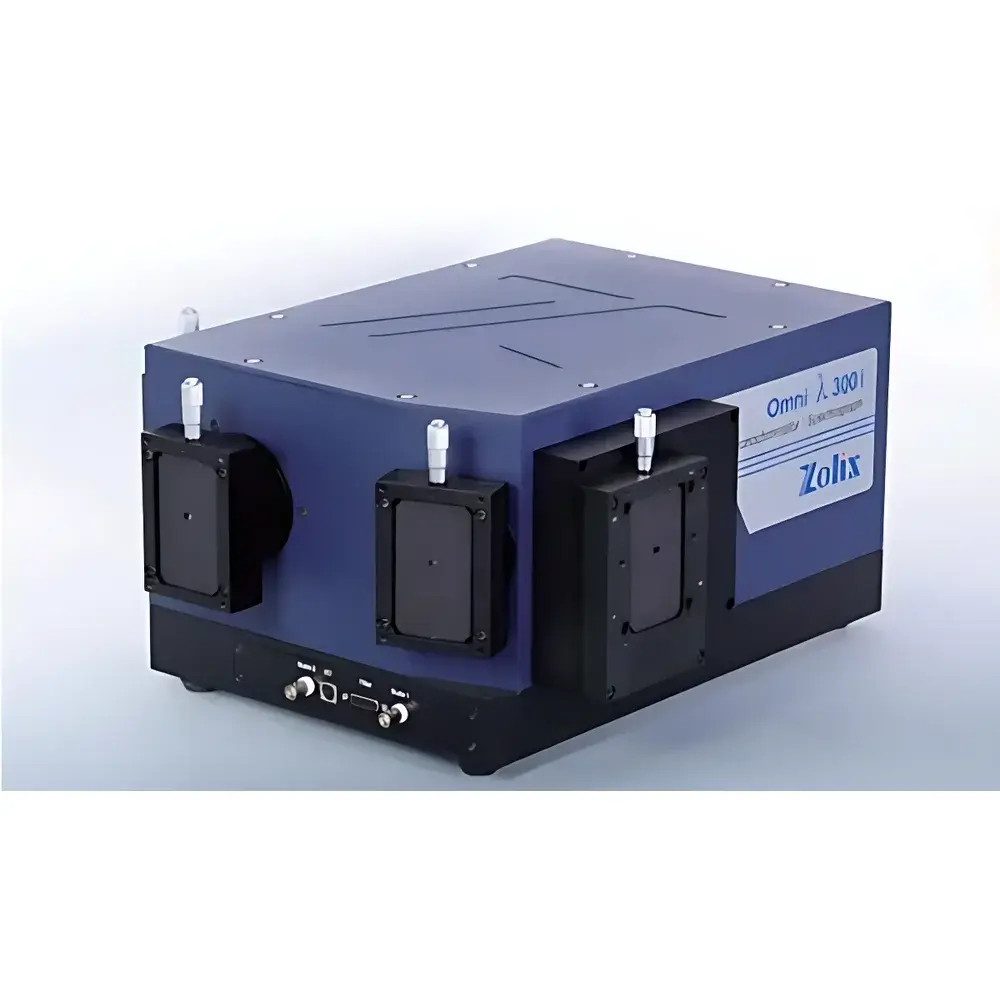
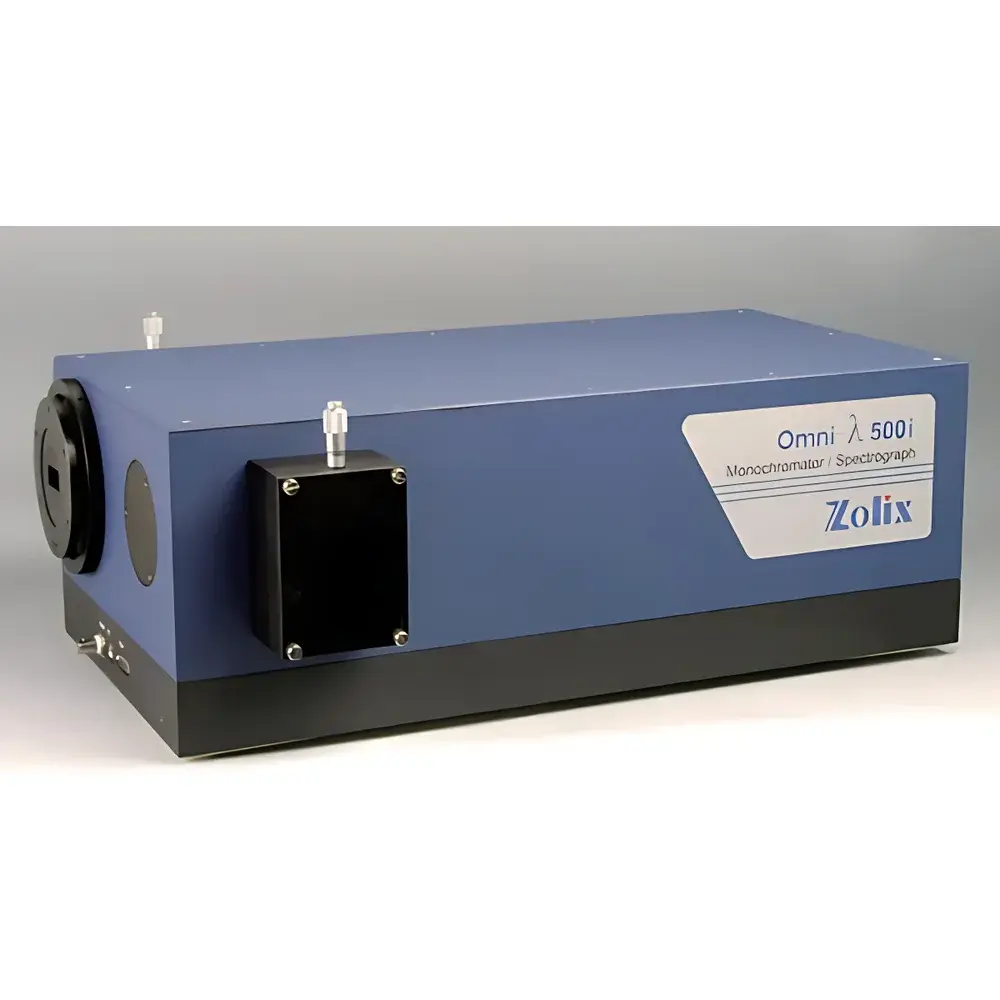
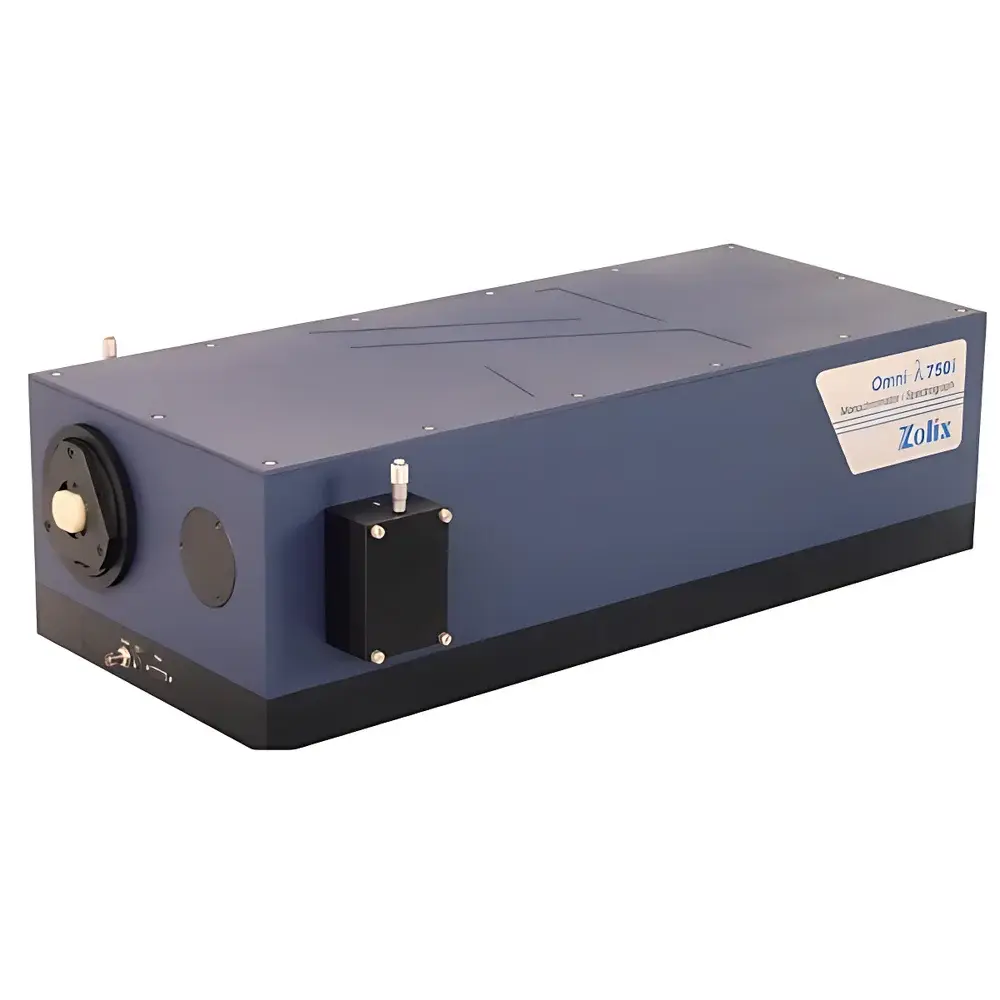
ZOLIX Omni-λXi Imaging Spectrograph Monochromator
| Brand | ZOLIX |
|---|---|
| Origin | Beijing, China |
| Manufacturer Type | OEM Manufacturer |
| Product Origin | Domestic (China) |
| Model | Omni-λXi |
| Application Systems | Transmission/Reflection Spectroscopy |
| Grating Configuration | Triple-Grating Turret |
| Spectral Resolution | 0.35 nm (@1200 g/mm) |
| Linear Dispersion | 3.68 nm/mm |
| Wavelength Range | 400–1000 nm |
| F-number | f/1 |
| Wavelength Accuracy | ±0.25 nm (@1200 g/mm) |
| Stray Light | ≤0.1% (1×10⁻³) |
Overview
The ZOLIX Omni-λXi Imaging Spectrograph Monochromator is a high-performance Czerny-Turner (C-T) optical instrument engineered for precision spectral isolation and imaging-based spectroscopic analysis across the visible to near-infrared (VIS-NIR) range. It operates on the principle of angular dispersion via diffraction gratings, where incident polychromatic light is spatially separated by wavelength at the focal plane—enabling both monochromatic selection (monochromator mode) and simultaneous multi-wavelength detection (spectrograph mode). Its f/1 optical architecture, combined with aspheric image correction optics, minimizes astigmatism and ensures diffraction-limited spot formation across the full focal plane—critical for coupling with array detectors (e.g., CCD, CMOS) and maintaining high signal-to-noise ratio in low-light applications such as fluorescence, Raman, and reflectance spectroscopy.
Key Features
- C-T optical design with aspheric mirror-based image correction, delivering superior spatial resolution and reduced off-axis aberrations across the entire 30 mm (W) × 14 mm (H) focal plane.
- Triple-grating turret system supporting rapid, software-controlled grating exchange—enabling seamless optimization of resolution, throughput, and spectral coverage without realignment.
- Large-format diffraction gratings (40 × 40 mm or 68 × 68 mm), including gold-coated variants for enhanced reflectivity above 1000 nm—ensuring high efficiency from UV through NIR.
- f/1 aperture design maximizes étendue and photon collection efficiency, particularly advantageous when paired with low-output sources or weak-emission samples.
- USB 2.0 digital interface with embedded DSP control enables deterministic motor positioning, sub-nanometer wavelength stepping (down to 0.0025 nm), and synchronized operation with external shutters or automated slits.
- Configurable input/output port architecture: dual-input/dual-output options support complex optical routing—including simultaneous excitation and emission path separation in fluorescence setups.
- Motorized slit drive (optional) with 0.01–3 mm continuously adjustable width and selectable heights (2, 4, 10, or 14 mm) for precise control of spectral bandwidth and throughput.
Sample Compatibility & Compliance
The Omni-λXi is compatible with standard free-space optical interfaces (e.g., SMA905, FC/PC fiber couplers, or custom kinematic mounts) and integrates natively with ZOLIX broadband light sources, lock-in amplifiers, PMTs, and scientific-grade CCD/CMOS detectors. Its mechanical wavelength repeatability (±0.01 nm) and accuracy (±0.25 nm) meet requirements for quantitative spectroscopic measurements under ISO/IEC 17025-accredited laboratory practices. While not pre-certified for regulatory environments, its deterministic USB-controlled operation, audit-trail-capable software logging, and stable thermal-mechanical housing support validation pathways aligned with FDA 21 CFR Part 11 and GLP/GMP documentation standards when deployed in QC/QA workflows.
Software & Data Management
Control and acquisition are managed via ZOLIX’s cross-platform SpectraMaster™ software suite (Windows/macOS/Linux), offering real-time wavelength calibration, grating auto-identification, multi-slit synchronization, and dark-current subtraction routines. Raw spectral data exports in standardized formats (CSV, HDF5, FITS) ensure interoperability with third-party analysis tools (e.g., MATLAB, Python SciPy, Igor Pro). The software supports scripting (Python API) for automated measurement sequences—including time-resolved spectral acquisition, kinetic scans, and multi-point mapping—and maintains full metadata tagging (grating ID, slit width, integration time, detector gain) for traceable data provenance.
Applications
The Omni-λXi serves as a core optical engine in diverse analytical configurations: transmission/reflection spectrophotometry of thin films and optical coatings; steady-state and time-resolved photoluminescence spectroscopy; micro-Raman systems with notch-filter-coupled excitation; LED and laser diode spectral characterization; and custom-built hyperspectral imaging platforms. Its imaging capability allows spatially resolved spectral acquisition across extended line fields—making it suitable for plasma diagnostics, combustion analysis, and remote sensing prototype development where spectral fidelity and radiometric consistency are paramount.
FAQ
What wavelength calibration standards are supported?
NIST-traceable Hg/Ar/Ne emission lamps and built-in software-assisted polynomial fitting enable first- and second-order calibration with RMS residuals <0.05 nm.
Can the Omni-λXi be used with fiber-optic inputs?
Yes—standard SMA905 or FC/PC adapters are available; optional fiber collimation kits maintain f/1 throughput and minimize modal noise.
Is vacuum or purged operation possible for UV-enhanced performance?
The base model is air-filled; optional nitrogen purge ports and UV-fused silica optics (for <200 nm extension) are available upon request.
How is stray light performance verified?
Stray light is measured per ASTM E275-20 using a 546.1 nm primary line and a deep-notch filter; reported values reflect worst-case conditions at 50 nm offset.
Does the instrument support external triggering for time-gated detection?
Yes—TTL-compatible trigger I/O allows synchronization with pulsed lasers, gated detectors, or oscilloscopes at rates up to 10 kHz.





