
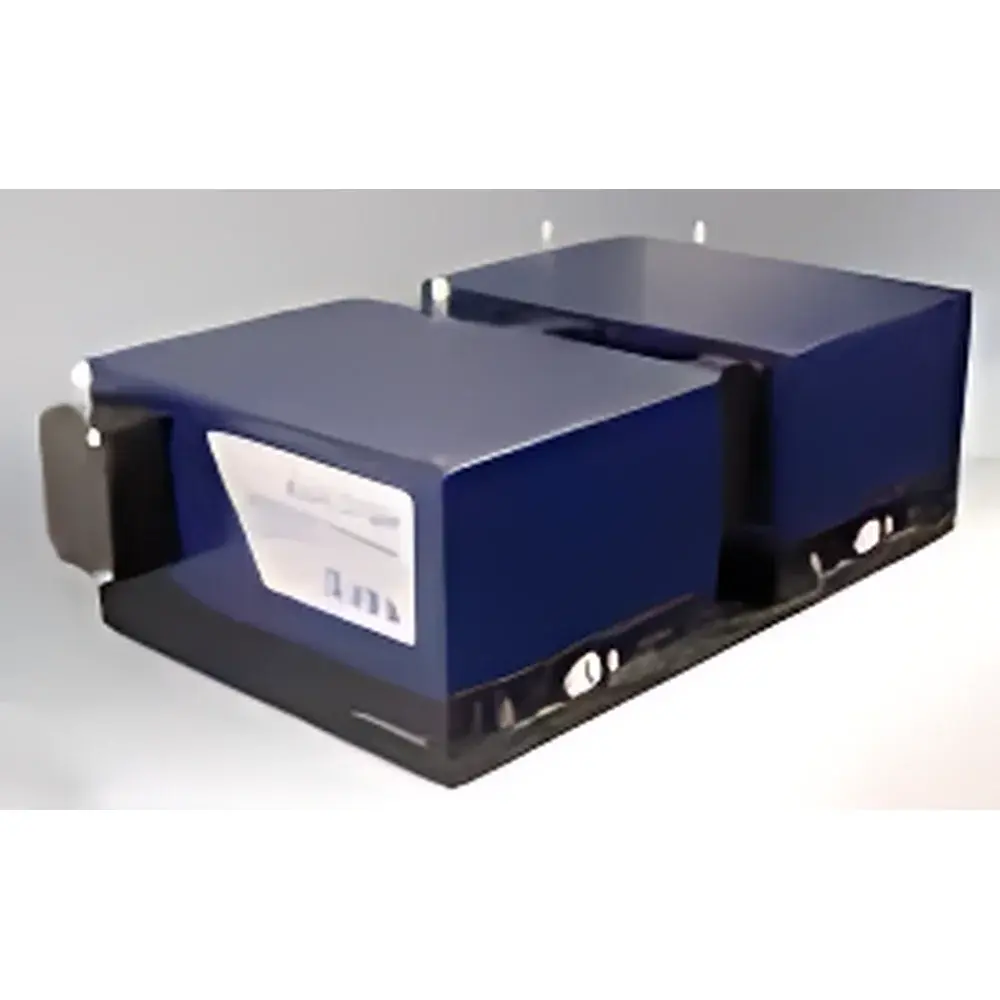
ZOLIX Omni-λxxxD Series Dual Monochromator
| Brand | ZOLIX |
|---|---|
| Model | Omni-λxxxD Series |
| Type | Dual-stage grating monochromator |
| Focal Length Options | 300 mm, 500 mm, or 750 mm per stage |
| Configuration Modes | Additive dispersion (high-resolution) and subtractive dispersion (low-stray-light) |
| Grating | 1200 g/mm standard |
| Slit Width | 0.01–3 mm (manual), motorized slit optional |
| Slit Height | 2 / 4 / 10 / 14 mm selectable |
| Wavelength Accuracy | ±0.2 nm |
| Wavelength Repeatability | ±0.1 nm |
| Relative Aperture | F/3.9 (300 mm), F/6.5 (500 mm), F/9.7 (750 mm) |
| Linear Dispersion (1200 g/mm) | 1.35 / 2.7 nm/mm (Omni-λ300D, additive/subtractive) |
| Resolution (1200 g/mm) | 0.05 / 0.1 nm (Omni-λ300D, additive/subtractive) |
| Interface | USB 2.0 standard, RS-232 optional |
Overview
The ZOLIX Omni-λxxxD Series Dual Monochromator is a precision optical instrument engineered for high-fidelity spectral isolation in demanding research and industrial spectroscopy applications. It consists of two independently calibrated Czerny–Turner monochromators—each based on the proven Omni-λ platform—with focal lengths of 300 mm, 500 mm, or 750 mm per stage. These units are mechanically and optically coupled to operate in either additive or subtractive dispersion configuration. In additive mode, the angular dispersion of both stages accumulates, effectively doubling spectral resolution and enabling sub-0.02 nm resolution performance at longer focal lengths. In subtractive mode, the second stage corrects first-order aberrations and suppresses stray light by more than two orders of magnitude compared to single-stage systems—critical for low-signal detection such as spontaneous Raman scattering, photoluminescence quantum yield measurement, and weak-emission plasma diagnostics.
Key Features
- Configurable dual-stage architecture supporting both high-resolution (additive dispersion) and ultra-low-stray-light (subtractive dispersion) operational modes
- Modular design with interchangeable gratings (standard 1200 g/mm, optional 300–3600 g/mm) and slit height options (2 mm, 4 mm, 10 mm, 14 mm)
- Precision manual slit width adjustment (0.01–3 mm); motorized slit drive available for automated wavelength scanning and reproducible slit positioning
- High mechanical stability achieved through rigid aluminum alloy housing, kinematic mirror mounts, and thermal-compensated optical bench
- Wavelength calibration traceable to NIST-traceable emission lines; accuracy maintained at ±0.2 nm across full spectral range (190–1100 nm typical)
- Dual-interface control: USB 2.0 for plug-and-play integration with Windows/Linux-based spectroscopy software; RS-232 optional for legacy DAQ or PLC synchronization
Sample Compatibility & Compliance
The Omni-λxxxD series is compatible with a broad range of light sources—including arc lamps, supercontinuum lasers, tunable OPOs, and broadband LEDs—as well as detectors such as PMTs, CCDs, and scientific CMOS cameras. Its low-stray-light performance (<10⁻⁵ relative intensity at ±10 nm from peak) meets ASTM E275 and ISO 9001 requirements for spectral purity verification. When integrated into GLP/GMP-compliant analytical workflows, the instrument supports audit-ready operation when paired with validated third-party control software that implements 21 CFR Part 11–compliant electronic signatures and change-tracking logs.
Software & Data Management
ZOLIX provides the OmniDriver SDK (Windows/Linux) for direct hardware-level control via C/C++, Python, MATLAB, or LabVIEW APIs. The SDK enables synchronized multi-axis motion control (grating rotation, slit actuation, filter wheel), real-time wavelength feedback, and hardware-triggered acquisition. Users may export calibrated spectra in industry-standard formats (CSV, FITS, JCAMP-DX) and generate NIST-matched calibration reports. For regulated environments, the system integrates seamlessly with LIMS platforms and supports metadata embedding—including operator ID, timestamp, environmental conditions, and instrument configuration state—for full data lineage tracking.
Applications
- Raman spectroscopy: Subtraction-mode operation minimizes Rayleigh scatter leakage, improving signal-to-noise ratio for low-frequency Raman bands and enabling detection of weak vibrational modes in 2D materials
- Photoluminescence excitation (PLE) mapping: High wavelength repeatability (±0.1 nm) ensures consistent excitation energy selection across large-area semiconductor wafer scans
- Atomic emission analysis: Resolving power exceeding 100,000 (at 500 nm, using Omni-λ750D additive mode) allows separation of adjacent Fe I lines at 358.121 nm and 358.132 nm
- UV-VIS-NIR spectroradiometry: Broadband throughput optimization via F-number matching between stages supports absolute irradiance measurements compliant with CIE S 026/E:2019
- Time-resolved fluorescence: Fast wavelength scanning (≤50 ms per 10 nm step) combined with external TTL triggering facilitates TCSPC-compatible kinetic profiling
FAQ
What is the primary advantage of subtractive dispersion mode over a single monochromator?
Subtractive dispersion reduces stray light by canceling first-order optical aberrations and suppressing higher-diffraction-order contributions—achieving typical stray light levels below 1×10⁻⁵, which is essential for detecting signals within 6–8 decades below the main excitation peak.
Can the Omni-λxxxD be used with vacuum UV sources?
Yes—when equipped with MgF₂-coated optics and evacuated housing (optional vacuum flange kit), the system operates down to 115 nm; standard configurations are optimized for 190–1100 nm ambient operation.
Is grating exchange user-serviceable?
Grating replacement requires alignment verification using He-Ne and Hg-Ar lamp lines; ZOLIX provides factory-alignment documentation and recommends recalibration by certified service engineers after any grating swap.
Does the system support automated wavelength calibration?
Yes—the SDK includes routines for auto-calibration using internal or external reference lamps, with residual error mapping and polynomial correction applied in real time during acquisition.
How is mechanical drift mitigated during long-duration scans?
Thermal expansion is minimized via low-CTE aluminum construction and passive thermal shielding; positional stability is further enhanced by closed-loop stepper motor control with encoder feedback on all critical axes.




