
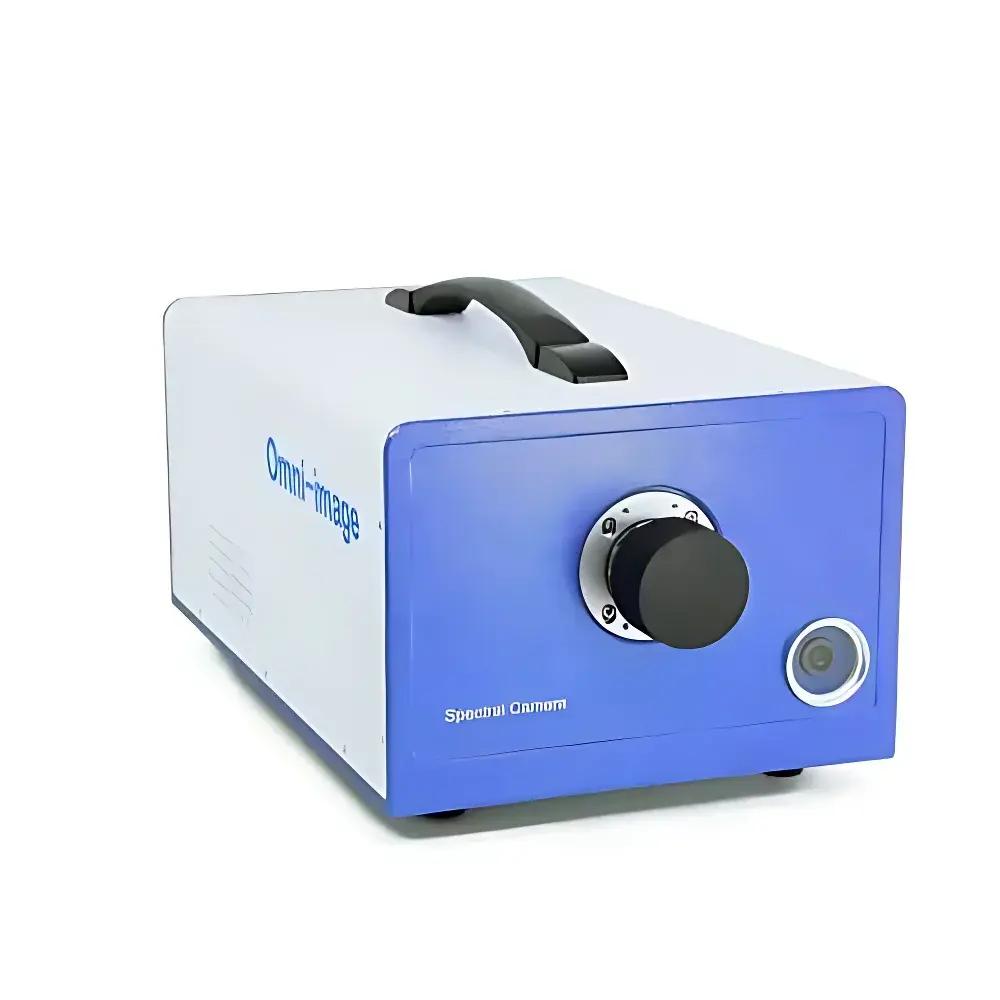
ZOLIX Omni-Imager Series Hyperspectral Imaging Instrument
| Brand | ZOLIX |
|---|---|
| Origin | Beijing, China |
| Manufacturer Type | Original Equipment Manufacturer (OEM) |
| Product Category | Domestic |
| Model | Omni-Imager |
| Price Range | USD 70,000 – 140,000 |
| Operating Principle | Push-broom scanning |
| Imaging Method | Filter-based |
| Deployment Mode | Ground-based and airborne compatible |
| Spectral Resolution | 2.8 nm @ 30 µm slit, 2 nm @ 18 µm slit |
| Detector Types | CCD (1392×1040), sCMOS (2048×2048), EMCCD (512×512), InGaAs (320×256 / 640×512) |
| Spectral Ranges | 400–1000 nm (Vis-NIR), 900–1700 nm (NIR) |
| Numerical Aperture | f/2.4 (Vis-NIR), f/2.0 (NIR) |
| Slit Dimensions | 30 µm × 14.2 mm (standard), 18 µm × 14.2 mm (optional) |
| Data Depth | 12-bit / 16-bit |
| Interface | USB 2.0 / USB 3.0 |
| Lens Mount | C-mount |
| Cooling | Air-cooled to −0 °C (CCD/sCMOS), TE-cooled to −80 °C (EMCCD), TE3-cooled (InGaAs) |
| Software | Proprietary acquisition & analysis suite with ENVI/Evince/SpecSight export compatibility |
| Optional Onboard Processing | Intel Core i7, 16 GB RAM, 256 GB SSD |
Overview
The ZOLIX Omni-Imager Series is a high-performance push-broom hyperspectral imaging instrument engineered for quantitative spectral-spatial data acquisition across visible–near-infrared (Vis–NIR) and short-wave infrared (SWIR) bands. It integrates a high-efficiency transmissive grating spectrometer with a high-sensitivity area-scan detector array and an embedded precision scanning mechanism—eliminating the need for external linear stages or complex optical alignment typical of legacy systems. Unlike conventional filter-wheel or tunable-filter architectures, the Omni-Imager employs a fixed-slit, line-scanning design that delivers consistent spectral fidelity and spatial registration across the full field of view. Its core measurement principle relies on spatially resolved dispersion of incident light along a detector line, synchronized with controlled sample or platform motion to construct hypercubes (x, y, λ). This architecture ensures high radiometric stability, low smile/keystone distortion, and reproducible spectral sampling—critical for applications requiring trace-level material identification, spectral unmixing, or time-series monitoring under variable illumination.
Key Features
- Integrated push-broom scanning mechanism with real-time speed matching: automatically synchronizes motor velocity to exposure time and frame rate to prevent geometric distortion (stretching or compression) in acquired hypercubes.
- Intelligent autofocus subsystem: calculates object distance via contrast optimization algorithms and completes focus calibration within 15 seconds—no user expertise required; supports lens-to-object distance quantification for repeatable standoff measurements.
- Dual-camera architecture: primary imaging sensor + auxiliary CMOS viewfinder enables precise region-of-interest selection, live framing, and real-time slit position overlay during setup.
- Onboard dark current compensation: built-in mechanical shutter facilitates automated dark-frame acquisition prior to each measurement sequence, ensuring accurate radiometric correction.
- Comprehensive pre-processing pipeline: includes radiometric calibration, reflectance normalization (via reference panel input), spatial uniformity correction, lens vignetting compensation, and spectral response equalization—all executed in real time or post-acquisition.
- Modular detector options: selectable from scientific-grade CCD (air-cooled, −0 °C), sCMOS (high QE >72%, 16-bit), EMCCD (ultra-low-light, QE >95%, −80 °C TE cooling), or dual-band InGaAs arrays (320×256 / 640×512, TE3-cooled) to match application-specific SNR and dynamic range requirements.
- C-mount compatibility: seamless integration with standard macro lenses, telecentric optics, or inverted/microscopy platforms without adapter redesign.
Sample Compatibility & Compliance
The Omni-Imager accommodates heterogeneous sample geometries—from flat laboratory specimens and conveyor-belt materials to irregular outdoor terrain and aerial survey targets. Its ruggedized mechanical design and optional battery power support field-deployable operation under ISO 17025-aligned environmental conditions (−10 °C to +45 °C ambient). All firmware and acquisition software comply with GLP/GMP data integrity principles: audit trails log operator actions, parameter changes, and calibration events; raw data files retain embedded metadata (wavelength calibration coefficients, slit width, integration time, temperature logs) in open HDF5 or BIL formats. Export modules ensure full interoperability with ASTM E131-compliant spectral libraries and USP spectral similarity assessment workflows. For regulated environments, optional FDA 21 CFR Part 11–compliant electronic signature and role-based access control modules are available upon request.
Software & Data Management
The proprietary OmniAcquire software provides unified control of hardware configuration, real-time preview, and batch processing—without dependency on external PCs (onboard computing option available). Acquisition parameters—including exposure, scan velocity, ROI definition, and auto-calibration triggers—are configurable via intuitive GUI or scriptable API (C/C++, Python SDK included). Processed data exports natively to ENVI (.hdr/.dat), Evince (.evi), SpecSight (.ssi), and MATLAB (.mat) formats, preserving wavelength vectors, georeferencing tags, and calibration metadata. The embedded analysis engine supports pixel-wise spectral angle mapper (SAM), binary encoding, endmember extraction (N-FINDR), and multivariate curve resolution (MCR)—all optimized for edge deployment. All data files include SHA-256 checksums and timestamped version history to satisfy ISO/IEC 17025 clause 7.5.2 traceability requirements.
Applications
- Pharmaceutical QA/QC: tablet coating uniformity mapping, counterfeit drug detection via spectral fingerprinting, and excipient distribution analysis.
- Agricultural phenotyping: chlorophyll content estimation, water stress indexing (NDWI, PRI), and early disease symptom detection in leaf canopies.
- Mineralogical remote sensing: lithological classification, alteration zone delineation, and rare-earth element proxy mapping using diagnostic absorption features (e.g., Al–OH at 2200 nm).
- Recycling automation: polymer sorting (PET vs. PVC vs. PP) based on C–H overtone bands (1650–1750 nm), metal alloy identification via oxide spectral signatures.
- Art conservation: pigment stratigraphy reconstruction, varnish degradation monitoring, and underdrawing visualization beneath opaque layers.
- Food safety: mycotoxin contamination screening in grains, bruise detection in fruit, and fat/moisture ratio quantification in meat products.
FAQ
What spectral calibration standards are supported?
Factory calibration uses NIST-traceable tungsten-halogen and mercury-argon lamps; users may perform field recalibration using certified reflectance panels (e.g., Labsphere Spectralon) or emission sources.
Is airborne integration validated?
Yes—Omni-Imager-NIR models have been deployed on UAVs and manned aircraft with GPS/IMU synchronization; vibration isolation mounts and real-time geotagging modules are available as OEM options.
Can I develop custom spectral classification models?
Yes—the Python SDK exposes full access to raw hypercube tensors, preprocessing functions, and spectral library loaders; trained models (e.g., SVM, PLS-DA) can be exported and deployed on the onboard processor.
How is radiometric accuracy maintained over time?
Each unit ships with a serialized calibration certificate; drift compensation is enabled via periodic dark/light reference acquisitions and integrated non-uniformity correction (NUC) routines executed before every measurement session.
What is the maximum usable field of view (TFOV) with standard optics?
With the 23 mm C-mount lens, TFOV ranges from 12.6° (Vis-NIR) to 9.8° (NIR), scalable via focal length selection; IFOV is determined by detector pitch, lens focal length, and working distance per standard geometric optics equations.
Related Products





