
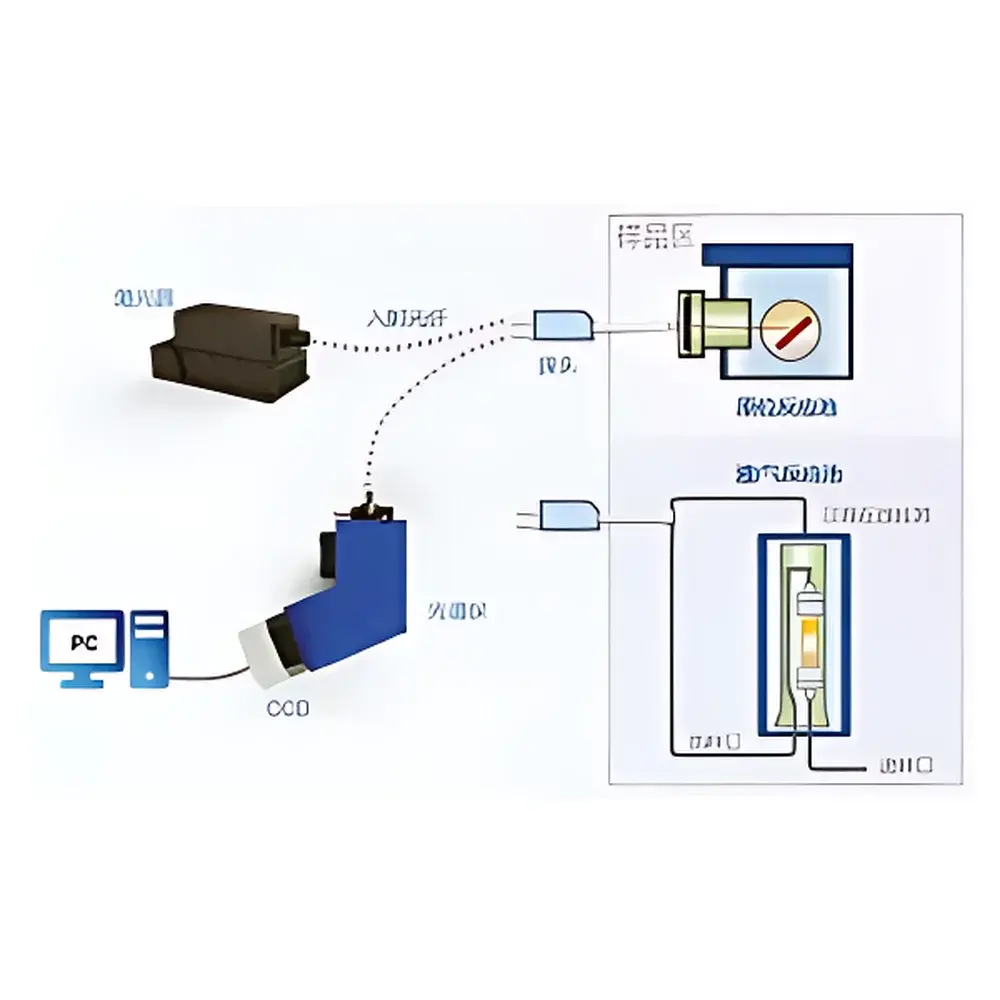
ZOLIX Omni-iSpecT Fiber-Coupled Raman Spectroscopy System with High-Temperature/High-Pressure Probe
| Brand | ZOLIX |
|---|---|
| Origin | Beijing, China |
| Model | Omni-iSpecT Fiber-Coupled Raman Spectroscopy System |
| Laser Options | 532 nm (100 mW), 785 nm (350 mW) |
| Raman Shift Range | 200–4000 cm⁻¹ (532 nm) |
| Spectral Resolution | <10 cm⁻¹ (typical, @50 µm slit) |
| CCD Detector | Back-illuminated deep-depletion CCD, 2000 × 256 pixels, 15 µm pixel size, -60 °C cooling, read noise <5 e⁻/pixel |
| Probe Working Distance | 3 mm / 7 mm (standard), customizable |
| Operating Temperature | 0–325 °C (customizable up to 400 °C) |
| Max Pressure Rating | 6000 psi |
| Probe Material | Hard-anodized aluminum + 316 stainless steel |
| Sealing | Perfluoroelastomer (FFKM) O-rings standard |
| Fiber Core | 100/100 µm (standard), SMA/MPO/10 mm cylindrical interface |
| Optical Throughput | F/1.8 (532 nm), F/2.3 (785 nm) |
| Grating | 1800 l/mm VPH (532 nm), 1200 l/mm VPH (785 nm) |
| Weight | 5.0 kg (spectrometer), 5.8 kg (full system) |
Overview
The ZOLIX Omni-iSpecT Fiber-Coupled Raman Spectroscopy System is an engineered solution for in situ and online molecular characterization under demanding process conditions. Unlike conventional benchtop micro-Raman systems constrained to ambient lab environments, this platform integrates a high-stability VPH-transmission grating spectrometer with a ruggedized, fiber-coupled probe designed for direct immersion or remote interrogation of samples in real time. It operates on the principle of inelastic light scattering—Raman spectroscopy—where incident monochromatic laser photons interact with molecular vibrational modes, producing frequency-shifted scattered light that encodes chemical identity, phase state, crystallinity, stress, and compositional dynamics. The system supports dual-laser excitation (532 nm and 785 nm) to balance signal intensity, fluorescence suppression, and photostability across diverse sample classes—including corrosive gases, molten salts, pressurized reactors, and aqueous electrochemical interfaces.
Key Features
- Robust fiber-optic architecture enabling physical decoupling of spectrometer and probe—critical for thermal isolation, EMI immunity, and hazardous environment compliance.
- High-temperature/high-pressure probe rated to 325 °C and 6000 psi, with FFKM sealing and 316 stainless steel/ultra-hard anodized aluminum construction for compatibility with HF, Cl₂, H₂S, and other aggressive media.
- VPH-transmission gratings deliver high throughput and low stray light, supporting spectral resolution better than 10 cm⁻¹ across broad Raman shift ranges (200–4000 cm⁻¹ at 532 nm; 350–2400 cm⁻¹ at 785 nm).
- Deep-cooled back-illuminated CCD detector (–60 °C) with 85% from 500–900 nm ensures high signal-to-noise ratio for weak Raman signals in low-concentration or fast-transient processes.
- Modular optical design: adjustable XY fiber coupler, selectable long-pass filters (OD >6), motorized slits (10 µm–6 mm), and interchangeable VPH gratings for method flexibility and future upgrade paths.
- Probe optics support ~100 µm spot size at standard working distances (3 mm or 7 mm), with numerical aperture 0.22 and customizable focal lengths (9 mm, 12 mm, 15 mm, 18 mm) to match reactor geometry and optical access constraints.
Sample Compatibility & Compliance
The Omni-iSpecT system accommodates solid, liquid, gas, and multiphase samples via direct probe immersion, flow-cell coupling, or window-based external focusing. Its probe design conforms to ISO 14644 cleanroom compatibility guidelines and meets mechanical integrity requirements outlined in ASME B31.3 Process Piping standards for pressure containment. For regulated industries, the system supports audit-ready operation when integrated with compliant data acquisition software: full electronic records, user access controls, and 21 CFR Part 11–compliant audit trails are achievable through optional software modules. Probe materials and seals comply with ASTM D1418 (elastomer classification) and FDA-approved FFKM formulations for pharmaceutical and nuclear applications. The system has been validated in accordance with ICH Q2(R2) for method suitability in quantitative in-process monitoring.
Software & Data Management
Acquisition and analysis are performed using ZOLIX SpectraPro Control Suite—a modular, Windows-based application supporting real-time spectral streaming, kinetic profiling, multivariate calibration (PLS, PCA), and automated peak tracking. Raw spectra are stored in HDF5 format with embedded metadata (laser power, integration time, temperature, pressure timestamp). The software exports to ASTM E131-compliant .spa files and supports direct import into MATLAB, Python (via h5py), and chemometric platforms including Unscrambler and SIMCA. All data operations maintain traceability: every spectrum carries a unique identifier, operator ID, instrument serial number, and hardware configuration hash. Optional GLP/GMP modules enable electronic signatures, change control logs, and periodic system suitability checks per USP .
Applications
- In-line fluorination process monitoring: Real-time tracking of PuO₂ → PuF₄ conversion in HF-containing off-gas streams, using quartz-windowed probe insertion to avoid laser path contamination.
- Nuclear waste glass durability assessment: In situ pH and borate speciation quantification in borosilicate leachates at 90 °C, eliminating sampling artifacts from evaporation or surface-area-to-volume drift.
- MOF synthesis kinetics: Time-resolved monitoring of Co-MOF-74 nucleation and framework maturation in microfluidic reactors, correlating Raman band evolution (e.g., ν(C=O), δ(OH)) with XRD-derived lattice parameters.
- Electrochemical interface analysis: Operando detection of adsorbed intermediates (e.g., *CO, *OH) on catalyst surfaces during CO₂ reduction, enabled by sub-second spectral acquisition and probe integration into custom electrochemical cells.
- High-pressure catalysis: Monitoring of C–H activation pathways in supercritical CO₂ or hydrothermal reactors, where probe stability at >4000 psi enables direct observation of transient metal–ligand vibrations.
FAQ
What laser wavelengths are supported, and how do I select between them?
The system ships with either 532 nm (100 mW) or 785 nm (350 mW) excitation. Use 532 nm for higher Raman cross-sections and crystalline solids; choose 785 nm to minimize fluorescence in organics, biological matrices, or doped semiconductors.
Can the probe operate continuously at 325 °C?
Yes—the probe’s thermal management, FFKM seals, and refractory metallurgy are qualified for continuous duty at 325 °C. For extended exposure above 300 °C, we recommend active fiber jacket cooling and periodic calibration verification.
Is the system compatible with third-party process control systems?
All spectrometers output ASCII or HDF5 data over TCP/IP or USB-VCOM protocols. OPC UA and Modbus TCP drivers are available upon request for integration into DeltaV, Siemens PCS7, or Emerson DCS environments.
How is spectral calibration maintained under thermal cycling?
Each spectrometer includes an internal neon-argon reference lamp for automated wavelength calibration before each acquisition sequence. Drift compensation algorithms correct for thermal expansion-induced pixel shifts using known Raman bands (e.g., silicon at 520.7 cm⁻¹).
Do you provide application-specific probe customization?
Yes—ZOLIX offers engineering services for probe geometry (length, diameter, bend radius), fiber termination (SMA, MPO, hermetic feedthrough), optical window material (CaF₂, sapphire, fused silica), and bespoke sealing solutions for ultra-high vacuum or radioactive environments.





