
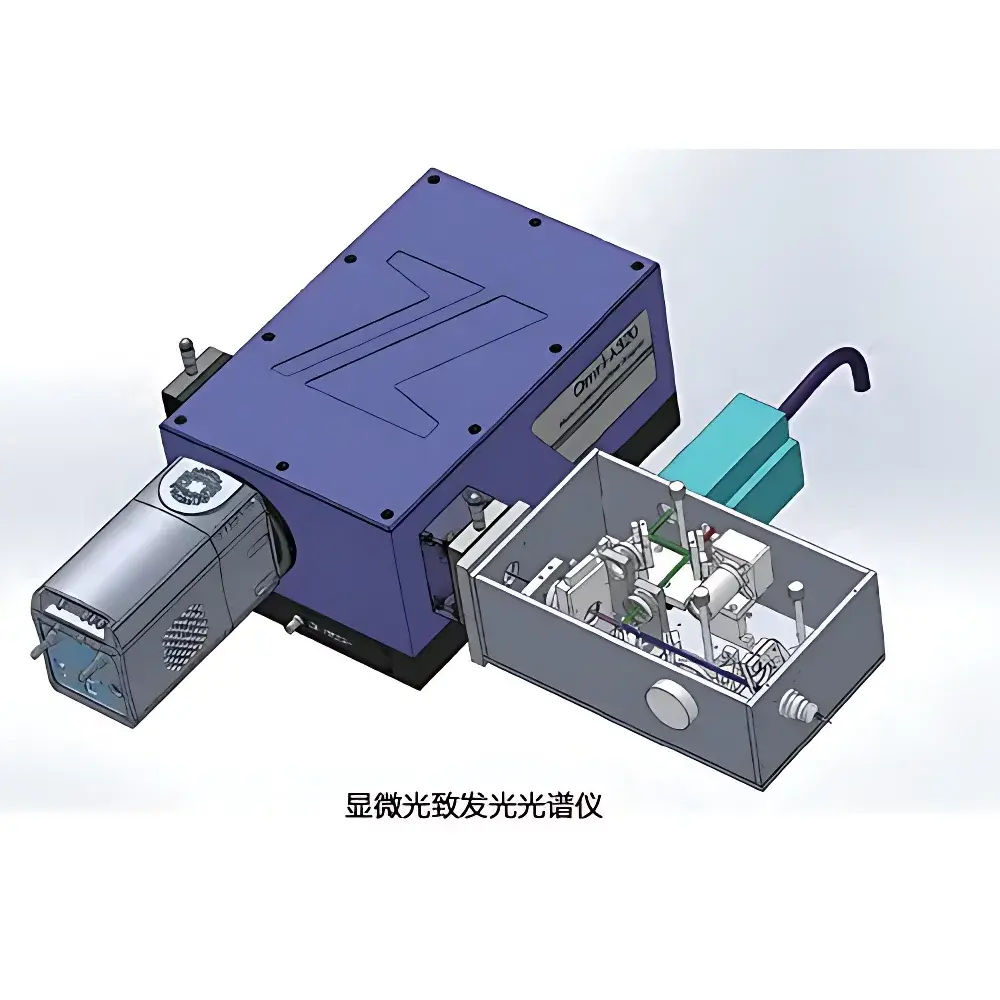
ZOLIX OmniPL-MicroS Micro-Photoluminescence Spectroscopy System
| Brand | ZOLIX |
|---|---|
| Model | OmniPL-MicroS |
| Origin | Beijing, China |
| Manufacturer | ZOLIX Optics Co., Ltd. |
| Type | Integrated Micro-PL Spectrometer |
| Spectral Range | 200–1600 nm |
| Excitation Wavelengths (Optional) | 325, 405, 442, 473, 532, 633, 785 nm |
| Mapping Area | 50 mm × 50 mm (customizable) |
| Cryogenic Compatibility | Down to 10 K (with optional cryostat) |
| Software Features | Emission Spectrum Correction, Auto-Mapping, EL & Raman Expansion Modules |
Overview
The ZOLIX OmniPL-MicroS Micro-Photoluminescence Spectroscopy System is an integrated, research-grade instrumentation platform engineered for high-sensitivity, spatially resolved photoluminescence (PL) characterization of solid-state materials. It operates on the fundamental principle of optical excitation—typically via monochromatic laser sources—followed by collection and spectral dispersion of emitted photons using a high-throughput Czerny-Turner spectrograph coupled with a back-illuminated CCD or InGaAs detector array. Unlike conventional microscope-based PL setups that rely on off-the-shelf optical microscopes, the OmniPL-MicroS features a purpose-built optical architecture optimized for quantum efficiency, mechanical stability, and modular expandability. Its design addresses critical limitations observed in legacy systems: inefficient fiber coupling, poor UV excitation compatibility, thermal misalignment under cryogenic conditions, and lack of standardized spectral radiometric calibration. The system enables quantitative PL intensity mapping, peak position analysis, full-width-at-half-maximum (FWHM) evaluation, and temperature-dependent bandgap extraction—essential for semiconductor physics, nanomaterial development, and optoelectronic device qualification.
Key Features
- Integrated optical alignment: All reflective and dispersive optics are pre-aligned at factory level; minimal user intervention required post-installation, ensuring long-term repeatability and reducing setup drift.
- Dual-path illumination geometry: Switchable horizontal and vertical excitation/collection pathways accommodate diverse sample geometries—including bulk crystals, thin films, 2D materials on substrates, and packaged devices—without realignment.
- Extended spectral coverage: 200–1600 nm range supports deep-UV to near-infrared detection, enabling comprehensive analysis of wide-bandgap semiconductors (e.g., GaN, AlN), transition metal dichalcogenides (e.g., MoS₂), and colloidal quantum dots.
- Real-time video monitoring: Integrated CMOS camera with 10×–100× magnification provides precise positioning of laser focus spot (<1 µm resolution) and verification of sample homogeneity prior to spectral acquisition.
- Factory-calibrated emission correction: Built-in NIST-traceable spectral response function compensates for wavelength-dependent detector quantum efficiency and grating diffraction efficiency, delivering radiometrically accurate spectra across the full range.
- Modular excitation options: Laser sources spanning 325 nm (HeCd) to 785 nm (diode) are mechanically and software-integrated, with power stabilization and beam profiling capabilities to ensure consistent excitation fluence.
Sample Compatibility & Compliance
The OmniPL-MicroS accommodates planar, freestanding, and encapsulated samples up to 75 mm in diameter. Its open-stage design permits direct integration with commercial closed-cycle cryostats (e.g., Janis ST-500, BlueFrog), enabling stable operation from 10 K to 300 K with sub-0.1 K temperature control precision. Vacuum-compatible configurations are available for ultra-high-vacuum (UHV) environments. All optical components comply with ISO 10110 surface quality standards; detector electronics meet IEC 61326-1 electromagnetic compatibility requirements. The system supports GLP/GMP-aligned workflows through optional audit-trail-enabled software (21 CFR Part 11 compliant version available upon request). Data export formats include ASCII, CSV, and HDF5—ensuring interoperability with MATLAB, Python (SciPy/NumPy), and OriginLab for advanced statistical modeling and machine learning–driven spectral classification.
Software & Data Management
Control and analysis are performed via ZOLIX SpectraSuite™ v5.x—a native Windows application built on Qt and leveraging multi-threaded acquisition engines. Core functions include real-time spectrum preview, automated background subtraction (dark current + ambient light), peak fitting (Gaussian/Lorentzian/Voigt models), spectral deconvolution, and batch processing of mapping datasets. The auto-mapping module supports raster scanning with programmable step size (100 nm–10 µm), dwell time (1 ms–60 s), and trigger synchronization with external equipment (e.g., temperature controllers, bias supplies). All raw and processed data files embed EXIF-style metadata: excitation wavelength, power, integration time, grating position, detector temperature, and stage coordinates. Version-controlled project archives facilitate reproducibility and regulatory submission readiness.
Applications
- Bandgap engineering validation in III–V and II–VI compound semiconductors (e.g., temperature-dependent PL shift in GaN heterostructures at 10 K).
- Defect state identification in metal oxides: ZnO thin films exhibit characteristic near-band-edge emission at ~382 nm and defect-related green luminescence (500–600 nm); spectral ratio analysis correlates with oxygen vacancy concentration.
- Strain mapping in van der Waals heterostructures via spatially resolved PL peak shifts.
- Quantum dot size distribution analysis through ensemble PL linewidth broadening quantification.
- Operando electroluminescence (EL) characterization when configured with optional voltage biasing module—enabling direct comparison between PL and EL quantum efficiencies.
FAQ
What cryostats are compatible with the OmniPL-MicroS?
Standard integration is supported with Janis, BlueFrog, and Oxford Instruments closed-cycle systems; custom flange adapters are available for proprietary cryogenic platforms.
Can the system perform time-resolved PL measurements?
Time-resolved capability requires optional TCSPC module (PicoHarp 300 or HydraHarp 400) and pulsed laser source; not included in base configuration.
Is spectral calibration traceable to NIST standards?
Yes—each system ships with a certificate of calibration referencing NIST SRM 2035 (tungsten halogen lamp) and SRM 2036 (mercury-argon emission lines).
How is stray light minimized in the UV region?
Optical path employs UV-enhanced aluminum coatings, black-anodized baffles, and order-sorting filters; grating blaze angle is optimized for 325 nm primary use.
Does the software support automated pass/fail criteria for production QA?
Yes—customizable threshold-based reporting templates can be deployed for inline material screening, with configurable alerts and PDF report generation.





