
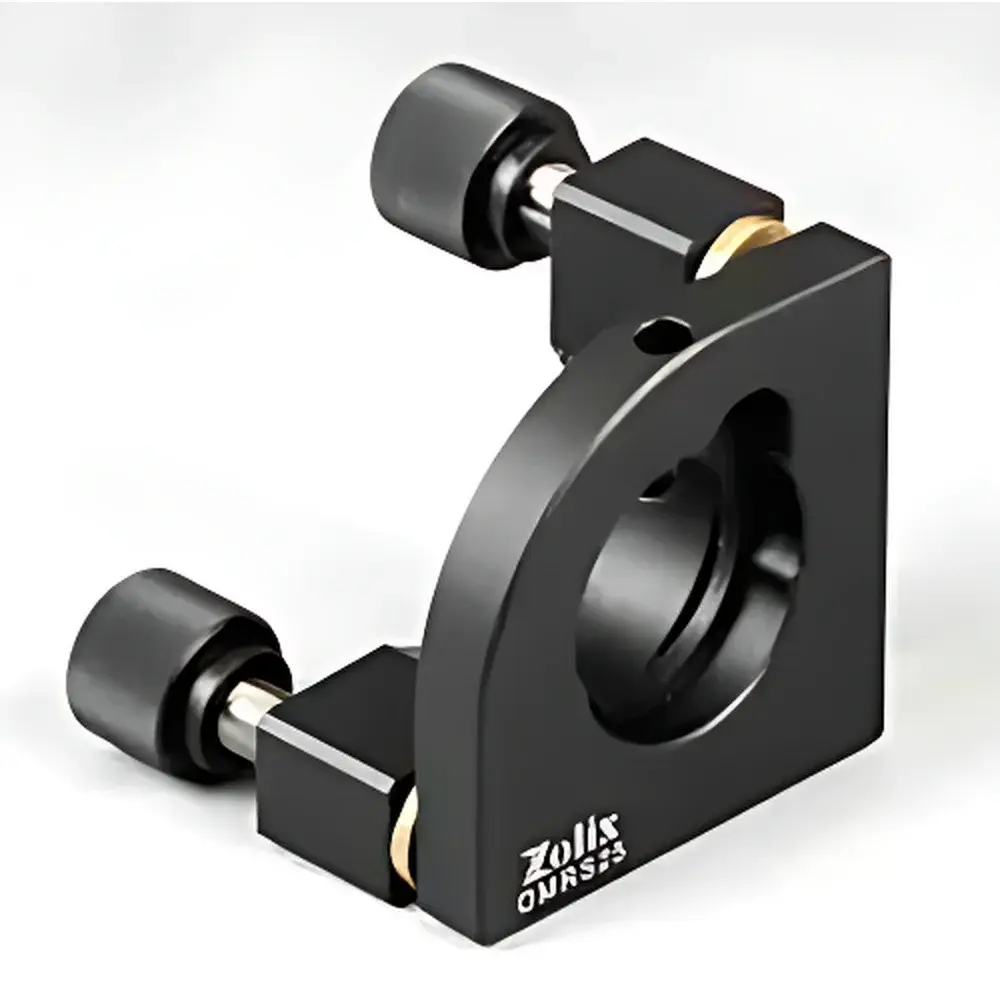
ZOLIX OMRSxx Series Two-Dimensional High-Stability Optical Mirror Mounts
| Brand | ZOLIX |
|---|---|
| Origin | Beijing, China |
| Manufacturer Type | Direct Manufacturer |
| Product Line | OMRSxx Series |
| Mounting Aperture Range | 12.7 mm to 50.8 mm |
| Adjustment Mechanism | Dual-Axis Micrometer-Grade Fine-Pitch Threaded Actuation |
| Mounting Options | Closed-Type Set-Screw (Standard), Open-Type Set-Screw (-B), Closed-Type Retaining Ring (-C) |
| Locking Options | Non-Locking (Standard) or Integrated Mechanical Lock (-S) |
| Material | Anodized Aluminum Alloy (6061-T6) with Stainless Steel Adjustment Screws |
| Compliance | Designed for ISO/IEC 17025-aligned optical alignment workflows |
| Software Integration | None (Manual Precision Mechanical System) |
Overview
The ZOLIX OMRSxx Series Two-Dimensional High-Stability Optical Mirror Mounts are precision-engineered mechanical positioning platforms designed for demanding optical alignment tasks in research laboratories, metrology setups, and industrial laser systems. These mounts operate on the principle of orthogonal micrometer-driven translation—employing two independent, high-resolution fine-pitch threaded actuators (typically M3 × 0.35 or M4 × 0.5 pitch, depending on model size) to enable precise, repeatable angular and lateral adjustment of mounted optics. Unlike kinematic or piezo-based solutions, the OMRSxx series relies on passive mechanical stability, eliminating thermal drift, electronic noise, or power dependency—making it ideal for long-duration interferometric measurements, cavity alignment, and beam steering applications where zero drift and deterministic repeatability are critical. Each unit is assembled under controlled environmental conditions and undergoes functional verification for backlash ≤ 2 µrad and angular reproducibility ≤ ±5 µrad over 100 adjustment cycles.
Key Features
- Two-axis independent adjustment via dual fine-pitch threaded screws—engineered for sub-microradian sensitivity and minimal hysteresis
- Modular aperture compatibility spanning 12.7 mm (½″), 25.4 mm (1″), and 50.8 mm (2″) optic diameters—ensuring scalability across prototyping and production-grade optical benches
- Three standardized optic retention configurations: closed-set-screw (standard), open-set-screw (-B variant for rapid access), and retaining-ring (-C variant for low-stress, uniform clamping of coated or fragile substrates)
- Optional integrated mechanical locking mechanism (-S suffix) utilizing dual-point frictional engagement—verified to maintain alignment under 5 g lateral acceleration without slippage
- Structural housing fabricated from stress-relieved, anodized 6061-T6 aluminum alloy; adjustment screws made from passivated A2 stainless steel to ensure corrosion resistance and torque consistency over >10⁵ actuation cycles
- No electrical components or firmware—fully compatible with ultra-high-vacuum (UHV) environments (down to 1×10⁻⁹ mbar) and magnetic resonance imaging (MRI) suites where EMI immunity is mandatory
Sample Compatibility & Compliance
The OMRSxx mounts accommodate plano, concave, and convex mirrors—including metallic (Al, Au, Ag), dielectric-coated, and ion-beam-sputtered substrates—with thicknesses ranging from 3 mm to 12 mm. The -C (retaining ring) configuration is certified for use with λ/10 surface figure optics per ISO 10110-5, minimizing edge-induced distortion. All variants comply with mechanical interface standards per ANSI/OPI-1.0 (Optical Positioning Interfaces) and are dimensionally referenced to the Thorlabs SM-series and Newport KM-series mounting footprints—enabling drop-in replacement in existing optical tables. Units are supplied with RoHS-compliant hardware and conform to ISO 9001:2015 manufacturing traceability requirements. Documentation includes material certificates (EN 10204 3.1), dimensional inspection reports, and torque calibration records for each batch.
Software & Data Management
The OMRSxx series is a purely mechanical alignment system with no embedded electronics, firmware, or digital interfaces. Consequently, it requires no software drivers, calibration utilities, or network connectivity. Alignment parameters are recorded manually or integrated into lab-wide documentation workflows using standard LIMS or ELN platforms (e.g., LabArchives, Benchling). For traceable metrology applications, users may log actuator positions using calibrated dial indicators or digital calipers compliant with ISO/IEC 17025—supporting full audit trails under GLP and GMP frameworks. No FDA 21 CFR Part 11 compliance is applicable, as no electronic records are generated.
Applications
- Laser cavity alignment in Ti:sapphire, fiber, and diode-pumped solid-state (DPSS) oscillators
- Interferometer mirror positioning in Michelson, Mach–Zehnder, and Twyman–Green configurations
- Beam steering and collimation in Raman spectroscopy, LIBS, and OCT source modules
- Stable mounting of reference mirrors in gravitational wave detector prototype testbeds
- Integration into automated optical assembly lines where mechanical robustness supersedes motorized convenience
- Education and training platforms in university photonics labs—demonstrating fundamental principles of angular resolution, mechanical amplification, and thermal stability
FAQ
What is the maximum recommended optic weight for the OMRS25-C-S mount?
The OMRS25-C-S variant supports optics up to 120 g at full tilt (±4°), verified under static load testing per ISO 14729 Annex D.
Can the retaining ring (-C) be used with wedged or Brewster-angle substrates?
Yes—the -C design incorporates a floating, self-centering ring with radial compliance; it has been validated for use with 15° wedge prisms and 56.5° fused silica Brewster windows without induced stress birefringence.
Is thermal expansion compensated in the OMRSxx structural design?
No active compensation is implemented; however, the symmetric aluminum housing geometry and matched CTE of Al 6061-T6 and 304 SS screws limit relative drift to <0.8 µrad/°C over the 15–30 °C operational range.
Are custom thread pitches or non-standard apertures available?
ZOLIX offers OEM engineering services for modified thread specifications (e.g., M2.5 × 0.25) and aperture diameters (e.g., 30 mm, 40 mm) under NRE-supported development contracts.
Do OMRSxx mounts meet vacuum outgassing requirements for space-qualified instruments?
Standard units meet ECSS-Q-ST-70-02C Class B outgassing limits (<1.0% TML, <0.1% CVCM) when cleaned per NASA-STD-6002; UHV-compatible versions with vacuum-rated lubricants are available upon request.



