

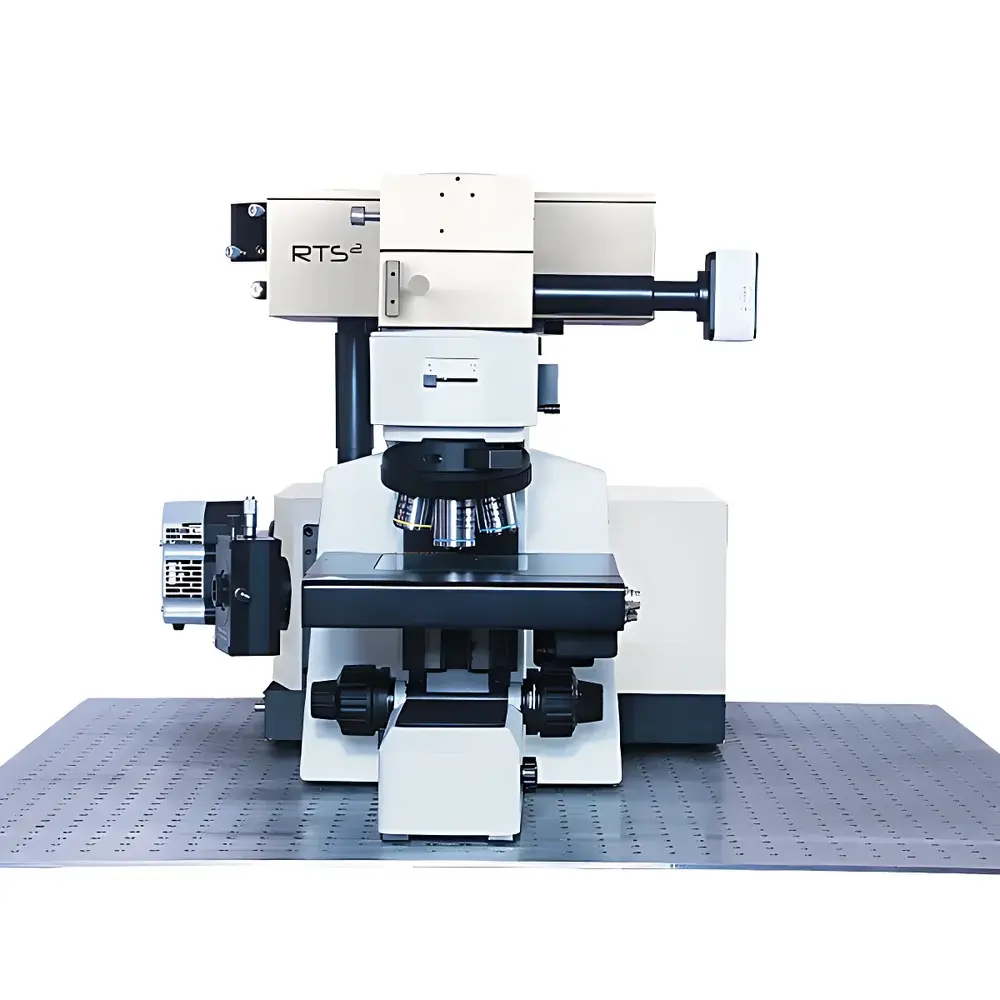
ZOLIX RTS2-InSitu In-Situ Spectroscopy System
| Brand | ZOLIX |
|---|---|
| Origin | Beijing, China |
| Manufacturer Type | Manufacturer |
| Product Origin | Domestic (China) |
| Model | RTS2-InSitu |
| Pricing | Upon Request |
Overview
The ZOLIX RTS2-InSitu In-Situ Spectroscopy System is an engineered optical platform designed for non-invasive, real-time spectral interrogation of samples confined within sealed or inaccessible environments—including ultra-high vacuum (UHV) chambers, high-pressure reactors, cryogenic dewars, and hermetically sealed enclosures. Unlike conventional benchtop spectrometers requiring sample extraction, the RTS2-InSitu employs a modular, atmosphere-isolated optical probe architecture that couples excitation and collection optics through optical viewports—enabling Raman, photoluminescence (PL), time-resolved Raman, and laser-induced breakdown spectroscopy (LIBS) measurements without compromising environmental integrity. Its operational principle relies on confocal optical coupling: a collimated laser beam is focused onto the sample surface via a long-working-distance objective mounted externally to the chamber; scattered photons are recollected through the same objective path and routed via fiber optic coupling to a high-throughput spectrometer and scientific-grade CCD or EMCCD detector. This configuration ensures minimal thermal loading, suppression of blackbody radiation in high-temperature processes (e.g., CVD growth), and sub-micron spatial resolution—critical for mapping stress distribution in diamond thin films or phase evolution in epitaxial semiconductor layers under process conditions.
Key Features
- Modular optical head: Fully integrated microscope, autofocus mechanism, laser defocus sensor, and confocal coupling optics housed in a single atmospheric-side unit—removable during UHV chamber bake-out (≤150 °C) and repositionable with micron-level repeatability.
- Viewport-adapted optical design: Active aberration correction for variable window thickness (1–10 mm fused silica or CaF2), maintaining diffraction-limited spot size and spectral fidelity across spectral ranges from VUV (120 nm) to NIR (1100 nm).
- Multi-modal spectroscopic capability: Simultaneous or sequential acquisition of Raman (325/532/785 nm excitation), steady-state PL, time-resolved Raman (with pulsed lasers and gated detection), and LIBS—each configurable via interchangeable laser sources, gratings (up to 2400 gr/mm), and detectors.
- High-sensitivity confocal collection: Numerical aperture-optimized optics achieving >25% total optical throughput from sample to detector; 50 µm confocal pinhole standard, optional 25 µm for enhanced depth discrimination.
- Mechanical flexibility: Motorized XYZ translation stage (±5 mm range, 100 nm step resolution) integrated with manual tip/tilt adjustment for precise alignment to angled surfaces (e.g., 45° oblique imaging of rotating substrates) and dynamic strain fields.
Sample Compatibility & Compliance
The RTS2-InSitu supports in situ characterization of heterogeneous, fragile, or environmentally sensitive specimens—including museum-grade artifacts sealed behind laminated glass, catalytic monoliths in flow reactors, electrochemical electrodes in liquid cells, and 2D materials transferred under UHV interconnect systems. It complies with ISO/IEC 17025 requirements for measurement traceability when paired with NIST-traceable calibration standards (e.g., silicon Raman shift reference, neon emission lines). For regulated environments, data acquisition software supports audit trails, electronic signatures, and metadata embedding per FDA 21 CFR Part 11 guidelines. Mechanical interfaces conform to CF-63, KF-40, and ISO-K standard flanges; custom viewport integration kits accommodate differential pumping stages and bakeable (<200 °C) stainless-steel vacuum chambers operating down to 10−9 mbar.
Software & Data Management
Acquisition and analysis are performed using ZOLIX SpectraView Pro—a platform-independent application built on Qt/C++ with Python API support. Core functionalities include real-time spectral preview with baseline subtraction (asymmetric least squares), automated peak fitting (Voigt profiles), spatial mapping with coordinate registration to optical images, and kinetic series export in HDF5 format for FAIR (Findable, Accessible, Interoperable, Reusable) data stewardship. All raw spectra retain embedded metadata: timestamp, laser power (monitored via inline photodiode), grating position, slit width, integration time, and environmental parameters (if interfaced with external pressure/temperature sensors). Export modules generate ASTM E1421-compliant spectral reports and support batch processing for GLP/GMP documentation workflows.
Applications
- Materials synthesis monitoring: Real-time Raman tracking of sp3/sp2 carbon ratio evolution during hot-filament CVD diamond growth on steel substrates—correlating thermal stress (peak shift of 1332 cm−1 mode) with cooling rate and interfacial adhesion.
- Electrochemical operando analysis: Detection of adsorbed intermediates (e.g., *CO, LixOy) on battery electrode surfaces during galvanostatic cycling, using 785 nm excitation to suppress fluorescence from polymer binders.
- Cultural heritage science: Non-contact identification of pigment degradation products (e.g., vermilion HgS → metacinnabar) beneath protective glazing on Renaissance panel paintings—without physical sampling or chamber evacuation.
- High-pressure chemistry: In situ observation of phase transitions in metal hydrides (e.g., LaH10) at 150 GPa using diamond anvil cell-compatible optics and 532 nm excitation.
- Mechanochemical dynamics: Strain-dependent Raman shifts in MoS2 monolayers during uniaxial tensile testing—mapped at 500 nm lateral resolution across microfabricated cantilevers.
FAQ
Can the RTS2-InSitu be integrated into existing UHV multi-chamber systems?
Yes—the optical head mounts externally via standardized flanges; optional probe-style viewport adapters enable direct insertion into load-lock or analysis chambers without breaking vacuum.
What is the minimum resolvable Raman shift uncertainty under typical operating conditions?
With 1800 gr/mm grating and 50 µm slit, spectral resolution is ≤1.2 cm−1 FWHM (measured on Si 520 cm−1 peak); wavenumber accuracy is ±0.3 cm−1 after daily calibration.
Is LIBS functionality compatible with reactive gas environments (e.g., O2, Cl2) inside the chamber?
Yes—LIBS plasma generation occurs only during nanosecond laser pulses; no continuous gas interaction is required. Optical coatings are rated for halogen exposure up to 100 ppm.
Does the system support automated focus maintenance during thermal expansion of the chamber window?
Yes—the integrated laser defocus sensor provides closed-loop feedback to the piezoelectric objective mount, compensating for thermal drift at rates up to 5 µm/min.
Are spectral libraries for pigment and mineral identification included?
ZOLIX provides a curated library of >1200 reference spectra (Raman, PL, LIBS) compliant with RRUFF and ICDD databases; users may extend it via proprietary sample calibration routines.







