
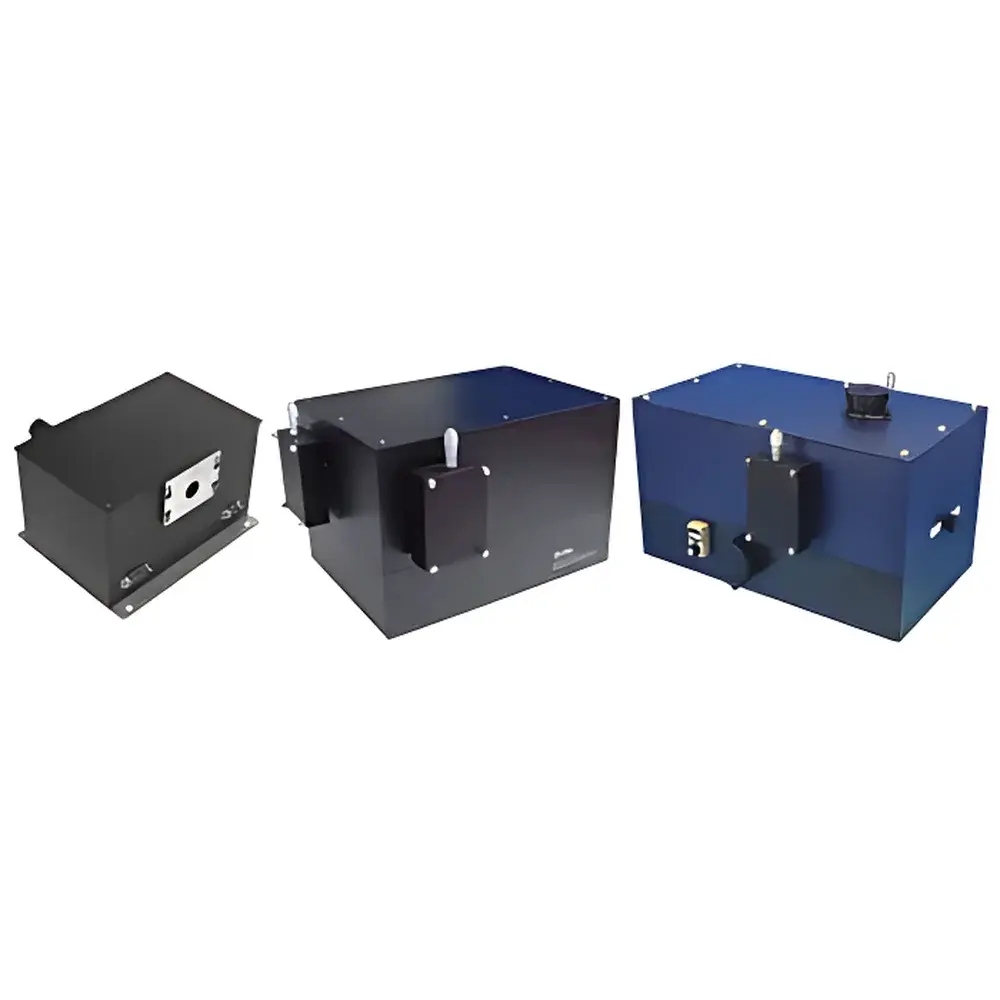
ZOLIX SSM Series OEM Monochromator
| Brand | ZOLIX |
|---|---|
| Origin | Beijing, China |
| Manufacturer Type | Original Equipment Manufacturer (OEM) |
| Product Type | Grating-Based Monochromator for Spectroscopy |
| Model | SSM100 / SSM301 / SSM330 |
| Focal Length | 100 mm / 300 mm / 300 mm |
| Optical Design | Asymmetric Horizontal Mount / Symmetric Czerny–Turner |
| Mechanical Wavelength Range | 0–1100 nm |
| Resolution (FWHM) | 0.5 nm (SSM100) / 0.1 nm (SSM301 & SSM330) |
| Reciprocal Linear Dispersion | 8.1 nm/mm (SSM100) / 2.7 nm/mm (SSM301 & SSM330) |
| Wavelength Accuracy | ±0.5 nm (SSM100) / ±0.2 nm (SSM301 & SSM330) |
| Wavelength Repeatability | ±0.5 nm (SSM100) / ±0.1 nm (SSM301 & SSM330) |
| Input/Output Slit Height | 5 mm (fixed) / 2, 4, 10, 14 mm (selectable) |
| Slit Width | Fixed options (100, 300, 500, 1000 µm) or continuously adjustable (0.01–3 mm manual |
| Grating Size | 30×30 mm² (SSM100) / 55×55 mm² (SSM301 & SSM330) |
| Grating Tower | Single-grating standard / Triple-grating turret optional |
| Aperture Ratio | f/3 (SSM100) / f/6 (SSM301 & SSM330) |
| Optical Axis Height | 101 mm (SSM100) / 164 mm (SSM301 & SSM330) |
| Dimensions (L×W×H) | 220×215×135 mm³ (SSM100) / 388×292×282 mm³ (SSM301 & SSM330) |
| Weight | 5 kg (SSM100) / 15 kg (SSM301 & SSM330) |
| Wavelength Drive | Precision handwheel with digital counter |
| Grating Options | UV–VIS–NIR broadband gratings (e.g., 1200 g/mm standard) |
Overview
The ZOLIX SSM Series monochromators are precision optical instruments engineered for integration into OEM spectroscopic systems, including laser tuning assemblies, fluorescence spectrometers, Raman excitation modules, and custom photonic measurement platforms. Based on classical grating dispersion principles, each model employs either an asymmetric horizontal optical layout (SSM100) or a symmetric Czerny–Turner configuration (SSM301/SSM330), optimized for minimal aberration and high spectral fidelity across the 0–1100 nm range. The core optical path relies on ruled or holographic diffraction gratings mounted in thermally stable aluminum towers, with wavelength selection achieved via precise rotation of the grating using a hand-driven micrometer mechanism featuring a calibrated digital counter. This mechanical scanning architecture ensures traceable, reproducible wavelength positioning without reliance on stepper motors or closed-loop encoders—making the SSM series particularly suitable for applications requiring long-term stability, vacuum compatibility, or electromagnetic immunity.
Key Features
- High-accuracy sine-bar drive mechanism with ground-thread lead screw assembly, delivering wavelength accuracy of ±0.2 nm (SSM301/SSM330) and repeatability within ±0.1 nm under controlled environmental conditions.
- Optimized optical throughput via large entrance/exit apertures and f/3 (SSM100) or f/6 (SSM301/SSM330) relative aperture design—maximizing signal collection efficiency for low-light detection scenarios.
- Modular grating turret options: single-grating standard configuration for fixed-bandwidth applications; triple-grating turret (optional) enabling rapid interchange among UV, VIS, and NIR optimized gratings without realignment.
- Customizable slit system: fixed-width slits (100–1000 µm) or continuously adjustable manual slits (0.01–3 mm); motorized slit drives available for automated spectral bandwidth control in synchronized acquisition workflows.
- Robust mechanical architecture with black-anodized aluminum housing, precision-machined kinematic mounts, and vibration-damped baseplate—designed for integration into compact optical benches or enclosed instrument enclosures.
Sample Compatibility & Compliance
The SSM monochromators are not sample-contacting devices; they serve as wavelength-selection components within larger analytical or photonic systems. Their optical design supports compatibility with fiber-coupled inputs (SMA905 or FC/PC), free-space collimated beams (Ø10–25 mm), and vacuum-compatible configurations (upon request). All models meet RoHS Directive 2011/65/EU requirements for hazardous substance restrictions. While not certified to ISO/IEC 17025 as standalone metrological instruments, the SSM series is routinely deployed in GLP-compliant laboratories where wavelength calibration traceability is established using NIST-traceable Hg/Ne/Cd emission line sources. Documentation packages—including factory calibration reports, mechanical drawings, and optical alignment procedures—are provided to support customer validation per internal SOPs or regulatory audit requirements (e.g., FDA 21 CFR Part 11 compliant data acquisition integrations).
Software & Data Management
As OEM-grade hardware, the SSM series does not include embedded firmware or proprietary software. It operates as a fully manual or externally actuated optical component. Integration with third-party control environments (e.g., LabVIEW, Python via serial/USB-to-RS232 adapters, or PLC-based motion controllers) is supported through standardized analog voltage input (0–10 V) for motorized versions or ASCII command protocols for optional motorized slit/grating actuators. Calibration files mapping encoder counts to wavelength (in nm) are supplied in CSV format, enabling users to implement custom interpolation algorithms—including polynomial or spline-based corrections—for enhanced spectral accuracy across extended ranges. Audit trails for wavelength settings are maintained at the host system level, consistent with GMP-aligned data integrity practices.
Applications
- Laser line selection and narrowband filtering in tunable diode laser absorption spectroscopy (TDLAS) and cavity ring-down systems.
- Excitation wavelength isolation in steady-state and time-resolved fluorescence instrumentation.
- Spectral calibration reference in UV–VIS–NIR spectrophotometers and array detector-based hyperspectral engines.
- Beam conditioning for photoacoustic spectroscopy, ellipsometry, and photoluminescence quantum yield measurement setups.
- Modular building block in educational optics labs for teaching diffraction theory, aberration correction, and monochromator alignment methodology.
FAQ
What wavelength calibration standards are recommended for routine verification?
NIST-traceable low-pressure discharge lamps (e.g., Hg, Ne, Cd) are recommended for periodic verification. A full calibration report referencing primary emission lines is included with each unit.
Can the SSM be operated under vacuum or inert gas purge?
Yes—standard models feature sealed bearing housings and non-outgassing adhesives; vacuum-rated variants (10⁻⁵ mbar) and nitrogen-purged configurations are available upon request.
Is motorized wavelength scanning supported?
Manual scanning is standard; motorized grating drive and automated slit control are optional add-ons with compatible controller interfaces (RS485, USB, or TTL step/direction signals).
How is stray light performance characterized?
Stray light ratio is specified as <1×10⁻⁴ (600 nm) for SSM301/SSM330 with 1200 g/mm grating; measured per ASTM E275-20 using sodium nitrite solution at 340 nm cutoff.
Are optical coatings customizable for specific polarization or reflectance requirements?
Yes—aluminum, enhanced aluminum, or dielectric coatings (e.g., MgF₂ overcoat for UV durability, protected silver for NIR) can be applied to gratings and mirrors per customer specification.





