
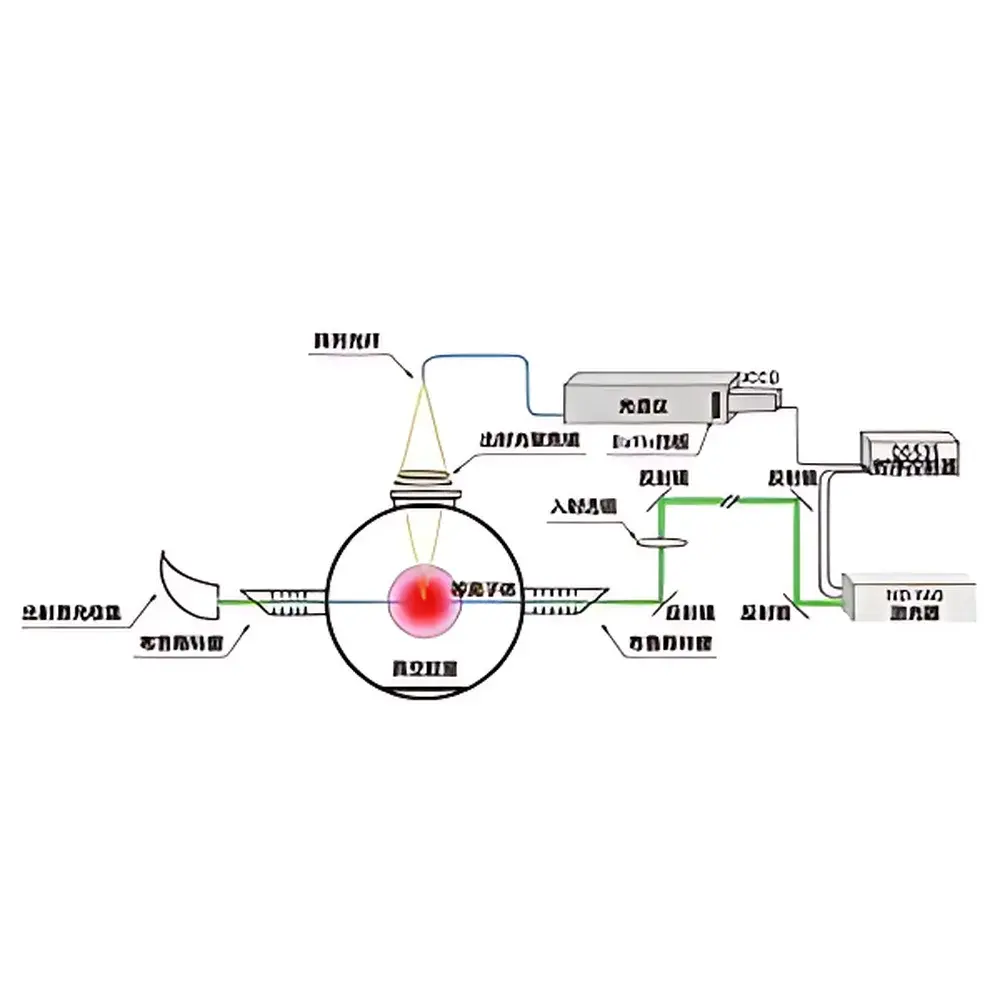
ZOLIX Thomson Scattering Spectroscopic Diagnostic System
| Brand | ZOLIX |
|---|---|
| Origin | Beijing, China |
| Manufacturer Type | Authorized Distributor |
| Product Origin | Domestic (China) |
| Model | Thomson Scattering Spectroscopic Diagnostic System |
| Pricing | Upon Request |
Overview
The ZOLIX Thomson Scattering Spectroscopic Diagnostic System is a precision optical instrumentation platform engineered for quantitative, spatially resolved measurement of electron temperature (Te) and electron number density (ne) in laboratory plasmas. It operates on the fundamental principle of Thomson scattering—elastic scattering of monochromatic laser light (typically 532 nm) by free electrons—where spectral broadening of the scattered signal is governed by the electron thermal velocity distribution. Under the assumption of a Maxwellian electron energy distribution, the full width at 1/e intensity (Δλ1/e) of the scattered spectrum relates directly to Te via Δλ1/e ≈ 1.487 × Te1/2 (with Te in eV and Δλ in nm). This physics-based calibration enables absolute, non-perturbative diagnostics without reliance on plasma equilibrium assumptions or emissivity models. The system is optimized for both high-temperature fusion-relevant plasmas and low-temperature non-equilibrium plasmas (e.g., RF, microwave, or pulsed discharges), supporting measurements down to Te ≥ 0.1 eV and ne ≥ 1 × 10¹⁹ m−3. Its modular architecture allows integration into vacuum chambers with standard CF or KF flanges, and supports time-resolved acquisition synchronized via external triggers (e.g., DG645 digital delay generator).
Key Features
- High-spatial-resolution localized probing enabled by diffraction-limited laser focusing (e.g., DLP ≈ 1 mm using f = 1000 mm lens and θ = 0.5 mrad input beam)
- Dual-grating spectrograph compatibility (e.g., ZOLIX Omni-750 or 207 spectrometers) with selectable groove densities (1200–1800 l/mm) to balance spectral resolution (≤0.4 nm) and coverage (≥13 nm)
- Optimized light collection optics: imaging lens with adjustable object–image ratio; fiber-coupled detection with 400 µm core diameter fibers arranged linearly over ≤13 mm
- Integrated Rayleigh scattering rejection using Brewster-angle windows, baffled cage structures, and black-anodized light traps to suppress elastic scattering from neutrals and ions
- Flexible detector options: iStar 334T ICCD (13.3 × 13.3 mm active area, 18 mm image intensifier) or ZOLIX IIM-A series lens-coupled image intensifier modules compatible with large-format sCMOS/CCD cameras (up to 25 mm intensifier diameter)
- Calibration-ready configuration including NIST-traceable broadband source (standard A lamp) and motorized slit for resolution tuning and stray-light management
Sample Compatibility & Compliance
The system is designed for in situ diagnostics of gaseous and magnetically confined plasmas across pressure regimes from 10−3 Pa to atmospheric conditions. It accommodates cylindrical, planar, and toroidal discharge geometries with line-of-sight access through standard optical viewports. All optical components comply with ISO 10110 surface quality standards; mechanical mounts conform to DIN 3185 and are vacuum-rated to ≤10−7 mbar. The system supports GLP/GMP-aligned data acquisition workflows when paired with timestamped, audit-trail-enabled software (see Software & Data Management). While not certified to a specific regulatory standard, its measurement methodology aligns with ASTM E2867–22 (Standard Guide for Plasma Diagnostics) and ISO/IEC 17025:2017 requirements for measurement uncertainty quantification in physical testing laboratories.
Software & Data Management
Data acquisition and analysis are performed using ZOLIX’s proprietary SpectraMaster™ platform, which provides real-time spectral preview, multi-channel synchronization, and automated background subtraction. Raw spectra are stored in HDF5 format with embedded metadata (laser pulse timing, grating position, slit width, detector gain, calibration coefficients). Post-processing includes Voigt-profile fitting of scattered spectra, error propagation for Te and ne, and cross-validation against Langmuir probe or interferometric data. The software supports export to MATLAB, Python (via h5py), and ASCII for third-party analysis. For regulated environments, optional 21 CFR Part 11-compliant modules provide electronic signatures, user access control, and immutable audit trails for all calibration and analysis events.
Applications
- Electron energy distribution function (EEDF) characterization in low-temperature plasma reactors used for thin-film deposition, surface functionalization, and biomedical device sterilization
- Validation of kinetic simulation codes (e.g., BOLSIG+, Particle-in-Cell) by benchmarking predicted vs. measured Te profiles in magnetized plasma columns
- Time-resolved monitoring of electron heating dynamics during RF power modulation in capacitively coupled plasmas (CCPs)
- Diagnostic support for plasma-assisted combustion research, where Te–Tgas decoupling informs reaction pathway modeling
- Multi-point radial profiling in tokamak edge plasmas using fiber bundle arrays and scanning mirror assemblies (customizable)
FAQ
What is the minimum detectable electron temperature?
The system achieves reliable Te determination down to 0.1 eV when configured with a 1200 l/mm grating, 400 µm core fiber, and iStar 334T ICCD under optimal signal-to-noise conditions (≥104 photons per pixel per laser shot).
Can this system measure ion or neutral species temperatures?
No—the Thomson scattering channel is selective to free electrons. However, the same optical train can be reconfigured (e.g., via grating exchange and filter selection) to acquire Rayleigh scattering or optical emission spectra for rotational/vibrational temperature analysis of neutrals.
Is vacuum compatibility included as standard?
All optical mounts, fiber feedthroughs, and detector housings are rated for UHV operation (≤10−7 mbar); custom CF-100 or CF-150 flange interfaces are available upon request.
How is spectral calibration performed?
Wavelength calibration uses Hg/Ar spectral lamps traceable to NIST SRM 2034; intensity calibration employs a calibrated tungsten-halogen source (standard A lamp) with known spectral radiance.
What trigger latency is achievable for time-resolved measurements?
With DG645 digital delay generator integration, jitter is ≤50 ps RMS; temporal resolution is limited primarily by laser pulse duration (typically 5–10 ns FWHM for Q-switched Nd:YAG systems).





