
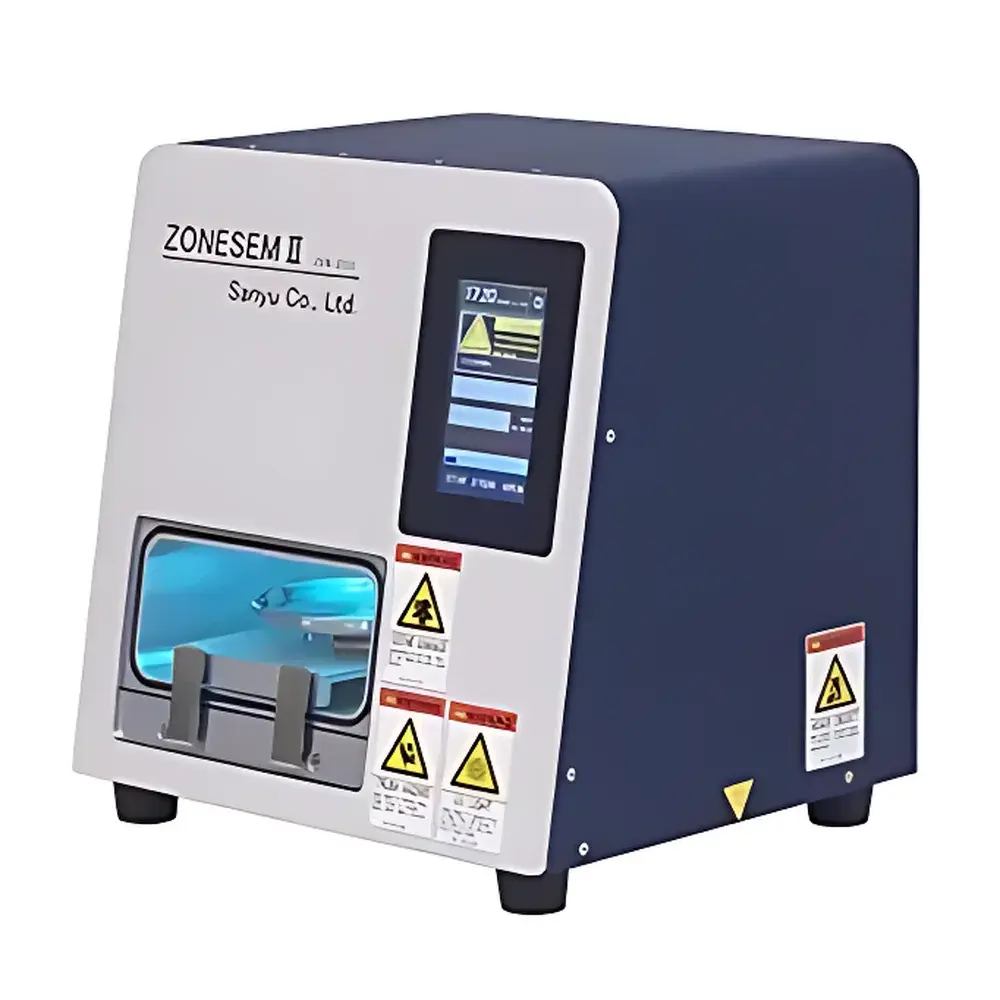
ZONESEM II UV-Ozone Cleaning System by SUNYOU
| Brand | SUNYOU |
|---|---|
| Origin | Japan |
| Model | ZONESEM II |
| Cleaning Principle | UV-Ozone Oxidation |
| Vacuum System | Oil-Free Diaphragm Pump (9 L/min) |
| Pump-Down Time | ≤3 min to Target Vacuum |
| Operating Vacuum Range | 100–500 torr (100-step adjustable) |
| Cleaning Chamber Dimensions | Ø100 mm × H36 mm |
| Cleaning Modes | Vacuum UV-Ozone Cleaning & Vacuum Storage Mode |
| Cleaning Duration | 1–1440 min (1-min increments) |
| Effective Cleaning Area | Ø100 mm |
| Compliance | Designed for SEM sample preparation per ISO 14644-1 Class 5 cleanroom-compatible workflows |
Overview
The ZONESEM II UV-Ozone Cleaning System, engineered by SUNYOU and manufactured in Japan, is a precision surface decontamination instrument designed specifically for electron microscopy sample preparation. It employs deep-ultraviolet (UVC, 184.9 nm and 253.7 nm) irradiation in the presence of ambient oxygen to generate atomic oxygen and ozone—highly reactive species that oxidize and volatilize organic contaminants—including hydrocarbons, photoresists, greases, and adventitious carbon—without mechanical contact or thermal stress. Unlike plasma-based cleaning methods, UV-ozone treatment operates at ambient temperature and low vacuum (100–500 torr), minimizing risk of surface modification, charging, or structural damage to delicate specimens such as biological tissues, thin-film devices, polymer substrates, and beam-sensitive nanomaterials. The system is routinely deployed upstream of scanning electron microscopy (SEM), energy-dispersive X-ray spectroscopy (EDS), and electron backscatter diffraction (EBSD) workflows to ensure contaminant-free surfaces essential for high-fidelity imaging, quantitative elemental analysis, and crystallographic characterization.
Key Features
- Two operational modes: Active UV-ozone cleaning under controlled vacuum and passive vacuum storage mode for contamination-free sample holding prior to SEM insertion
- Oil-free diaphragm vacuum pump (9 L/min) achieving target pressure in ≤3 minutes—eliminating oil vapor backstreaming risks common with rotary vane pumps
- Precise vacuum regulation across 100 discrete setpoints between 100 and 500 torr, enabling optimization for diverse sample chemistries and chamber geometries
- Programmable cleaning duration from 1 minute to 24 hours (1-minute resolution), supporting both rapid pre-imaging treatment and extended decontamination protocols
- Compact cylindrical chamber (Ø100 mm × 36 mm height) accommodating standard SEM stubs, TEM grids on support holders, and small-area wafers—fully compatible with JEOL, Hitachi, Thermo Fisher, Zeiss, and TESCAN SEM platforms
- UVC lamp assembly with calibrated spectral output and stable intensity over rated lifetime; lamp replacement interval specified per IEC 62471 photobiological safety guidelines
Sample Compatibility & Compliance
The ZONESEM II is validated for use with a broad spectrum of electron microscopy specimens, including but not limited to: sputter-coated biological sections, FIB-prepared cross-sections, graphene and 2D material transfers, metal-organic frameworks (MOFs), perovskite thin films, and insulating ceramic powders. Its non-ionic, non-thermal mechanism preserves native surface topography and chemical states—critical for XPS and AES validation studies. The system conforms to ISO 14644-1 requirements for Class 5 (ISO 5) cleanroom-compatible equipment design, and its vacuum control architecture supports GLP-compliant documentation when integrated with external data loggers. While not a medical device, it aligns with ASTM E2912–22 practices for surface cleanliness assessment in microanalysis and satisfies prerequisite conditions for USP and ISO/IEC 17025-accredited laboratories performing SEM-based quality control.
Software & Data Management
The ZONESEM II operates via an embedded microcontroller interface with tactile membrane keypad and dual-line LCD display. All process parameters—including vacuum setpoint, dwell time, and mode selection—are stored in non-volatile memory with timestamped execution logs accessible via USB export (CSV format). Though no proprietary PC software is bundled, the device supports RS-232 serial communication for integration into centralized lab automation systems compliant with IEEE 11073 or LabVIEW-based instrument control architectures. Audit trails meet minimum traceability requirements for FDA 21 CFR Part 11–aligned environments when paired with validated third-party electronic lab notebook (ELN) solutions.
Applications
- Removal of hydrocarbon monolayers from gold-coated SEM stubs to improve secondary electron yield and reduce charging artifacts
- Pre-EBSD cleaning of Ni-based superalloy cross-sections to eliminate carbon deposition and enhance Kikuchi band contrast
- Surface activation of PDMS stamps prior to microcontact printing for nanoscale pattern fidelity
- Decontamination of TEM grid windows prior to cryo-EM grid vitrification to suppress ice crystallinity artifacts
- Routine maintenance cleaning of SEM chamber components—including stage inserts and detector apertures—to extend service intervals and maintain vacuum integrity
FAQ
Does the ZONESEM II require consumables beyond the UVC lamp?
No—aside from periodic UVC lamp replacement (typical service life: 1,500–2,000 hours), the system operates without gases, solvents, or disposable filters.
Can it be used for conductive sample cleaning without affecting coating integrity?
Yes—UV-ozone does not sputter or etch conductive coatings such as Au/Pd or Cr; it selectively removes adsorbed organics while preserving film thickness and adhesion.
Is ozone exhaust management required?
Yes—integrated ozone destruct unit or connection to facility exhaust with activated carbon filtration is mandatory per OSHA PEL (0.1 ppm) and local environmental regulations.
What vacuum level is optimal for most SEM stub cleaning?
A setting of 300 torr balances ozone generation efficiency and uniform UVC exposure; empirical optimization is recommended for each sample type using the 100-step vacuum adjustment.
How does it compare to low-pressure oxygen plasma cleaning?
UV-ozone achieves comparable organic removal rates at lower energy input and zero ion bombardment—making it preferable for beam-sensitive, nanostructured, or insulating samples where plasma-induced damage or charging remains a concern.





