ZONWON IVS800 Automated Intrinsic Viscosity Measurement System
| Brand | ZONWON |
|---|---|
| Origin | Zhejiang, China |
| Manufacturer Type | OEM/ODM Producer |
| Country of Origin | China |
| Model | IVS800 |
| Pricing | Upon Request |
| Temperature Control Range | 15–90 °C |
| Temperature Uniformity | ≤ ±0.01 °C |
| Timing Resolution | 0.001 s |
| Measured Time Range | 0–9999.999 s |
| Kinematic Viscosity Range | 0.3–100,000 mm²/s |
| Capillary Type | Z-type Ubbelohde (modified) |
| Sample Chamber Capacity | Dual- or Quad-position (720×320×700 mm / 1040×320×700 mm) |
| Power Supply | 220 V / 50 Hz |
| Rated Power | 2 kW |
| Wireless Communication Range | Up to 50 m |
Overview
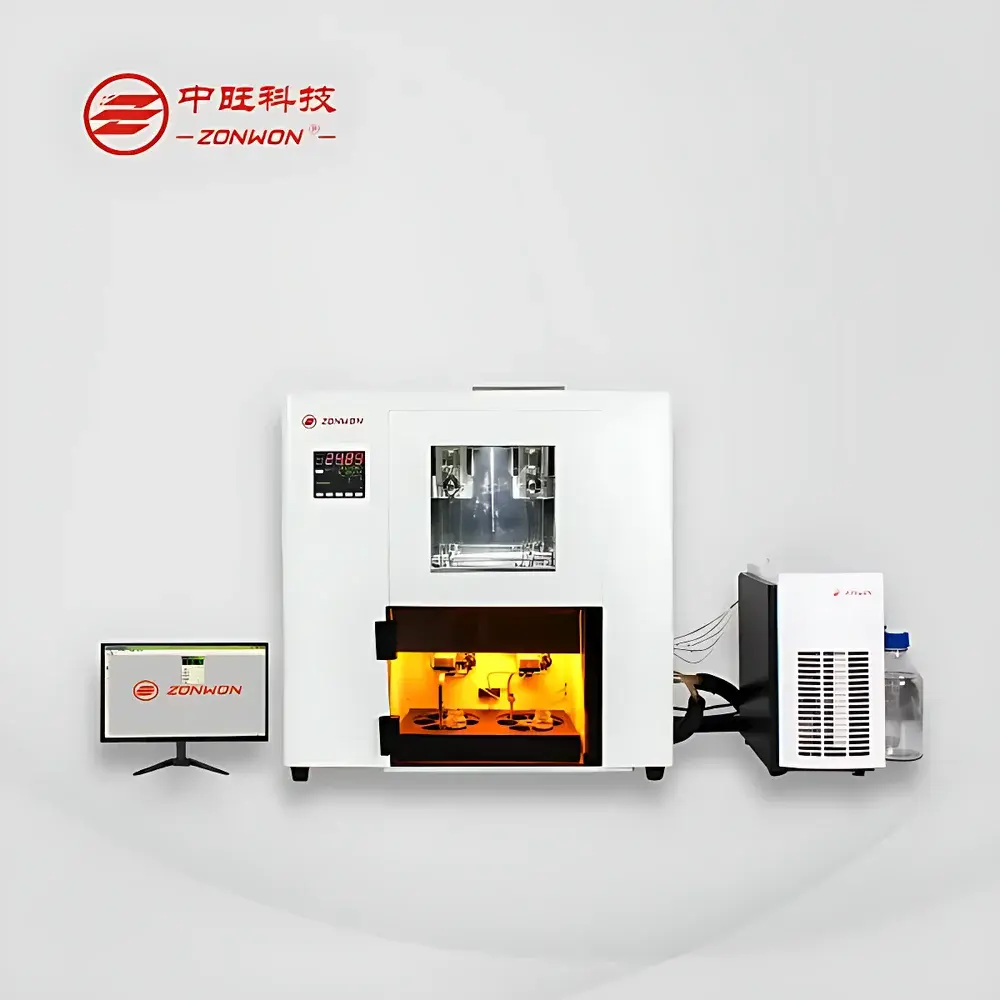
The ZONWON IVS800 Automated Intrinsic Viscosity Measurement System is a fully integrated laboratory instrument engineered for high-precision, unattended determination of intrinsic viscosity and related polymer solution parameters using the capillary efflux principle—specifically adapted from the classical Ubbelohde viscometry method. Unlike conventional manual or semi-automated systems, the IVS800 implements a Z-type modified Ubbelohde capillary design that eliminates the traditional reservoir bulb, reducing internal volume to just 7 mL. This structural optimization minimizes sample retention, accelerates solvent exchange between runs, and enhances repeatability in sequential measurements. The system operates on a thermodynamically controlled efflux time measurement principle: kinematic viscosity (ν) is derived from the measured flow time (t) of a defined volume of polymer solution through a calibrated capillary under gravity, corrected for temperature-dependent density and calibration constants. From this base measurement, the IVS800 computes intrinsic viscosity [η], relative viscosity (ηr), specific viscosity (ηsp), logarithmic viscosity (ln ηr), Fickentscher’s K-value, viscosity-average molecular weight (Mv), degree of polymerization (DP), dynamic viscosity (η), and kinematic viscosity (ν)—all traceable to ISO 1628-1, ASTM D2857, and GB/T 1632.1 standards.
Key Features
- Fully automated workflow: auto-thermal equilibration, capillary rinsing, sample aspiration, efflux timing, data calculation, solvent purge, and nitrogen-assisted drying—all executed without operator intervention.
- High-stability temperature control architecture: dual-zone thermostatic bath with physically separated measurement and regulation zones ensures thermal uniformity ≤ ±0.01 °C across the entire capillary sensing region.
- Z-type Ubbelohde capillary with optimized geometry: no reservoir bulb, minimal dead volume (7 mL), reduced residual sample carryover, and rapid cleaning cycle (< 60 s per rinse/dry sequence).
- Closed-loop volatile handling: integrated exhaust ducting routes vapors (e.g., phenol, chloroform, HFIP) directly outdoors, complying with OSHA and EU Directive 2004/40/EC workplace exposure limits.
- Modular sample staging: dual- or quad-position恒温 sample tray maintains all vials at target temperature prior to injection—eliminating in-capillary pre-equilibration delays and preventing crystallization or phase separation in thermosensitive polymers.
- No capillary disassembly required: all fluidic operations—including sample switching, solvent flush, and drying—are performed via programmable peristaltic and pneumatic valving.
Sample Compatibility & Compliance
The IVS800 supports a broad range of polymer-solvent systems including but not limited to: polyethylene terephthalate (PET) in phenol/trichlorophenol, polycarbonate (PC) in methylene chloride, polyacrylonitrile (PAN) in DMF, cellulose derivatives in cupriethylenediamine (CED), and polyolefins in decalin at elevated temperatures. All measurement protocols adhere to ISO 1628 (Plastics – Determination of Viscosity Number), ASTM D1243 (Standard Test Method for Dilute Solution Viscosity of Vinyl Chloride Polymers), and USP for pharmaceutical-grade polymers. Data integrity meets ALCOA+ principles; audit trails, electronic signatures, and user-access controls are configurable to satisfy FDA 21 CFR Part 11 and EU Annex 11 requirements when paired with optional compliant software modules.
Software & Data Management
The IVS800 is operated via Windows-based ZONWON Viscosoft™ Suite, which provides real-time monitoring of temperature stability, flow-time acquisition, outlier detection (via Grubbs’ test), and automatic baseline correction. Raw efflux times are stored with full metadata: timestamp, operator ID, ambient humidity, bath temperature log (sampled every 0.5 s), and calibration certificate reference. Export formats include CSV, PDF analytical reports (with embedded uncertainty budgets per GUM guidelines), and XML for LIMS integration. Optional 21 CFR Part 11 compliance package includes role-based permissions, electronic signature workflows, and immutable audit logs covering all parameter changes, result modifications, and instrument maintenance events.
Applications
- Quality control of synthetic polymers (PET, PA6, PC, POM) in chemical manufacturing plants.
- R&D characterization of biodegradable polymers (PLA, PHA) and hydrogels under variable temperature gradients.
- Pharmaceutical excipient qualification per ICH Q5C and USP monographs for viscosity-dependent release kinetics.
- Academic polymer physics studies requiring high-reproducibility [η] vs. concentration extrapolation (Huggins, Kraemer plots).
- Regulatory submission support for medical device coatings where Mv correlates with mechanical performance and degradation rate.
FAQ
Does the IVS800 support ASTM D4603-compliant high-temperature PET testing?
Yes—the system achieves stable operation up to 90 °C with certified thermal uniformity ≤ ±0.01 °C in the capillary zone, meeting the bath stability requirement specified in ASTM D4603 Section 7.2.
Can the Z-type capillary be calibrated per ISO 3105?
Yes. Each capillary is supplied with a NIST-traceable calibration certificate (kinematic viscosity constant C, unit mm²/s²), and the software supports multi-point calibration using standard fluids (e.g., Cannon-Fenske oils) per ISO 3105 Annex B.
Is remote monitoring supported over Ethernet or only via wireless?
Both: the system features dual communication interfaces—Wi-Fi (up to 50 m line-of-sight) and Gigabit Ethernet—with identical API access for third-party SCADA or MES integration.
How is carryover minimized between high-viscosity samples like PMMA in toluene?
Three-stage solvent rinse (pre-rinse, main wash, post-dry) combined with positive-pressure nitrogen blow-down ensures < 0.02% residual volume—validated via dye-tracer recovery tests per ISO 5725-2 precision protocols.
What maintenance intervals are recommended for long-term GLP compliance?
Capillary inspection every 500 runs; temperature sensor verification quarterly; full fluidic path validation annually—documented via ZONWON’s PQ/QC checklist aligned with ISO/IEC 17025 Clause 6.4.