
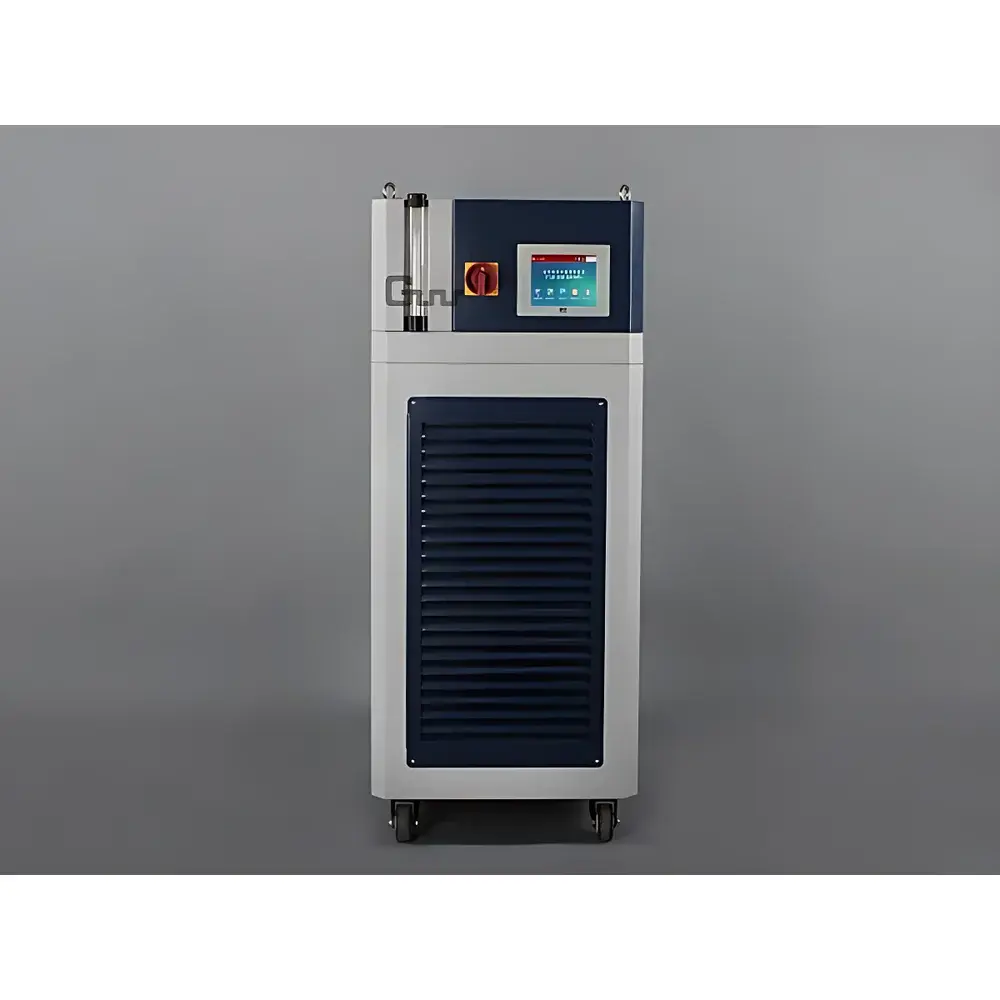
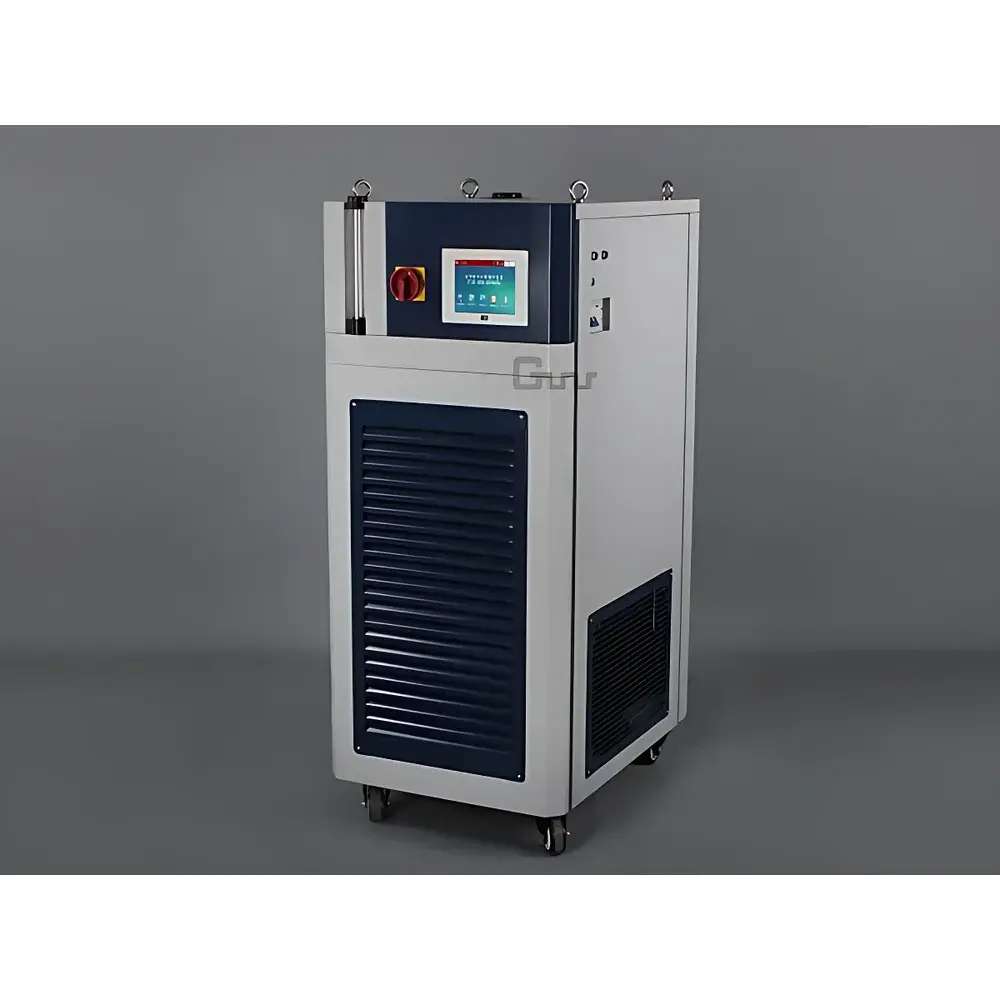
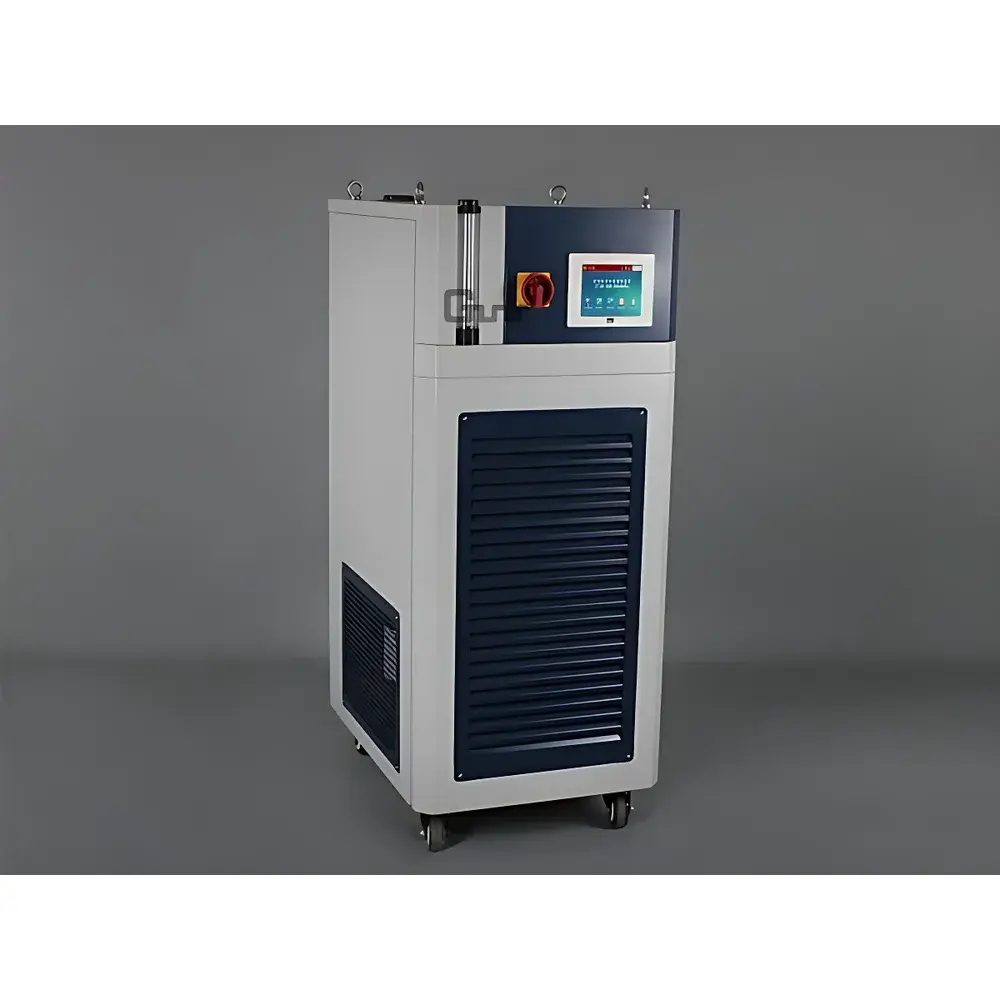
ZT-20-200-40H Closed-Loop Refrigerated & Heated Circulation Chiller by The Great Wall
| Brand | The Great Wall |
|---|---|
| Origin | Henan, China |
| Manufacturer Type | OEM/ODM Producer |
| Model | ZT-20-200-40H |
| Temperature Stability | ±0.5 °C |
| Operating Temp Range | −40 °C to +200 °C |
| Ambient Temp Range | 5–35 °C |
| Ambient Humidity | ≤70% RH |
| Power Supply | 3-phase 380 V, 50 Hz |
| Total Power | 5.7 kW |
| Heating Power | 3 kW |
| Compressor | Tecumseh, 2.238 kW |
| Refrigerant | R404A |
| Cooling Capacity | 1.7 kW @ 200 °C, 4.3 kW @ 10 °C, 3.1 kW @ −10 °C, 2.3 kW @ −20 °C, 1.2 kW @ −30 °C, 0.3 kW @ −35 °C |
| Circulation Pump | 0.28 kW, 30 L/min, 1 bar max pressure |
| Reservoir Volume | 8 L |
| Fluid Connection | 3/4″ BSP |
| Reservoir & Piping Material | SUS304 stainless steel |
| Dimensions (W×D×H) | 730 × 840 × 1470 mm |
| Safety Protections | Phase sequence detection, overcurrent, overtemperature, high/low pressure, thermal overload, and delayed startup |
Overview
The ZT-20-200-40H Closed-Loop Refrigerated & Heated Circulation Chiller is an engineered thermal management system designed for precise, stable, and bidirectional temperature control of external laboratory equipment—including jacketed reactors, rotary evaporators, calorimeters, and analytical instrumentation. Operating on a dual-mode thermodynamic cycle, it integrates a high-efficiency vapor-compression refrigeration circuit with electric resistance heating in a single, sealed fluid loop. This architecture enables seamless transition between cooling and heating without manual intervention or fluid exchange, eliminating thermal lag and ensuring consistent thermal transfer across the full operational range of −40 °C to +200 °C. Its closed-loop design prevents evaporation loss, oxidation, and contamination of the heat transfer fluid (typically silicone oil or specialized low-temperature bath fluids), supporting long-term stability in extended synthesis or process validation experiments.
Key Features
- High-precision temperature regulation with ±0.5 °C stability at setpoint—achieved via PID-controlled dual-stage heating/cooling modulation and real-time feedback from dual Pt100 sensors (reservoir and outlet)
- Robust thermal performance: 4.3 kW cooling capacity at 10 °C ambient, scalable down to 0.3 kW at −35 °C; 3 kW independent heating power ensures rapid ramp-up and overshoot suppression
- Industrial-grade Tecumseh hermetic compressor paired with R404A refrigerant—optimized for low-temperature operation and compatible with standard service infrastructure
- SUS304 stainless steel reservoir, piping, and valves—corrosion-resistant, non-reactive, and compliant with ISO 8502-3 surface cleanliness requirements for GMP environments
- Intuitive 7-inch capacitive touchscreen HMI with multilingual UI (English default), programmable ramp/soak profiles, and real-time graphing of temperature, flow rate, and system status
- Comprehensive safety architecture: phase-sequence monitoring, high/low refrigerant pressure cutoffs, overcurrent protection, thermal cutout on heater and compressor, and delayed restart logic to prevent compressor short-cycling
Sample Compatibility & Compliance
The ZT-20-200-40H is compatible with a broad spectrum of external devices requiring external thermal coupling—including glass-jacketed reactors (up to 50 L), falling-film evaporators, FTIR cells, and cryogenic sample holders. Its 8 L reservoir volume and 30 L/min flow rate support dynamic heat exchange in systems with moderate thermal mass and hydraulic resistance. All wetted materials conform to ASTM A240/A240M for 304 stainless steel and are passivated per ASTM A967. While not intrinsically rated, optional ATEX-certified explosion-proof variants (ZT-20-200-40H-Ex) are available for Class I, Division 1 hazardous locations. The unit meets CE marking requirements under the Machinery Directive 2006/42/EC and Low Voltage Directive 2014/35/EU. It supports audit-ready operation in GLP and GMP workflows through configurable event logging and user-access controls.
Software & Data Management
The embedded controller records timestamped temperature, flow, pressure, and fault events at 1-second intervals, storing up to 30 days of data locally. USB export enables CSV-based traceability for regulatory submission. Optional Ethernet or RS485 Modbus RTU interface allows integration into LabVantage, DeltaV, or custom SCADA platforms. Remote monitoring and parameter adjustment are supported via secure HTTPS web interface (TLS 1.2), with role-based access (Operator, Technician, Administrator). Audit trail functionality complies with FDA 21 CFR Part 11 requirements when paired with network-authenticated user login and electronic signature protocols.
Applications
- Controlled exothermic/endothermic reaction profiling in organic synthesis and catalysis studies
- Temperature-dependent kinetic analysis in pharmaceutical API crystallization and polymorph screening
- Stabilization of detector housings and optical benches in spectroscopy and chromatography systems
- Thermal conditioning of bioreactor jackets during fermentation process development
- Calibration and verification of temperature-sensitive metrology tools (e.g., PT100 probe testers, DSC reference cells)
- Material testing under thermal cycling per ASTM D696 (Coefficient of Linear Expansion) and ISO 11359 (Dynamic Mechanical Analysis)
FAQ
What types of heat transfer fluids are compatible with this chiller?
Silicone oils (e.g., DC200 series), polyalphaolefins (PAOs), and low-freezing-point glycol/water blends (with corrosion inhibitors) are suitable. Fluid selection must align with viscosity limits at minimum operating temperature and flash point requirements above maximum setpoint.
Can the unit operate unattended overnight or over weekends?
Yes—its redundant safety systems, non-volatile fluid containment, and automatic fault shutdown enable unattended operation for up to 168 hours when validated per internal SOP-THM-004.
Is remote diagnostics supported?
Standard firmware includes ping-based connectivity health checks; optional remote desktop support (via TLS-secured VNC) is available under extended service agreement.
How is calibration traceability maintained?
The unit ships with NIST-traceable calibration certificate for both Pt100 sensors and pressure transducers; annual recalibration is recommended per ISO/IEC 17025 guidelines.
Does it meet noise emission standards for shared laboratory spaces?
At 1 m distance, sound pressure level is ≤62 dB(A) under full-load cooling—compliant with ISO 7779 and EU Directive 2000/14/EC for laboratory equipment.



