
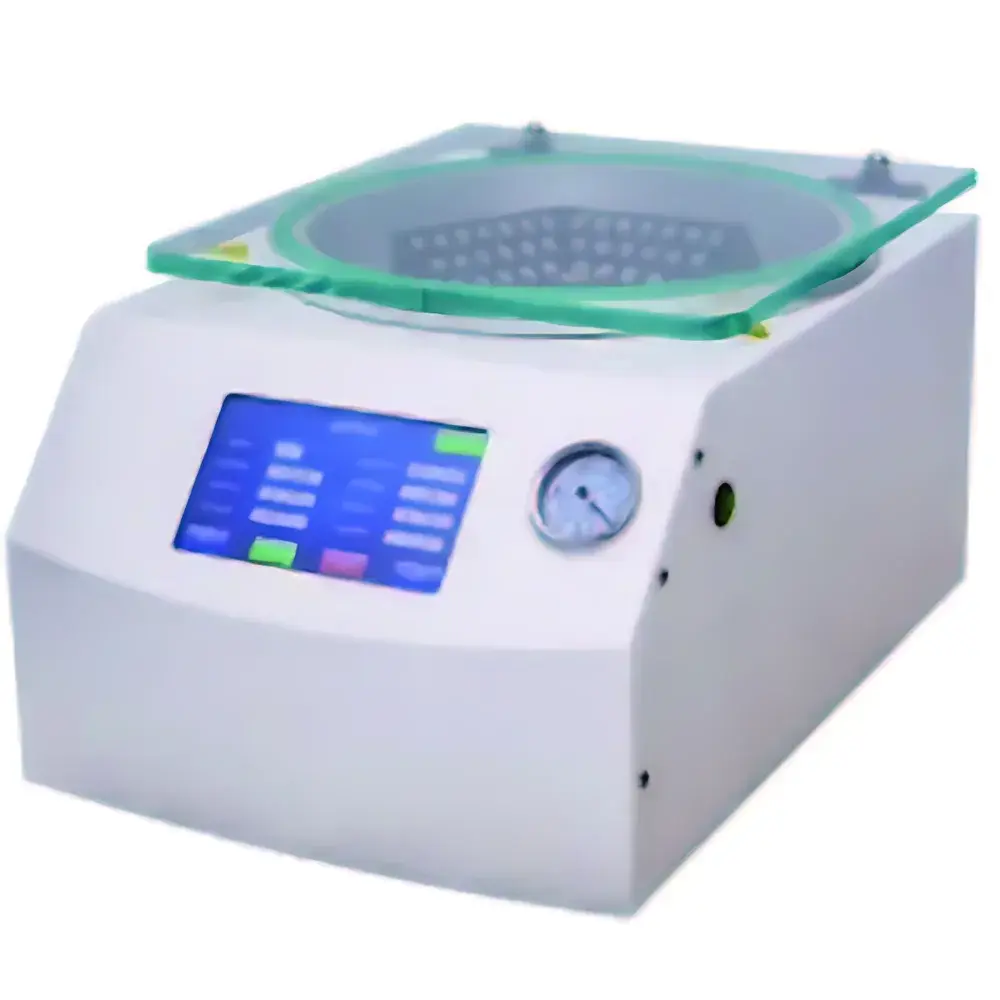
Zuofei ZF-132 Vacuum Centrifugal Concentrator
| Brand | Zuofei |
|---|---|
| Origin | Shanghai, China |
| Manufacturer Type | Direct Manufacturer |
| Product Category | Domestic |
| Model | ZF-132 |
| Instrument Type | Vacuum Centrifugal Concentrator |
| Temperature Range | Ambient to 100 °C |
| Temperature Control Accuracy | ±0.1 °C |
| Sample Capacity | 132 × 1.5 mL tubes |
Overview
The Zuofei ZF-132 Vacuum Centrifugal Concentrator is an engineered solution for gentle, efficient removal of volatile solvents from biological, chemical, and pharmaceutical samples under reduced pressure and controlled temperature. It operates on the principle of simultaneous centrifugation and vacuum-assisted evaporation: rotational force prevents sample bumping or foaming while lowering the boiling point of solvents via vacuum, enabling rapid concentration without thermal degradation. Designed for routine use in QC laboratories, core facilities, and academic research settings, the ZF-132 integrates precise thermal regulation, high-speed rotor dynamics, and modular vacuum architecture to support reproducible sample recovery across diverse analyte classes—including nucleic acids, proteins, metabolites, and small-molecule standards.
Key Features
- Modular architecture: Independent centrifuge chamber, vacuum chamber, vacuum pump, and cold trap allow flexible configuration, service accessibility, and system scalability.
- TFT full-color touch screen interface with intuitive icon-based navigation; supports multi-language firmware (English default) and real-time parameter visualization including speed, temperature, vacuum level, and runtime.
- Microprocessor-controlled operation with programmable protocols: users define ramp profiles for speed, temperature, and vacuum timing—enabling method standardization and GLP-compliant documentation.
- Integrated vacuum delay function: vacuum initiation is automatically deferred until rotor reaches preset speed, minimizing aerosol formation and ensuring sample integrity during startup.
- Brushless AC frequency-controlled induction motor with electromagnetic drive: delivers stable torque across 500–1800 rpm range, low acoustic emission (<55 dB(A)), and zero maintenance over extended operational life.
- Quick-access temperature control: dedicated hotkey enables immediate selection of ambient-to-100 °C setpoints in 1 °C increments; PID algorithm ensures ±0.1 °C stability at target.
- Lightweight aluminum rotor (132-position, 1.5 mL tube capacity): autoclavable at 121 °C for 30 minutes; compatible with standard conical-bottom microcentrifuge tubes.
- Corrosion-resistant chamber housing: aerospace-grade aluminum alloy with electrophoretic epoxy coating; R-corner geometry eliminates crevices and simplifies decontamination between runs.
- Imported precision vacuum relief valve: enables automatic, pressure-triggered venting upon cycle completion; certified for fail-safe operation per IEC 61010-1 safety requirements.
- Optically transparent polycarbonate lid: provides unobstructed visual monitoring of solvent evaporation and condensate accumulation without interrupting vacuum or rotation.
Sample Compatibility & Compliance
The ZF-132 accommodates aqueous buffers, ethanol, methanol, acetonitrile, ethyl acetate, and other low-boiling organic solvents commonly used in nucleic acid purification, peptide synthesis, and HPLC fraction collection. Its temperature-limited operation (up to 100 °C) ensures compatibility with thermolabile biomolecules, while the absence of moving seals or gaskets in the rotor assembly minimizes carryover risk. The system meets essential electrical safety standards (IEC 61010-1), and its sealed vacuum path complies with ISO 8573-1 Class 4 compressed air purity requirements when used with external oil-free pumps. For regulated environments, optional audit trail logging (via USB export) supports adherence to FDA 21 CFR Part 11 principles when paired with validated SOPs.
Software & Data Management
The embedded control firmware stores up to 99 user-defined methods with timestamped execution logs. All parameters—including actual vs. setpoint temperature curves, vacuum decay profiles, and rotor acceleration history—are recorded at 1-second intervals and exportable as CSV files via USB-A port. No proprietary software installation is required; raw data files are natively readable in Excel, GraphPad Prism, or LabArchives ELN platforms. Optional RS-232 or Ethernet modules (sold separately) enable remote status polling and integration into LIMS workflows using Modbus RTU or TCP protocols.
Applications
- Concentration of DNA/RNA eluates post-column purification or phenol-chloroform extraction.
- Drying of MALDI matrix solutions prior to crystallization on target plates.
- Removal of residual solvents from synthetic intermediates in medicinal chemistry workflows.
- Preparative-scale concentration of cell culture supernatants containing secreted recombinant proteins.
- Stabilization of unstable calibration standards for LC-MS/MS quantitation.
- Routine volume adjustment of HPLC fractions prior to lyophilization or NMR analysis.
FAQ
Is the ZF-132 suitable for concentrating acid-sensitive samples such as oligonucleotides?
Yes—the combination of low-temperature operation, minimal foaming due to centrifugal stabilization, and absence of metal-on-metal contact in the rotor assembly reduces hydrolytic degradation risk.
Can the cold trap be operated independently of the centrifuge?
Yes—modular design allows standalone cold trap use for pre-chilling solvents or capturing vapors from external vacuum sources.
What vacuum level does the integrated pump achieve?
The built-in diaphragm pump achieves ≤5 mbar absolute pressure; for lower endpoints (e.g., <0.1 mbar), an external turbomolecular or scroll pump may be connected via the auxiliary vacuum port.
Is rotor balancing required before each run?
No—the electromagnetic drive system automatically compensates for minor mass asymmetry; however, gross imbalance (>5% mass difference between opposing positions) must be avoided per ISO 21501-4 guidelines.
Does the unit support validation documentation packages?
Factory-installed IQ/OQ documentation templates (DQ available upon request) align with ISO/IEC 17025 and ASTM E2500-13 frameworks; final PQ must be performed by end-user under actual operating conditions.



