
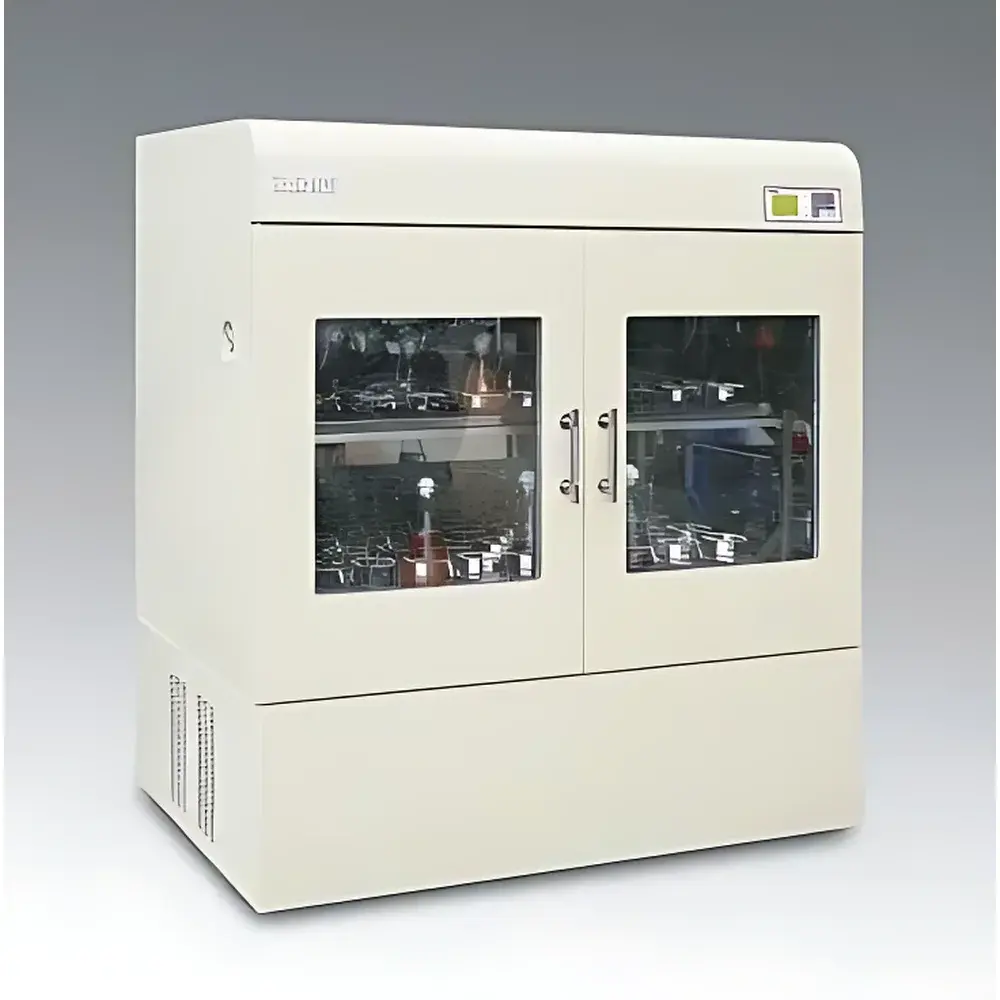
ZWY-2102 Dual-Layer High-Capacity Full-Temperature Incubator Shaker
| Origin | Shanghai, China |
|---|---|
| Manufacturer Type | Authorized Distributor |
| Origin Category | Domestic (China) |
| Model | ZWY-2102 |
| Quotation | Upon Request |
| Control Method | PID Microprocessor-Based Environmental Scanning Controller |
| Display | LCD Backlit Liquid Crystal Display |
| Air Circulation | Forced Convection |
| Oscillation Mode | Orbital (Circular) |
| Drive System | Multi-Dimensional Drive |
| Door Configuration | Dual Front Doors |
| Ambient Temperature Range | 5–25 °C |
| Temperature Control Range | 4–60 °C |
| Temperature Resolution | ±0.1 °C |
| Temperature Uniformity | ≤±1 °C (at 37 °C) |
| Temperature Stability | ≤±0.1 °C (at 37 °C) |
| Refrigeration Control | Manual Setpoint |
| Speed Range | 30–300 rpm |
| Speed Accuracy | ±1 rpm |
| Orbit Diameter | Φ26 mm |
| Timer Range | 0–500 h |
| Shelf Dimensions | 734 × 458 mm |
| Number of Shelves | 2 |
| Chamber Volume | 332 L |
| Interior Dimensions | 845 × 515 × 765 mm |
| External Dimensions | 950 × 710 × 1370 mm |
| Net Weight | 235 kg |
| Gross Weight | 272 kg |
| Max Capacity (mL × qty) | 50×104 / 100×104 / 250×56 / 500×44 / 750×30 / 1000×24 |
| Power Consumption | 1200 W |
| Input Power | AC 220 V, 50/60 Hz |
Overview
The ZWY-2102 Dual-Layer High-Capacity Full-Temperature Incubator Shaker is an engineered platform for precise, scalable, and reproducible orbital incubation of biological samples under tightly controlled thermal and mechanical conditions. Designed for mid-scale bioprocess development and laboratory-scale fermentation, it integrates forced-air convection temperature regulation with high-stability orbital motion—enabling uniform heat transfer and consistent suspension of microbial cultures, mammalian cells, or enzymatic reaction mixtures. Its dual-shelf architecture maximizes volumetric throughput (332 L total chamber volume) while maintaining a compact footprint (950 × 710 mm base), making it suitable for ISO Class 7 cleanrooms, QC laboratories, and pilot bioreactor support suites where spatial efficiency and process fidelity are critical. The system operates across a full physiological-to-mesophilic range (4–60 °C), with PID-controlled thermal stability ≤±0.1 °C at 37 °C and uniformity ≤±1 °C across the entire chamber—meeting foundational requirements for ASTM E2924-21 (Standard Guide for Validation of Incubator Shakers) and supporting GLP-compliant workflows in pharmaceutical and academic settings.
Key Features
- Dual-layer vertical configuration with two independently accessible, reinforced stainless-steel shelves (734 × 458 mm each), enabling parallel processing of heterogeneous sample sets without cross-contamination risk.
- PID-based microprocessor controller with environmental scanning logic continuously monitors ambient drift, load mass, and thermal inertia to dynamically adjust heating/cooling output—ensuring minimal overshoot and rapid stabilization after door opening.
- Backlit LCD display shows real-time values for temperature, speed, elapsed time, and remaining timer duration; all parameters—including setpoints and lock status—are viewable at a glance under standard lab lighting.
- Programmable timer up to 500 hours with auto-stop and dual-mode alarm (audible beep + visual LED flash) upon cycle completion or fault detection (e.g., overtemperature, motor stall).
- Brushless AC induction motor with constant-torque design delivers stable rotational output from 30–300 rpm (±1 rpm accuracy) across full load range; no carbon brushes, zero scheduled maintenance, and >20,000-hour service life under continuous operation.
- Comprehensive safety architecture includes overtemperature cutoff (independent of main controller), motor overheat protection, power-fail recovery mode, and parameter encryption to prevent unauthorized modification during GMP audits.
- Ergonomic dual-door access with tempered glass viewing window and electrostatically sprayed steel enclosure ensures structural rigidity, corrosion resistance, and operator visibility without compromising thermal integrity.
Sample Compatibility & Compliance
The ZWY-2102 accommodates standard microbiological and cell culture vessels—including Erlenmeyer flasks (50–1000 mL), test tubes, deep-well plates, and custom bioreactor bags—across its maximum loading capacity (e.g., 104 × 100 mL flasks or 24 × 1000 mL bottles per shelf). Its orbital motion (Φ26 mm) provides gentle yet effective suspension for aerobic bacterial growth, yeast propagation, and hybridoma expansion, avoiding shear-induced damage common in high-rpm vortex systems. The unit complies with IEC 61010-1:2010 for laboratory equipment safety and meets electromagnetic compatibility (EMC) requirements per EN 61326-1. While not certified for sterile barrier applications, its smooth interior surfaces and absence of internal seams facilitate cleaning validation per USP Analytical Instrument Qualification guidelines.
Software & Data Management
The ZWY-2102 operates as a standalone instrument with embedded firmware—no external PC or proprietary software required for routine operation. All user-defined protocols (temperature, speed, duration) are stored in non-volatile memory and retained during power cycling. Audit trail functionality logs timestamped events including door openings, parameter changes, alarm triggers, and thermal deviations—exportable via optional RS-485 interface (Modbus RTU protocol) for integration into LIMS or electronic lab notebook (ELN) systems. For regulated environments, the device supports 21 CFR Part 11–compliant data integrity when paired with validated third-party acquisition software and role-based access control servers.
Applications
This shaker serves as a core platform in upstream bioprocessing labs for seed train expansion, media optimization studies, and small-batch fermentation of recombinant proteins and vaccines. It is routinely deployed in academic molecular biology labs for plasmid amplification, phage propagation, and enzyme kinetics assays requiring simultaneous thermal and agitation control. In quality control units, it supports USP / microbial limit testing, sterility method validation, and stability-indicating assays under ICH Q1A(R3) conditions. Additional use cases include environmental microbiology (BOD incubation), food safety pathogen enrichment (ISO 6579), and botanical extraction kinetics—where reproducible mixing intensity and temperature history directly impact analytical repeatability.
FAQ
Does the ZWY-2102 support refrigerated operation below ambient temperature?
No—the unit provides heating and passive cooling only; its minimum operating temperature is 4 °C, achievable via thermoelectric or compressor-assisted ambient conditioning of the lab space.
Can the two shelves operate at different temperatures or speeds?
No—both shelves share a single thermal zone and drive mechanism; temperature and speed are uniform across the entire chamber.
Is calibration documentation provided with the instrument?
Yes—factory calibration certificates for temperature (NIST-traceable probe) and speed (laser tachometer) are included; users may perform periodic verification using ISO/IEC 17025-accredited external standards.
What is the recommended preventive maintenance schedule?
Annual inspection of door gaskets, fan airflow, and motor mounting integrity is advised; no lubrication or consumable replacement is required due to brushless motor and sealed bearing design.
How is compliance with GLP/GMP verified during qualification?
IQ/OQ/PQ protocols are available upon request; the system supports installation qualification (IQ) via dimensional and electrical checks, operational qualification (OQ) through performance mapping across 4–60 °C and 30–300 rpm, and performance qualification (PQ) using calibrated thermal mapping probes and digital tachometers.




