
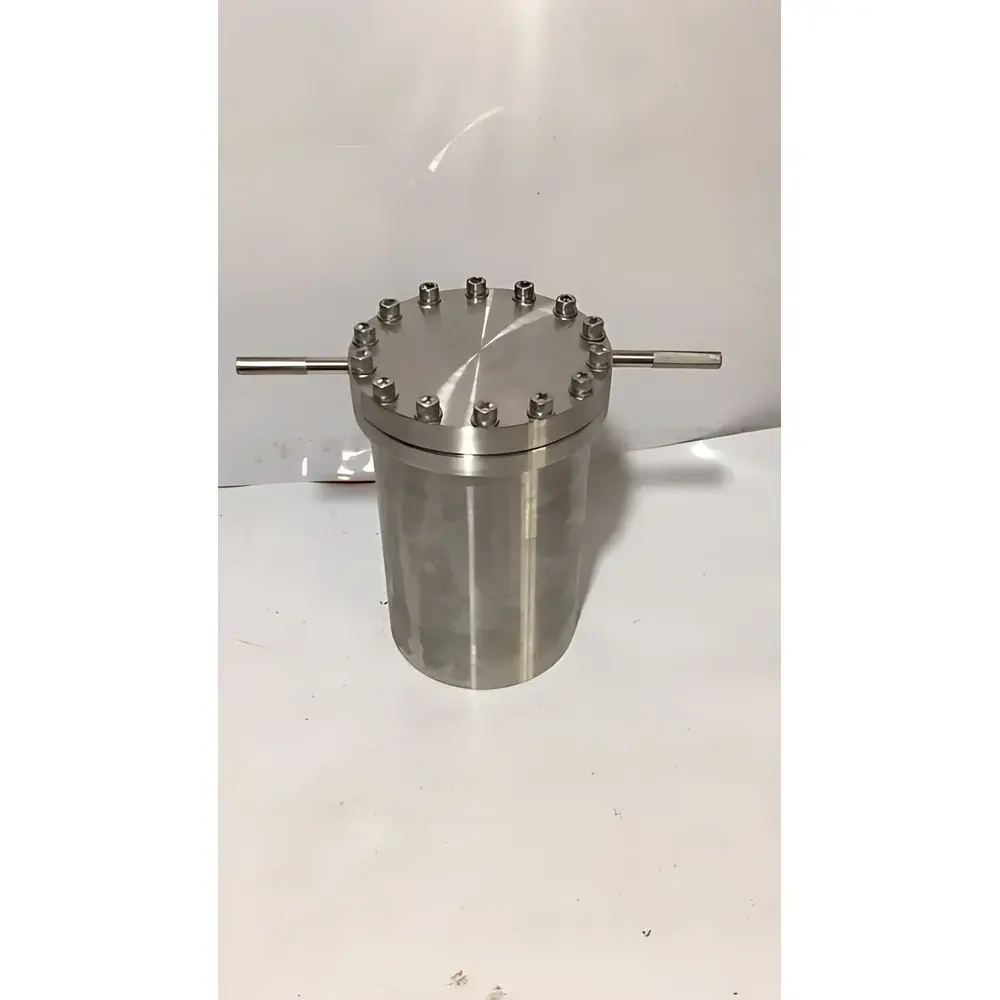
ZXYQI Flanged High-Temperature & High-Pressure Laboratory Reactor
| Brand | ZXYQI |
|---|---|
| Origin | Jiangsu, China |
| Manufacturer Type | Authorized Distributor |
| Country of Origin | China |
| Model | Flanged HT/HP Reactor |
| Usable Volume | Small-scale |
| Construction Material | Stainless Steel (316L typical) |
| Operating Pressure Class | Medium-pressure (up to 10 MPa typical for flanged design) |
| Capacity | Customizable (standard options: 25 mL–500 mL) |
| Vacuum Capability | Up to –0.1 MPa (absolute) |
Overview
The ZXYQI Flanged High-Temperature & High-Pressure Laboratory Reactor is a robust, modular batch reactor system engineered for controlled chemical synthesis, catalytic testing, hydrothermal reactions, and kinetic studies under elevated thermal and mechanical stress conditions. Designed around a dual-flange sealing architecture with precision-machined conical or spiral-wound gasket interfaces, it employs fundamental principles of pressure vessel mechanics—compliant with ASME BPVC Section VIII Division 1 design guidelines—and integrates thermally stable jacketed heating/cooling pathways. Its operational envelope typically spans temperatures from ambient to 350 °C and pressures up to 10 MPa (1450 psi), making it suitable for hydrogenation, supercritical fluid processing, polymerization initiation, and corrosion-resistant material screening in academic research labs and pilot-scale R&D facilities.
Key Features
- Flanged closure system with torque-calibrated bolting pattern ensuring repeatable seal integrity across thermal cycles
- 316L stainless steel construction as standard; optional Hastelloy C-276 or Inconel 625 liners available for highly corrosive media
- Electrically heated jacket with PID-controlled temperature regulation (±1 °C stability over full range)
- Integrated safety features including rupture disc assembly, pressure relief valve (ASME-certified), and redundant pressure transducer monitoring
- Modular port configuration: standard 1/4″ NPT or Swagelok™ fittings for gas/liquid feed, sampling, thermocouple insertion, and agitation shaft coupling
- Compatible with overhead mechanical stirrers (0–1200 rpm) or magnetic drive agitators for viscous or particulate-laden reaction mixtures
Sample Compatibility & Compliance
This reactor accommodates heterogeneous and homogeneous reaction systems—including slurries, molten salts, organic solvents, aqueous electrolytes, and reactive gases (H₂, CO, NH₃, Cl₂). All wetted surfaces meet ASTM A240 and ISO 8502-3 surface cleanliness specifications. The flange geometry conforms to EN 1514-2 and ANSI B16.5 Class 150/300 ratings. Documentation includes Material Test Reports (MTRs), hydrostatic test certification, and traceable calibration records for integrated pressure and temperature sensors—supporting GLP-compliant workflows and audit readiness per ISO/IEC 17025 requirements.
Software & Data Management
While the base model operates via analog front-panel controls, optional digital integration enables RS485/Modbus RTU or Ethernet/IP communication with LabVIEW™, MATLAB®, or custom SCADA platforms. Data logging supports time-stamped acquisition of pressure, temperature, stirrer torque, and external feed flow rates at configurable intervals (100 ms–5 s resolution). Audit trails comply with FDA 21 CFR Part 11 when deployed with validated electronic record systems; user access levels, electronic signatures, and change history are fully configurable.
Applications
- Catalyst evaluation under industrially relevant process conditions (e.g., Fischer–Tropsch, ammonia synthesis precursors)
- Hydrothermal synthesis of metal oxides, MOFs, and quantum dot nanomaterials
- Thermal stability assessment of battery electrolytes and solid-state ion conductors
- Supercritical CO₂ extraction method development and solvent screening
- Corrosion rate quantification of candidate alloys in acidic or chloride-rich environments
- Reaction calorimetry via jacket temperature differential analysis (when paired with calibrated heat transfer coefficients)
FAQ
What is the maximum recommended operating temperature for continuous use?
Continuous operation is rated to 300 °C with standard 316L construction; short-term excursions to 350 °C are permissible with derated pressure limits and verified gasket compatibility.
Can this reactor be configured for automated gas dosing and real-time headspace analysis?
Yes—integrated mass flow controllers (MFCs), gas chromatography sampling loops, and online FTIR or Raman probe ports are supported via customizable top-plate instrumentation packages.
Is third-party pressure vessel certification included?
Each unit ships with a manufacturer’s data report compliant with PED 2014/68/EU and ASME U-1 Form; optional TÜV or Lloyds Register witnessed hydrotest certification is available upon request.
How is leak integrity verified prior to first use?
A helium mass spectrometer leak test (≤1×10⁻⁹ mbar·L/s sensitivity) is performed during final QA; users receive a signed leak test certificate with serial-number traceability.
What maintenance intervals are recommended for gasket replacement and bolt torque verification?
Gaskets should be replaced after every 10 thermal cycles above 200 °C or following any overpressure event; flange bolt torque must be re-verified before each high-pressure run using a calibrated torque wrench per ISO 17025 procedures.



