
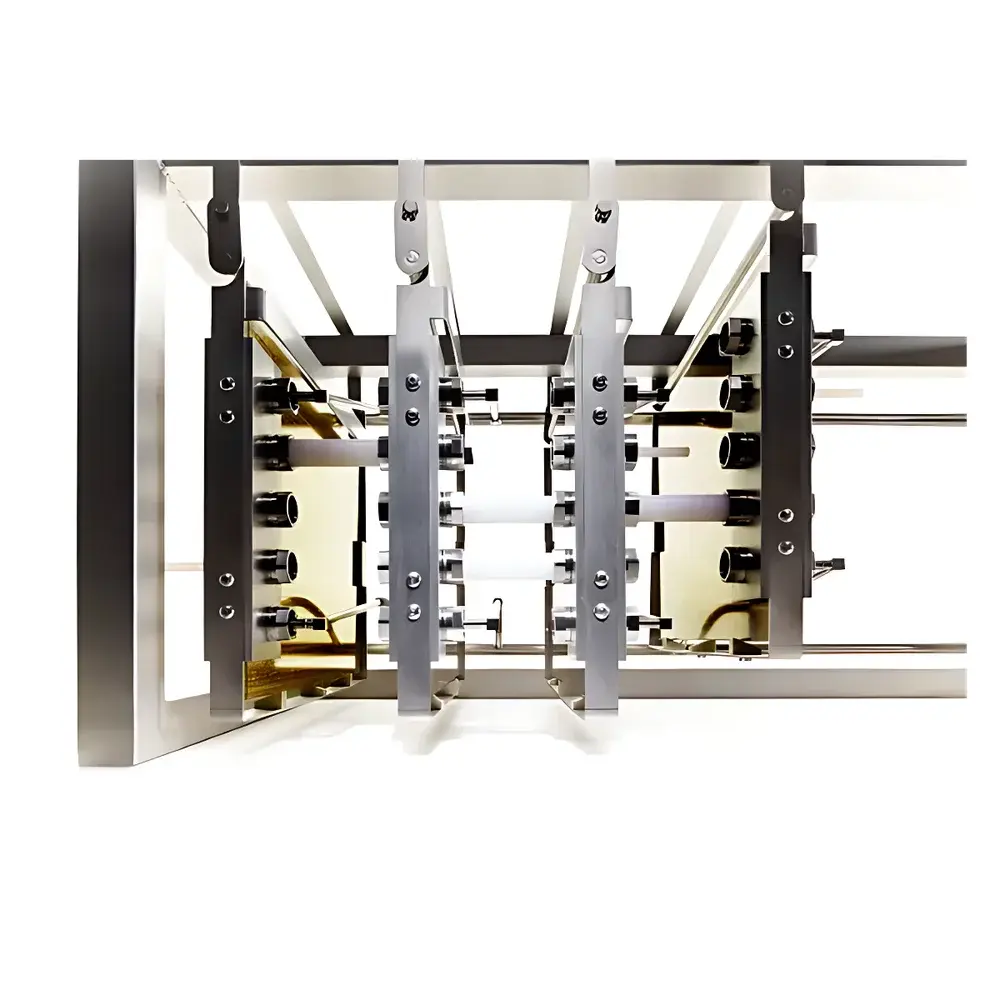
Corning G3 High-Throughput Glass/Photochemical Flow Reactor
| Brand | Corning |
|---|---|
| Origin | USA |
| Model | G3 |
| Fluid Throughput Capacity | Up to 1000 m³/year (≈1000 metric tons/year) |
| Temperature Range | –25 °C to 200 °C |
| Maximum Operating Pressure | 18 bar |
| Material | All-Glass Flow Path (Metal-Free) |
| Optical Transmission | Full UV-Vis Transparency (Quartz-Fused Silica Equivalent) |
| Modular Architecture | Interchangeable Reaction Units for Scalable Process Development |
| Photochemical Configuration | Dual-Side Illumination with Optional Wavelength-Selective LED Arrays (6 Standard Wavelengths: 365, 385, 405, 420, 450, 525 nm) |
| Thermal Management | Integrated Liquid-Cooled LED Mounting & Active Reactor Jacketing |
| Scale-Up Pathway | Direct Geometric and Kinetic Scaling from Corning G1 to G3 Platform |
Overview
The Corning G3 High-Throughput Glass/Photochemical Flow Reactor is an engineered continuous-flow platform designed for the safe, scalable, and reproducible execution of thermally sensitive, corrosive, and photochemically driven synthetic processes. Built upon Corning’s proprietary fused-silica-reinforced borosilicate glass architecture, the G3 reactor operates on the principle of segmented laminar flow with precisely controlled residence time distribution (RTD), enabling high-fidelity kinetic modeling and robust process intensification. Its all-glass fluidic pathway eliminates metal leaching—critical for catalysis involving Pd, Ni, or photoredox catalysts—and ensures compatibility with aggressive reagents including halogens, strong acids (e.g., HCl, HNO₃), oxidants (e.g., O₃, peracids), and organometallics. The system supports both thermal and photochemical reaction modes, with dual-side illumination geometry optimized for uniform photon flux delivery across the entire reaction channel cross-section. Designed for industrial transition, the G3 platform delivers a validated scale-up path from laboratory-scale G1 units through geometric similarity, identical shear profiles, and matched dimensionless numbers (e.g., Reynolds, Graetz, and Damköhler), facilitating regulatory filing under ICH Q5 and Q8 frameworks.
Key Features
- All-glass, metal-free fluidic circuit compliant with ASTM E2912–22 for corrosion resistance in aggressive chemical environments
- Dual-face optical access enabling >92% effective photon utilization (measured at 365 nm, 100 mW/cm² incident irradiance)
- Integrated liquid-cooled LED mounting system maintaining junction temperature 20,000 h LED lifetime (per IEC 62717)
- Modular reaction cartridges allowing plug-and-play configuration of mixing, residence, quenching, and phase-separation units
- Active temperature control via pressurized thermal fluid jacket (–25 °C to 200 °C; ±0.5 °C stability over 24 h)
- Pressure-rated to 18 bar (260 psi) with ASME B31.3-compliant mechanical design and traceable hydrostatic test certification
- Seamless scale-up from Corning G1 (mL/min) to G3 (L/min) using fixed dimensionless scaling parameters (Re, Fr, Da)
Sample Compatibility & Compliance
The G3 reactor accommodates a broad range of chemistries—including nitrations, halogenations, diazotizations, photocycloadditions, metallaphotoredox couplings, and enzymatic transformations—without degradation of performance or material integrity. Its optical-grade glass meets USP and ISO 10993–1 biocompatibility requirements for pharmaceutical intermediate synthesis. The system conforms to FDA 21 CFR Part 11 when paired with Corning’s validated FlowControl™ software (v4.2+), supporting electronic signatures, audit trails, and data integrity controls required under ALCOA+ principles. All pressure components carry CE marking per PED 2014/68/EU, and electrical subsystems comply with UL 61010–1 and IEC 61000–6–4 EMC standards.
Software & Data Management
Corning FlowControl™ software provides real-time monitoring of temperature, pressure, flow rate, LED intensity, and residence time distribution. It supports automated method sequencing, batch record generation (PDF/A-2b compliant), and export to LIMS or MES systems via OPC UA or CSV. Process analytical technology (PAT) integration includes optional inline FTIR and UV-Vis spectroscopy modules (via 1/4″ SMA fiber ports), enabling closed-loop feedback control per ISA-88/ISA-95 architectures. Raw sensor data is stored in SQLite databases with SHA-256 hashing and daily encrypted backups—fully traceable per 21 CFR Part 11 Annex 11 and EU GMP Annex 11 requirements.
Applications
- Continuous photoredox C–N, C–O, and C–S bond formation under GMP conditions
- High-yield synthesis of APIs requiring strict impurity control (e.g., sulfoxides, aziridines, strained heterocycles)
- Safe handling of exothermic nitration and diazonium chemistry via precise residence time control
- Multi-step telescoped sequences integrating heterogeneous catalysis, extraction, and crystallization
- Process validation studies supporting QbD-based regulatory submissions (ICH Q5, Q8, Q9)
- Accelerated reaction screening across wavelength, stoichiometry, and temperature domains
FAQ
Is the G3 reactor compatible with hydrogenation or ozonolysis?
Yes—the all-glass construction and 18 bar pressure rating support catalytic hydrogenation (with immobilized Pd/C cartridges) and ozone-mediated oxidations, provided appropriate gas–liquid mass transfer modules are installed.
Can existing G1 process methods be directly transferred to G3 without re-optimization?
Yes—Corning’s geometric and dynamic similarity protocol ensures equivalent mixing efficiency, heat transfer coefficients (h ≈ 1200–2500 W/m²·K), and photon flux profiles, minimizing requalification effort.
Does the system support PAT-integrated real-time reaction monitoring?
Yes—standard 1/4″ optical ports enable coupling with commercial inline spectrometers; full API documentation is provided for third-party integration.
What validation documentation is supplied with the G3 platform?
Each unit ships with Factory Acceptance Test (FAT) report, Installation Qualification (IQ) templates, and Operational Qualification (OQ) protocols aligned with ASTM E2500–13 and ISPE Baseline Guide Vol. 5.
Are spare glass modules available with different internal geometries (e.g., static mixers, packed beds)?
Yes—Corning offers 12 standardized cartridge types, including serpentine, microstructured, catalyst-coated, and photoactive TiO₂-functionalized variants, all qualified under the same mechanical and optical specifications.



