
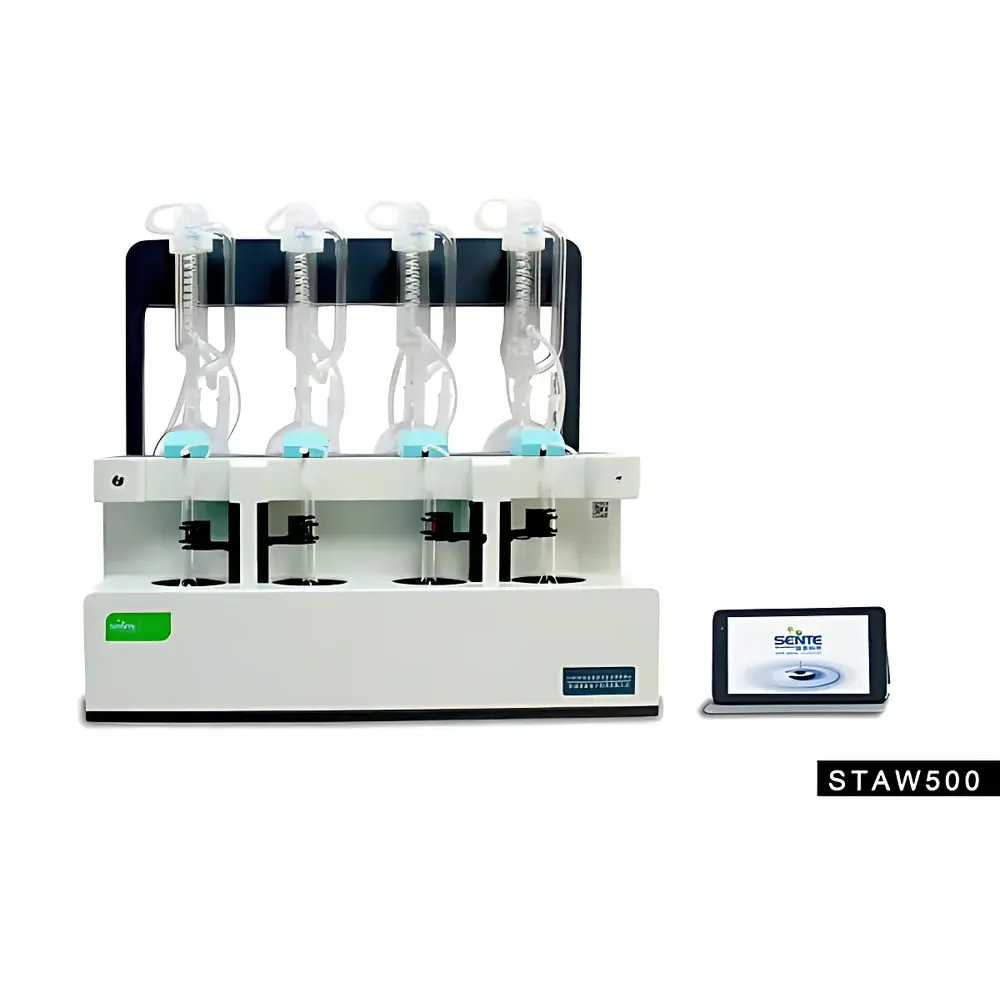
济南盛泰 STAW500 Automatic Ice-Bath Integrated Steam Distillation System
| Brand | SENTE (Jinan Shengtai) |
|---|---|
| Origin | Shandong, China |
| Manufacturer Type | OEM Manufacturer |
| Country of Origin | China |
| Model | STAW500 |
| Pricing | Upon Request |
| Heating Method | Far-Infrared Ceramic (Flame-Free, Waterproof) |
| Heating Capacity | 4 × 1000 mL Round-Bottom Flasks |
| Temperature Range | Ambient to 250 °C (per channel, independently controlled) |
| Distillation Time Range | 0–150 min |
| Endpoint Detection | Capacitive Contact Sensor |
| Endpoint Accuracy | ±2 mL |
| Cooling System | Closed-Loop Compressor-Based Internal Circulation (−10 °C to +5 °C operating range) |
| Power Supply | 220 V / 50 Hz |
| Rated Power | 3500 W (adjustable) |
| Dimensions (W×D×H) | 800 × 515 × 360 mm |
| Receiving Vessels | Standard: six 250 mL flasks |
| Optional | six 100 mL flasks |
| Safety Features | Built-in Leakage Protection Circuit |
| Compliance | Designed per GB/T 5009, GB 5009.48, GB 5009.120, and ISO 3696 Class 3 water specifications for analytical sample preparation |
Overview
The SENTE STAW500 Automatic Ice-Bath Integrated Steam Distillation System is an engineered solution for regulated, high-reproducibility steam distillation workflows requiring low-temperature condensate collection. It operates on the principle of saturated steam generation and controlled vapor-phase transfer, enabling quantitative isolation of volatile analytes—including ethanol in alcoholic beverages, N-nitrosamines in processed foods, and acetic acid derivatives—under thermally stabilized receiving conditions. Unlike conventional manual setups relying on external ice baths or recirculating chillers, the STAW500 integrates a hermetically sealed, compressor-driven cooling module directly into each receiver station. This ensures continuous sub-ambient temperature maintenance (typically 0–4 °C) throughout distillation, eliminating analyte loss via post-condensation volatilization—a critical requirement for compliance with GB 5009.48 (N-nitrosamine determination), GB/T 10345 (alcohol content in baijiu), and ISO 20275 (distillative ethanol assay). The system supports four parallel channels with independent thermal control, making it suitable for laboratories performing routine QC/QA in food safety, beverage authenticity, and regulatory testing environments.
Key Features
- Four-channel far-infrared ceramic heating platform with individual PID-controlled temperature regulation (ambient to 250 °C), eliminating open-flame hazards and offering superior moisture resistance;
- Integrated compressor-based cooling system delivering stable −10 °C to +5 °C operation at each receiver port—no external coolant, no ice replenishment, no temperature drift across multi-hour runs;
- Capacitive contact endpoint detection with ±2 mL volumetric accuracy, triggering automatic termination of heating and locking of distillate flow upon target volume achievement;
- Custom-designed 1000 mL borosilicate round-bottom flasks with optimized neck geometry and reinforced sealing interface to suppress bumping and ensure consistent steam entrainment;
- Touch-enabled 10.1-inch industrial-grade LCD HMI with intuitive workflow navigation, real-time parameter logging, and password-protected method storage;
- Self-contained closed-loop cooling architecture eliminates dependency on tap water or external chiller units—ideal for labs with limited utility infrastructure or strict water conservation protocols.
Sample Compatibility & Compliance
The STAW500 is validated for use with aqueous, alcoholic, and semi-viscous matrices compliant with national standard methods including GB 5009.48 (determination of N-nitrosodimethylamine in meat products), GB/T 10345 (ethanol content in distilled spirits), and GB 5009.120 (acetic acid and sodium acetate in vinegar and condiments). Its sealed steam path design minimizes cross-contamination risk and meets GLP-aligned sample integrity requirements. All wetted parts are constructed from borosilicate glass (DIN ISO 3585), PTFE, and 316 stainless steel—materials certified for food-contact use under EU Regulation (EC) No. 1935/2004 and FDA 21 CFR §177.2440. The system supports audit-ready operation when paired with optional time-stamped electronic logs and user-access-level controls.
Software & Data Management
The embedded control firmware supports method-based execution with up to 20 programmable profiles, each storing temperature ramp rates, hold times, target volumes, and cooling setpoints. All operational events—including start/stop timestamps, heater activation cycles, endpoint triggers, and fault codes—are recorded in non-volatile memory with UTC synchronization. Export options include CSV-formatted datasets compatible with LIMS integration (via USB or optional Ethernet module). While not natively 21 CFR Part 11-compliant, the system provides foundational traceability features required for GMP/GLP alignment: unique user login IDs, immutable event logs, and configurable audit trail retention periods (default: 90 days).
Applications
- Quantitative ethanol determination in baijiu, huangjiu, and other traditional Chinese distilled spirits per GB/T 10345–2023;
- Nitrosamine extraction from cured meats, fermented soy products, and tobacco-related matrices per GB 5009.48–2016;
- Acetic acid and sodium acetate recovery in vinegar, pickled vegetables, and food preservative assays;
- Preparative isolation of low-boiling-point volatiles (e.g., dimethyl sulfide, furfural) prior to GC or HPLC analysis;
- Standardized steam distillation for AOAC Official Method 972.13 (alcohol in wine) adaptation in regional food testing labs.
FAQ
Does the STAW500 require external cooling water or ice packs?
No—the system uses an integrated, sealed refrigeration circuit with R134a refrigerant and brushless DC compressors. It operates autonomously without tap water, dry ice, or periodic ice replacement.
Can the distillation volume be adjusted per channel?
Yes—each of the four channels supports independent endpoint programming from 10 mL to 250 mL in 1 mL increments, with capacitive sensing calibrated per flask geometry.
Is the system compatible with USP or ASTM distillation methods?
While designed primarily for GB-series standards, its steam-generation fidelity, temperature stability, and volumetric repeatability align with core performance criteria in ASTM D4052 (density of liquid petroleum products) and USP <467> residual solvents distillation prep steps.
What maintenance is required for the compressor cooling module?
Annual inspection of refrigerant pressure and condenser coil cleanliness is recommended. No consumables or scheduled refrigerant recharging is needed under normal laboratory operating conditions (25 °C ambient, ≤60% RH).
Are third-party calibration certificates available?
Yes—SETE offers optional NIST-traceable temperature and volumetric calibration reports issued by CNAS-accredited metrology laboratories, valid for 12 months from issuance.



