
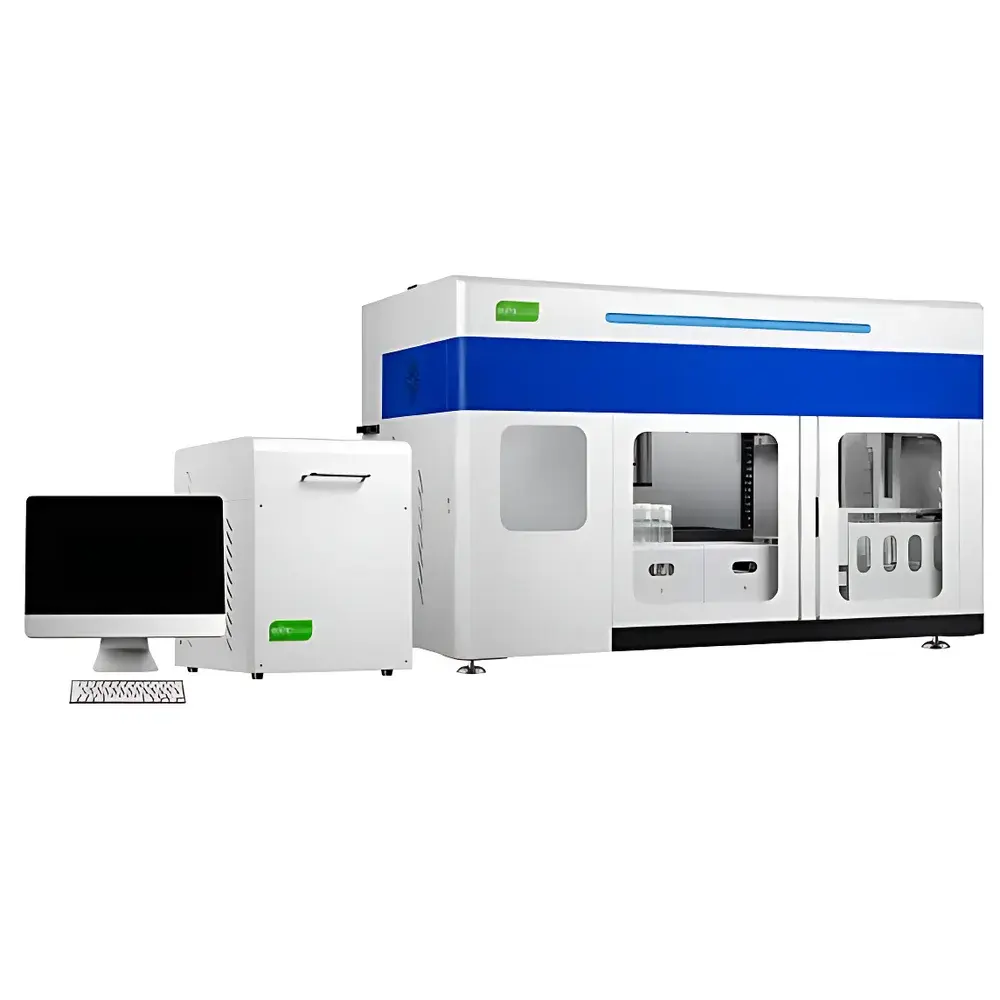
SENTE ST800L Automated Total Phosphorus and Total Nitrogen Analyzer
| Brand | SENTE |
|---|---|
| Origin | Shandong, China |
| Manufacturer Type | Direct Manufacturer |
| Product Category | Domestic Instrument |
| Model | ST800L |
| Application | Laboratory-Based Water Quality Analysis |
| Measurement Principle | Spectrophotometry (UV-Vis) |
| Measuring Parameters | Total Phosphorus (TP) and Total Nitrogen (TN) |
| Measurement Range | TP: 0.01–0.6 mg/L |
| Detection Limit | 0.01 mg/L |
| Accuracy | ≤ ±5% |
| Instrument Class | Benchtop Automated Analyzer |
| Compliance Standards | GB 11893–1989 (TP), HJ 636–2012 (TN) |
Overview
The SENTE ST800L Automated Total Phosphorus and Total Nitrogen Analyzer is a benchtop laboratory instrument engineered for precise, reproducible, and fully automated quantification of total phosphorus (TP) and total nitrogen (TN) in aqueous environmental samples—including surface water, wastewater, drinking water, and effluent streams. It implements two standardized spectrophotometric methodologies: (1) alkaline potassium persulfate digestion followed by molybdenum antimony colorimetry at 700 nm for TP (per GB 11893–1989), and (2) alkaline potassium persulfate digestion under controlled thermal conditions (120–124 °C) followed by UV absorption measurement at 220 nm and 275 nm for TN (per HJ 636–2012). The system integrates digestion, cooling, volumetric dilution, reagent addition, mixing, optical detection, and post-run cleaning into a single unattended workflow—eliminating manual intervention while maintaining strict adherence to regulatory measurement protocols.
Key Features
- Fully automated batch processing: sequential digestion, cooling, volumetric定容 (to 50 mL), homogenization, photometric measurement, and cuvette rinsing—all executed without operator input.
- Modular workflow flexibility: supports full automation or semi-automated modes—e.g., automated oxidant addition and digestion only, followed by manual transfer; or automated post-digestion steps including reagent dispensing, dilution, mixing, and analysis.
- Gentle, contamination-free mixing: replicates the “inversion mixing” protocol mandated by GB 11893–1989 using motorized sample tube inversion—avoiding air-bubble formation, volatilization loss, or cross-contamination associated with gas-driven or aspiration-based mixing.
- High-precision liquid handling: employs dual-syringe injection pumps (not peristaltic tubing) for reagent delivery, ensuring volumetric accuracy ≤ ±0.5% RSD across 0.1–5.0 mL dispense ranges.
- Intelligent digestion management: robotic lid actuation for digestion vessels, real-time temperature monitoring, and programmable hold times (1–120 min) with thermal ramp control (±1 °C).
- Auto-calibration capability: generates multi-point calibration curves (up to 8 standards) and performs intelligent proportional dilution for out-of-range samples—retaining traceability and minimizing manual recalibration.
- Multi-sample scheduling: supports staggered batch execution via sample tray zoning, enabling concurrent processing of heterogeneous sample sets (e.g., low-TN river water + high-TN industrial effluent) without inter-sample carryover.
Sample Compatibility & Compliance
The ST800L accepts standard 16 mm × 100 mm borosilicate digestion tubes and accommodates sample volumes from 5–25 mL. It is validated for use with raw wastewater, clarified effluent, groundwater, and treated potable water matrices. All analytical routines comply with national regulatory requirements for environmental laboratories in China, including mandatory reference to GB 11893–1989 and HJ 636–2012. While not certified to ISO/IEC 17025 out-of-the-box, the instrument’s audit trail logging, user-access controls, and electronic record retention support GLP-aligned validation protocols. Data export formats (CSV, PDF report, XML metadata) facilitate integration into LIMS environments compliant with ISO 17025:2017 Clause 7.5.2.
Software & Data Management
The embedded Windows-based control software provides role-based access (Administrator, Analyst, Viewer), complete with electronic signatures and time-stamped audit logs for all critical operations—including method loading, calibration, sample run initiation, and result approval. Raw absorbance data (A220, A275, A700) and processed concentration values are stored with full metadata: digestion temperature profile, reagent lot numbers, instrument ID, operator ID, and QC flag status. Software supports automatic interference correction (e.g., nitrate correction for TN via A275 subtraction), QC charting (Levey-Jennings), and customizable reporting templates aligned with municipal environmental monitoring submission formats. Data backups are configurable to network drives or encrypted USB media—meeting basic requirements for data integrity under China’s Cybersecurity Law and supporting future alignment with FDA 21 CFR Part 11 if deployed in regulated R&D settings.
Applications
The ST800L serves as a dedicated solution for routine compliance monitoring in municipal wastewater treatment plants (WWTPs), provincial environmental monitoring centers, third-party testing laboratories, and university environmental engineering labs. Typical use cases include: quarterly TP/TN discharge reporting per local ecological bureaus; source tracking of nutrient loading in watershed studies; performance evaluation of tertiary denitrification and phosphorus removal units; and method validation against reference laboratories using certified reference materials (CRMs) such as NIST SRM 1643e (Trace Elements in Natural Water). Its automation reduces analyst hands-on time by >70% compared to manual benchtop workflows—enabling higher throughput without compromising measurement fidelity.
FAQ
Does the ST800L require external UV-Vis spectrophotometer hardware?
No—the instrument integrates a dual-beam UV-Vis photometer with tungsten and deuterium light sources, optimized optical path (10 mm quartz flow cell), and thermoelectrically stabilized detector.
Can it analyze seawater or high-salinity samples?
Yes—matrix tolerance has been verified up to 35 g/L NaCl; however, chloride interference for TN requires optional post-digestion chloramine-T quenching, which can be added manually prior to analysis.
Is method validation documentation provided?
Yes—each unit ships with a Factory Performance Verification Report covering linearity (R² ≥ 0.999), repeatability (n = 6, RSD ≤ 3.2%), and recovery testing (85–115%) using CRMs.
What maintenance intervals are recommended?
Daily: optical window cleaning and waste reservoir emptying. Quarterly: syringe pump calibration verification and digestion block thermal uniformity check. Annually: full photometric wavelength validation and pressure-seal inspection of digestion chamber.
Is remote monitoring supported?
Yes—via Ethernet-connected web interface allowing real-time status viewing, run queue management, and alarm notification (SMTP/email); no proprietary cloud service required.
Related Products







