
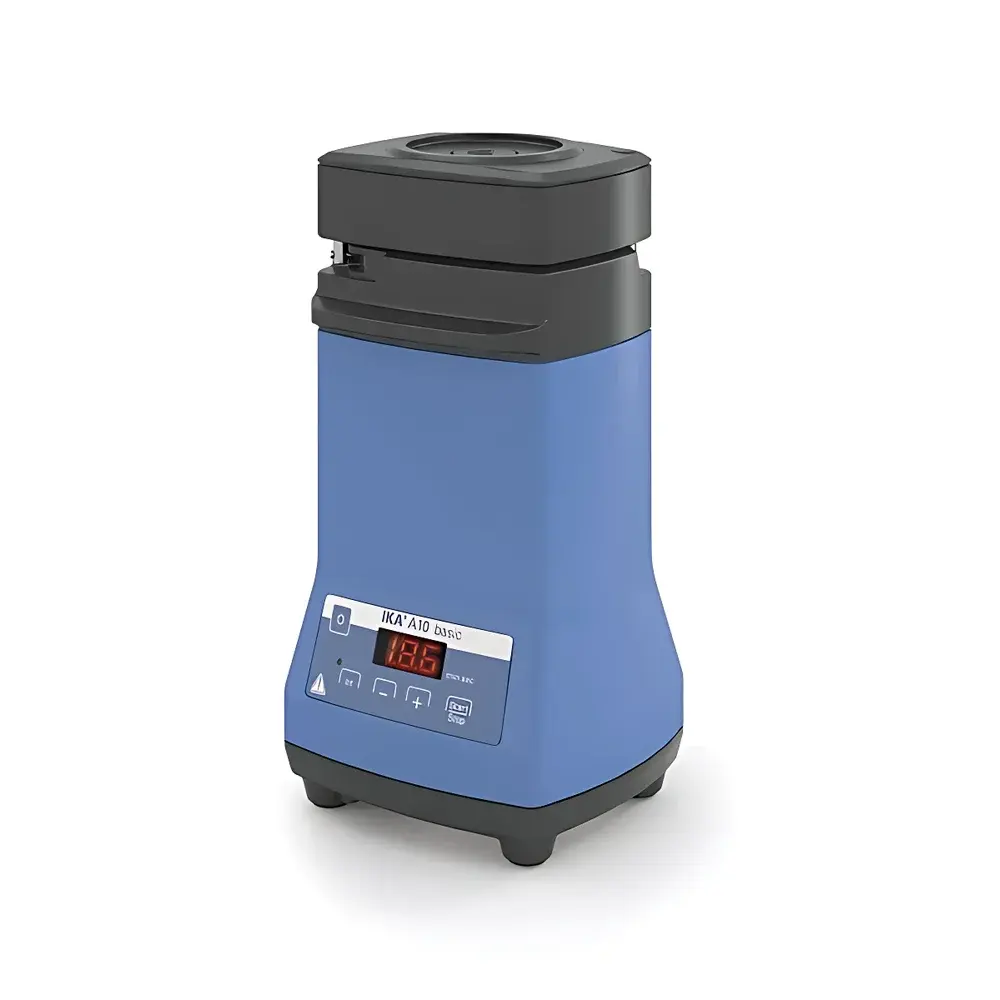
IKA A10 basic Batch Grinder
| Brand | IKA |
|---|---|
| Origin | Germany |
| Model | A10 basic |
| Instrument Type | Batch Grinder |
| Sample Applicability | Hard, brittle, soft, and fibrous materials |
| Final Particle Size | < 0.01 mm |
| Maximum Feed Hardness | 5 Mohs |
| Maximum Feed Particle Size | 6 mm |
| Grinding Chamber Capacity | 50 mL |
| Motor Input Power | 300 W |
| Motor Output Power | 240 W |
| Max. Speed | 25,000 rpm |
| Speed Tolerance | ±500 rpm |
| Max. Peripheral Speed | 73 m/s |
| Duty Cycle | 5 min ON / 10 min OFF |
| Cooling | Water-cooling compatible |
| Grinding Head Material | Stainless Steel 1.4034 |
| Grinding Chamber Material | Stainless Steel 1.4301 |
| Dimensions (W × H × D) | 130 × 250 × 145 mm |
| Weight | 3.13 kg |
| Ambient Temperature Range | 5–40 °C |
| Relative Humidity Limit | ≤80% RH |
| Ingress Protection | IP 41 (DIN EN 60529) |
| Voltage | 220–240 V |
| Frequency | 50/60 Hz |
| Drive Type | Brushless Electronic Motor |
| Control Interface | Membrane Keypad with Digital Timer |
| Safety Features | Interlocked Lid Switch, Automatic Brake, Error Code Display |
| Optional Accessories | A10.1 Impact Rotor, Reduced-Volume Rotor |
| Compliance | CE, RoHS, IEC 61000-6-3, IEC 61000-6-2 |
Overview
The IKA A10 basic is a precision-engineered batch grinder designed for reproducible, controlled size reduction of diverse laboratory samples—including hard, brittle, soft, fibrous, oily, and aqueous materials. Operating on a dual mechanical principle of high-speed impact and shear forces, the instrument delivers consistent sub-10 µm particle size distribution (PSD) under optimized conditions. Its robust stainless-steel grinding chamber (material 1.4301) and hardened rotor (1.4034) ensure chemical resistance and dimensional stability across repeated use cycles. The device is classified as a Class II electrical appliance per IEC 61010-1 and conforms to electromagnetic compatibility standards IEC 61000-6-2 (immunity) and IEC 61000-6-3 (emission), making it suitable for regulated environments including GLP-compliant laboratories.
Key Features
- Brushless electronic motor delivering 240 W output power at up to 25,000 rpm—ensuring extended service life, low acoustic emissions (<75 dB(A)), and minimal maintenance
- Interlocked safety lid mechanism: operation only permitted when lid is fully engaged; automatic brake engages immediately upon lid opening or emergency stop
- Digital timer with real-time display enables precise control of grinding duration (0–999 s), supporting method standardization and audit readiness
- Integrated cooling capability: water-jacketed chamber design allows external coolant circulation; dry-ice insertion directly into the chamber facilitates cryogenic grinding of thermolabile or waxy samples
- Modular rotor system: standard impact/shear rotor included; optional A10.1 high-impact rotor and reduced-volume rotor enable adaptation to sample mass (down to 1 mL) and hardness profiles
- Ergonomic quick-lock clamping system simplifies lid actuation and enhances operator safety during routine loading/unloading
- Error code diagnostics (e.g., E1: overload, E2: temperature limit exceeded) support rapid troubleshooting without service intervention
Sample Compatibility & Compliance
The A10 basic accommodates samples with Mohs hardness up to 5 and initial particle sizes ≤6 mm. It is routinely validated for pharmaceutical excipients (e.g., microcrystalline cellulose, lactose), geological aggregates, plant tissues, polymers, and composite powders. All wetted parts comply with FDA 21 CFR §177.2600 for indirect food contact. The unit meets CE marking requirements under Directive 2014/30/EU (EMC) and 2014/35/EU (LVD), and adheres to DIN EN 60529 for IP41 ingress protection—suitable for non-dusty, non-condensing lab environments. Routine operation falls within ISO 17025-relevant parameters when paired with traceable calibration procedures (e.g., speed verification via tachometer, temperature monitoring during cryo-grinding).
Software & Data Management
While the A10 basic operates as a standalone instrument with no PC connectivity, its digital timer and error logging provide essential data integrity features for SOP-driven workflows. Time-stamped grinding cycles and fault codes are retained in volatile memory until power-off, enabling manual entry into electronic lab notebooks (ELNs) or LIMS systems. For laboratories requiring 21 CFR Part 11 compliance, the device may be integrated into broader instrument networks via external PLC-controlled start/stop triggers and analog signal logging (0–10 V output for speed feedback, optional accessory). All operational parameters—including duty cycle adherence (5 min ON / 10 min OFF)—are documented in the user manual per ISO/IEC 17025 clause 7.2.2.
Applications
- Preparation of homogeneous powder blends prior to X-ray diffraction (XRD) or scanning electron microscopy (SEM) analysis
- Particle size reduction of API intermediates for dissolution testing per USP <711>
- Cryogenic grinding of elastomers and thermoplastics to prevent thermal degradation during SEM sample preparation
- Routine homogenization of botanical extracts and herbal matrices for HPLC assay development
- Size reduction of ceramic precursors prior to sintering studies, ensuring narrow PSD for reproducible densification kinetics
- Fragmentation of composite material cross-sections for failure mode analysis in materials science labs
FAQ
What is the maximum recommended batch volume for reproducible results?
For optimal particle size distribution and energy transfer efficiency, the nominal working volume is 10–50 mL. Volumes below 10 mL require the optional reduced-volume rotor (A10.1) to maintain rotor immersion and avoid air cavitation.
Can the A10 basic be used for cryogenic grinding with liquid nitrogen?
Direct LN₂ injection is not supported due to thermal shock risk to stainless-steel components. However, pre-chilling samples with dry ice inside the chamber (−78 °C) is validated and commonly applied for heat-sensitive organics and polymers.
Is speed calibration traceable to national standards?
Yes—speed verification using a calibrated optical tachometer (NIST-traceable) is specified in the maintenance protocol (Section 5.3 of Operation Manual Rev. 4.2). Annual verification is recommended for GLP/GMP environments.
Does the instrument support continuous operation?
No. The A10 basic is strictly a batch processor with a defined thermal duty cycle: 5 minutes active grinding followed by ≥10 minutes cooling. Continuous operation violates thermal design limits and voids warranty.
How often should the impact rotor be replaced?
Rotor lifetime depends on abrasive load and hardness. Under typical use with Mohs 3–4 materials, replacement is advised after 500–800 grinding cycles or upon visible edge rounding (>10 µm radius increase measured via profilometry).



