
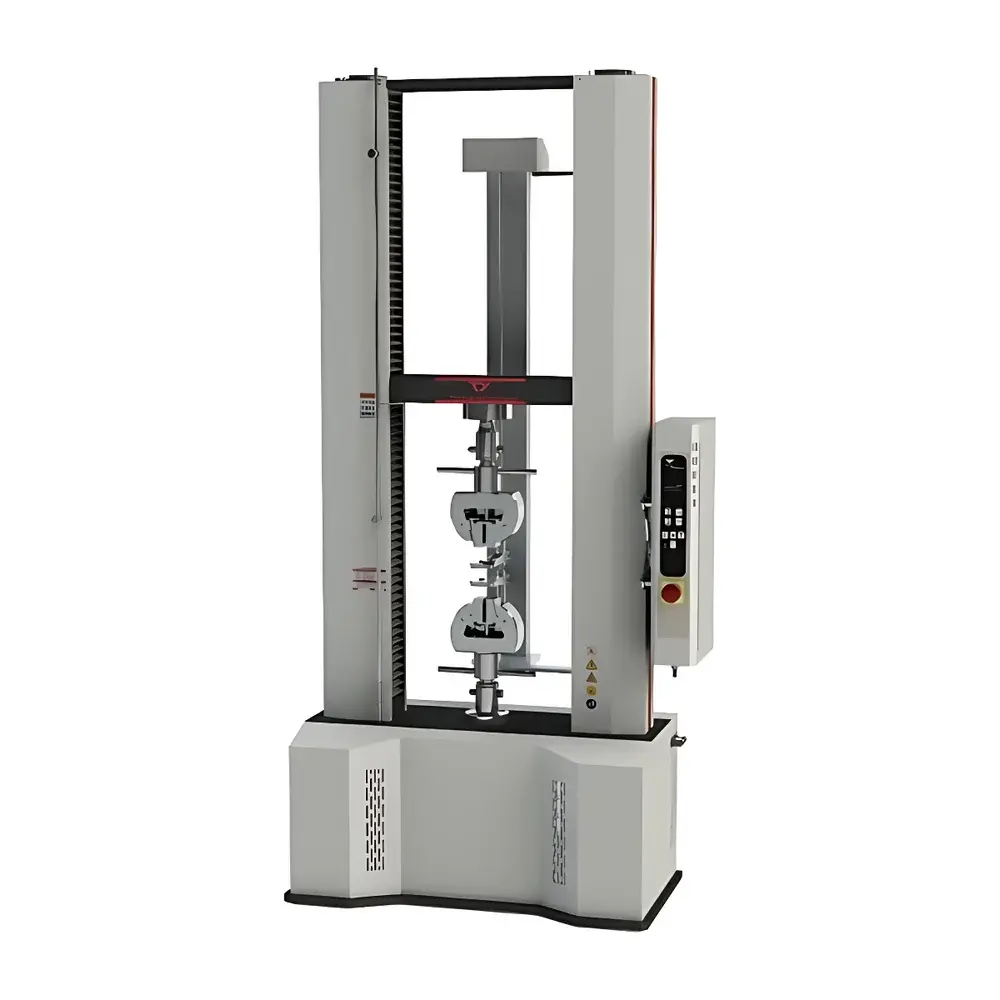
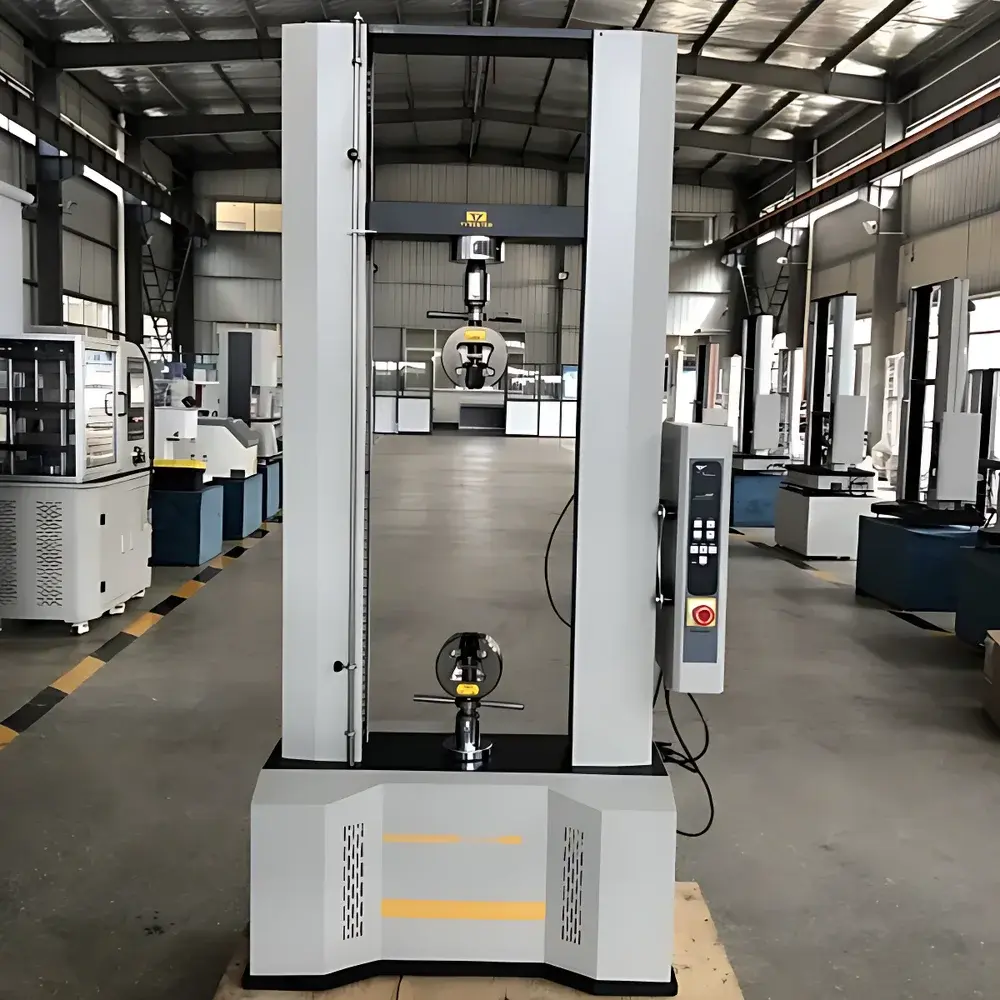
TianYuan TY8000-B Series Electronic Universal Tensile Testing Machine
| Brand | TianYuan |
|---|---|
| Origin | Jiangsu, China |
| Manufacturer Type | Direct Manufacturer |
| Product Origin | Domestic (China) |
| Model | TY8000-B |
| Instrument Type | Electronic Universal Testing Machine |
| Maximum Test Load | 50 kN |
| Force Measurement Range | 1%–100% of Full Scale (FS) |
| Force Accuracy | ≤ ±0.5% |
| Test Stroke | 980 mm |
| Displacement Resolution | 0.01 mm |
| Load Cell Resolution | 1/60,000 |
| Speed Range | 0.1–500 mm/min |
| Speed Accuracy | ≤ ±0.8% |
| Effective Width | 420 mm |
| Dimensions (W×D×H) | 920 × 430 × 1850 mm |
| Weight | 260 kg |
| Power Supply | 220 V ±10%, 50 Hz, 800 W |
Overview
The TianYuan TY8000-B Series Electronic Universal Tensile Testing Machine is a high-precision, servo-controlled mechanical testing system engineered for static mechanical property evaluation under uniaxial loading conditions. Based on the fundamental principles of Hooke’s Law and stress–strain continuum mechanics, it applies controlled displacement or load to specimens while continuously measuring force, displacement, and time-synchronized response. Designed in strict compliance with ISO 7500-1 (Class 1 accuracy), ASTM E4, ASTM E8/E8M, and GB/T 16491, the TY8000-B supports standardized tensile, compression, flexure, shear, peel, tear, and puncture testing across metallic, polymeric, composite, ceramic, and elastomeric materials. Its rigid C-frame architecture—reinforced with high-stiffness cast iron and preloaded ball screws—minimizes deflection and ensures measurement integrity across full-load cycles.
Key Features
- Servo motor-driven actuation system with planetary gear reduction, delivering high torque density, low backlash (< 0.01°), and consistent speed regulation across the full 0.1–500 mm/min range.
- Full-digital triple-closed-loop control architecture integrating DSP + MCU processors for simultaneous real-time regulation of load, displacement, and strain—enabling precise closed-loop ramp-hold, cyclic, and creep testing protocols.
- High-resolution load cell with 1/60,000 internal resolution and verified force accuracy ≤ ±0.5% FS per ISO 7500-1; calibrated traceable to national metrology institutes via NIST-traceable standards.
- Optimized mechanical rigidity: 420 mm effective test width, 980 mm usable stroke, and 260 kg mass ensure minimal frame compliance during high-force (up to 50 kN) tests.
- Integrated PC-based control and analysis platform featuring dynamic real-time curve plotting (force vs. displacement, stress vs. strain, modulus vs. time), customizable axis units (N/kN/kgf/lbf), and multi-curve overlay for comparative analysis.
- Post-test graphical processing module supporting manual baseline correction, yield point identification (0.2% offset method), tangent modulus calculation, and automatic report generation with user-defined templates.
Sample Compatibility & Compliance
The TY8000-B accommodates standard specimen geometries per ASTM D638 (plastics), ASTM E8/E8M (metals), ISO 527, ISO 6892-1, GB/T 228.1, and EN 10002-1. Optional accessories include wedge-action tensile grips, compression platens, bend fixtures, pneumatic clamps, and extensometers compliant with GB/T 12160 (Class 1). All hardware and firmware meet electromagnetic compatibility (EMC) requirements per IEC 61326-1 and safety standards per IEC 61000-6-2/6-3. The system supports audit-ready operation under GLP and GMP environments when configured with 21 CFR Part 11-compliant software modules (user authentication, electronic signatures, and immutable audit trails).
Software & Data Management
The embedded Windows-based software provides intuitive workflow navigation, parameter preset libraries for common standards (e.g., “ASTM D638 Type I”, “ISO 6892-1 Metallic Tensile”), and synchronized multi-channel data acquisition at up to 1 kHz sampling rate. Raw data is stored in binary format with embedded metadata (operator ID, timestamp, environmental conditions, calibration history). Export functions include native .xlsx reports with embedded charts, CSV for third-party statistical analysis (e.g., JMP, Minitab), and PDF with digital signature fields. Data integrity safeguards include write-once storage mode, automatic backup to network drives, and optional encrypted database logging.
Applications
This system is routinely deployed in QC laboratories for incoming material verification (e.g., aluminum alloy sheet tensile strength, PP film elongation-at-break), R&D departments evaluating novel polymer blends or biodegradable composites, and certification bodies conducting accredited mechanical testing per ISO/IEC 17025. Typical use cases include determining ultimate tensile strength (UTS), yield strength (Rp0.2), Young’s modulus, fracture toughness proxies (via J-integral estimation), adhesion strength of coated substrates, and fatigue life initiation thresholds under controlled displacement control.
FAQ
What international standards does the TY8000-B comply with for force calibration and system verification?
It meets ISO 7500-1 Class 1 for static force calibration, ASTM E4 for verification of testing machines, and GB/T 16491 for electronic universal testing machines.
Can the system be integrated into an existing LIMS or MES infrastructure?
Yes—via OPC UA or TCP/IP protocol support, enabling bidirectional data exchange with laboratory information management systems and manufacturing execution systems.
Is extensometer compatibility available, and what accuracy class is supported?
Standard configuration supports clip-on and non-contact extensometers compliant with GB/T 12160 Class 1 (≤ ±1 µm error over 25 mm gauge length).
What maintenance intervals are recommended for long-term metrological stability?
Annual force calibration and biannual mechanical inspection (ball screw lubrication, grip jaw wear assessment, alignment verification) are advised per ISO 17025 technical requirements.
Does the software support multi-user role-based access control?
Yes—administrator, operator, and reviewer roles with configurable permissions for test setup, execution, data export, and report approval.



