
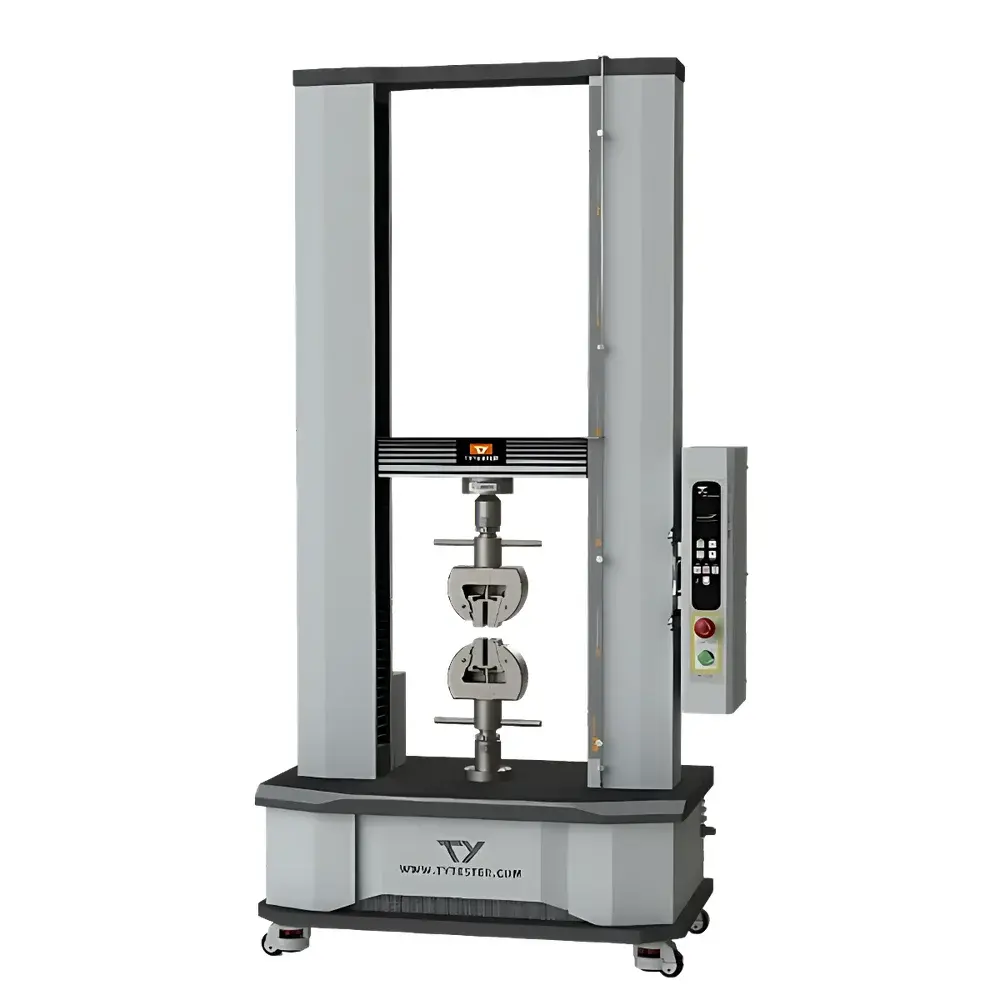
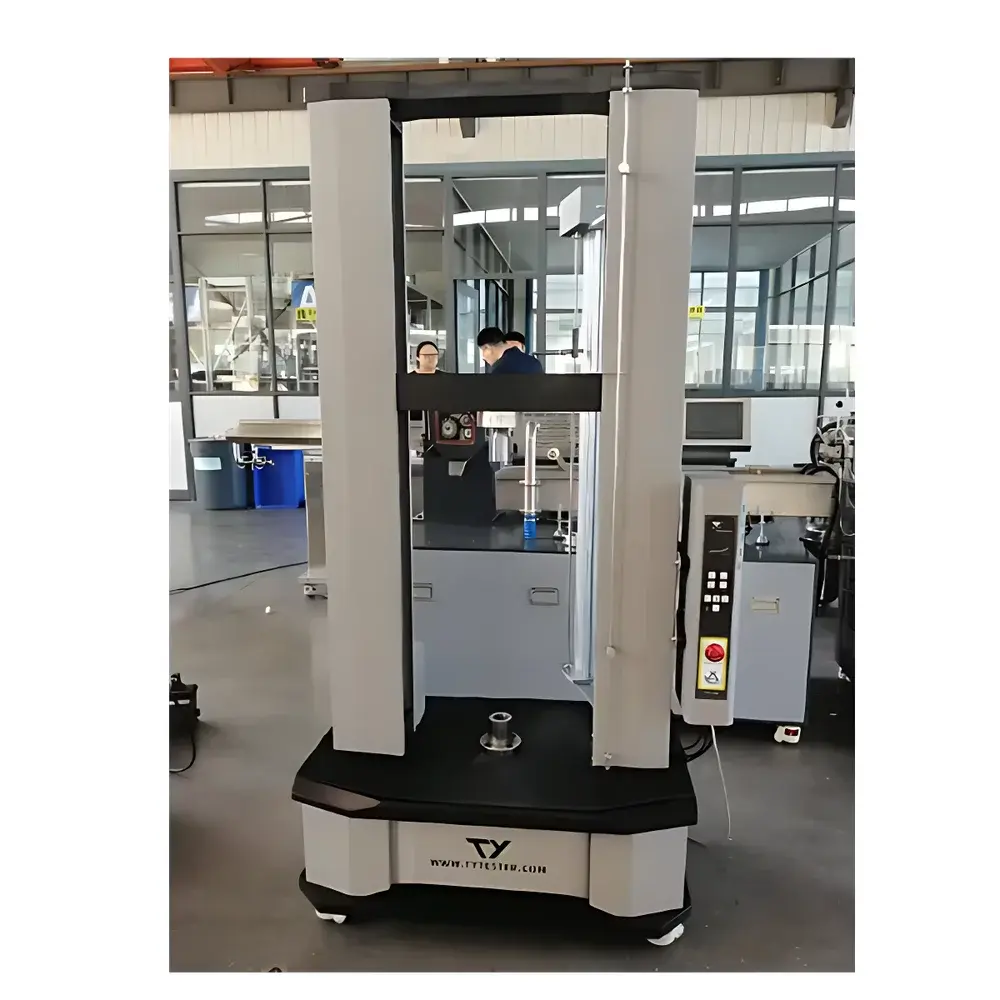
TianYuan TY8000-A 50 kN Electromechanical Universal Testing Machine
| Brand | TianYuan |
|---|---|
| Origin | Jiangsu, China |
| Manufacturer Type | Manufacturer |
| Model | TY8000-A 50 kN |
| Load Capacity | 0.02 N – 50 kN |
| Load Accuracy | ±0.5% |
| Force Resolution | 1/500,000 FS |
| Force Measurement Range | 0.4–100% FS |
| Deformation Measurement Range | 0.2–100% FS |
| Force Control Rate Range | 0.01–5% FS/s |
| Deformation Control Rate Range | 0.02–5% FS/s |
| Crosshead Travel (excl. grips) | 1000 mm |
| Effective Width | 445 mm |
| Test Speed | 0.001–500 mm/min |
| Speed Accuracy | ≤±0.3% |
| Displacement Resolution | 0.01 mm |
| Sampling Frequency | up to 1000 Hz (optional) |
| Power Supply | 220 V, 900 W |
| Dimensions (W×D×H) | 880 × 550 × 1960 mm |
| Weight | 520 kg |
Overview
The TianYuan TY8000-A 50 kN Electromechanical Universal Testing Machine is a high-precision, servo-controlled static mechanical testing system engineered for standardized tensile, compression, flexural, shear, tear, peel, and puncture testing of metallic and non-metallic materials. It operates on the principle of electromechanical force application via a closed-loop controlled servo motor driving a planetary gear reducer and preloaded ball screw assembly—ensuring minimal backlash, high positional repeatability, and long-term mechanical stability. Designed in strict compliance with GB/T 16491–2008 (Chinese national standard for electronic universal testing machines) and aligned with international metrological frameworks, the system delivers traceable mechanical property data including ultimate tensile strength, yield strength (upper/lower), Young’s modulus, secant modulus, elongation at break, energy absorption (net, return, total), and Poisson’s ratio—when used with compatible extensometry.
Key Features
- Servo-driven actuation using Panasonic industrial-grade AC servo motor and driver, delivering high torque density, low inertia response, and precise motion control.
- High-rigidity load frame with optimized structural damping, supporting maximum test loads up to 50 kN and crosshead travel of 1000 mm (excluding grip height).
- Triple-closed-loop digital control architecture based on DSP + MCU platform, enabling simultaneous real-time regulation of load, displacement, and strain—each with independent PID tuning and dynamic feedforward compensation.
- Advanced force measurement subsystem featuring IMG LOGICS precision load cell (US-manufactured), calibrated to ±0.5% accuracy across 0.4–100% full scale, with resolution down to 1 part in 500,000 FS.
- High-speed data acquisition system capable of up to 1000 Hz sampling (optional configuration), ensuring fidelity in dynamic loading profiles and transient event capture.
- Intuitive Windows-based software interface (Visit platform) with multi-curve overlay, real-time plotting, post-test curve replay, zoom/pan functionality, and customizable report templates.
Sample Compatibility & Compliance
The TY8000-A accommodates a broad spectrum of specimen geometries and material classes—including sheet metals, rods, wires, composites, plastics, elastomers, textiles, adhesives, and biomedical polymers—via interchangeable grip systems (standard tensile jaws included; optional wedge, pneumatic, hydraulic, or custom fixtures available). All mechanical calibrations and verification procedures adhere to GB/T 12160 (extensometer specifications), GB/T 16825 (verification of force-measuring systems), and ISO 7500-1:2018 (static uniaxial testing machines). The system supports full implementation of ASTM E4, ASTM E8/E8M, ISO 6892-1, ISO 178, ISO 148-1, JIS Z2241, DIN 50125, and BS EN 10002-1 test protocols. Force and displacement data logging meets GLP/GMP audit trail requirements when configured with timestamped, user-access-controlled data storage and electronic signature options per FDA 21 CFR Part 11 guidelines.
Software & Data Management
The Visit test software provides comprehensive test definition, execution, and analysis workflows under Windows OS. Users may configure complex multi-step tests—including ramp-hold, cyclic loading (low-cycle fatigue), constant-rate, constant-force, and constant-strain modes—with programmable dwell times, trigger conditions, and safety limits. Raw data is stored in proprietary binary format with embedded metadata (operator ID, calibration status, environmental tags), and exportable to CSV, Excel (.xlsx), or PDF without loss of precision. Graphical analysis tools support derivative calculations (e.g., tangent modulus), automatic yield point detection (0.2% offset, ISO method), area-under-curve integration, and comparative overlay of up to 16 curves. Audit-ready reports include header information, raw data tables, annotated stress–strain diagrams, statistical summaries, and digital signatures.
Applications
This system serves quality control laboratories, R&D centers, and third-party certification bodies requiring repeatable, standards-compliant mechanical characterization. Typical use cases include: validation of incoming raw material specifications per supplier agreements; mechanical qualification of welded joints and additive-manufactured parts; creep and relaxation behavior assessment of thermoplastics and viscoelastic biomaterials; interlaminar shear strength (ILSS) testing of fiber-reinforced composites; peel strength evaluation of pressure-sensitive adhesives; and tensile property mapping across temperature-controlled environmental chambers (when integrated externally). Its modular architecture allows future expansion with digital video extensometry, acoustic emission sensors, or high-temperature furnace modules.
FAQ
What standards does the TY8000-A comply with for force calibration?
It conforms to GB/T 16825.1–2008, ISO 7500-1:2018, and ASTM E4, with factory calibration traceable to national metrology institutes.
Can the system perform cyclic loading tests?
Yes—it supports low-cycle fatigue testing with programmable load/displacement/strain waveforms (sine, triangle, trapezoidal) and closed-loop control over frequency, amplitude, and mean value.
Is extensometry supported for strain measurement?
Standard configuration includes clip-on axial extensometers compliant with GB/T 12160 Class 1; video extensometry and laser-based non-contact options are available as upgrades.
What data security and traceability features are included?
User-level access control, time-stamped test logs, immutable data archives, and optional 21 CFR Part 11-compliant electronic signatures with audit trail generation.
How is maintenance minimized in the drive train?
The planetary gearbox (Taiwan Liming) requires no periodic lubrication, offers 10⁷ cycles—unlike conventional worm-gear alternatives.



