
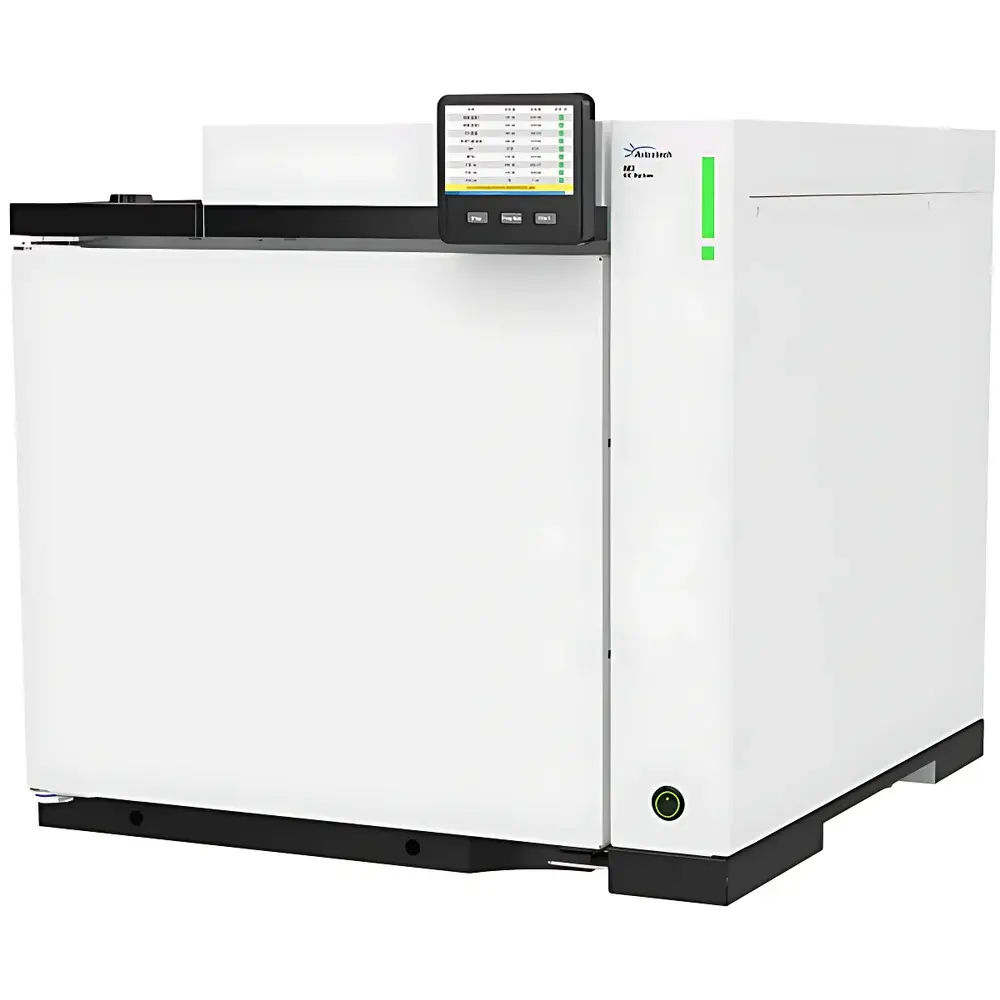
Asicotech M3 Gas Chromatograph
| Brand | Asicotech |
|---|---|
| Origin | Shanghai, China |
| Manufacturer Type | Direct Manufacturer |
| Regional Classification | Domestic (China) |
| Model | M3 |
| Price Range | USD 14,000 – 280,000 |
| Instrument Type | Laboratory Gas Chromatograph |
| Application Scope | General-Purpose |
| Oven Temperature Range | −30 °C to 450 °C |
| Oven Ramp Rate | 0–150 °C/min |
| Cooling Rate | 0–150 °C/min |
| Carrier Gas Flow Range & Control | 0–1200 mL/min |
| Carrier Gas Pressure Range & Control | 0–150 psi |
| Injector Maximum Operating Temperature | 450 °C |
| Injector Pressure Setpoint Range | 0–150 psi |
| Injector Total Flow Setpoint Range | 0–1000 mL/min |
Overview
The Asicotech M3 Gas Chromatograph is a modular, laboratory-grade analytical platform engineered for high reproducibility, method flexibility, and seamless integration into modern analytical workflows. Built upon fourth-generation Electronic Pressure Control (EPC) architecture, the M3 implements precise, digital regulation of carrier gas pressure and flow across all critical subsystems—including inlet, column oven, and detector—ensuring retention time stability ≤ 0.02% RSD and peak area precision < 1.0% RSD under routine operation. Its core separation principle relies on partitioning of volatile and semi-volatile analytes between a mobile phase (inert carrier gas, e.g., He, H₂, or N₂) and a stationary phase coated inside a fused-silica capillary column. The instrument supports both isothermal and multi-segment programmed temperature ramping, enabling resolution of complex mixtures ranging from permanent gases (e.g., O₂, N₂, CO, CH₄) to high-boiling aromatic hydrocarbons and oxygenates.
Key Features
- Modular hardware architecture: All functional units—including inlet modules (split/splitless, high-pressure liquid, multi-port gas valve, pressure-controlled), oven modules (isothermal or programmable; up to four independent ovens configurable in tandem or parallel), detector modules (FID, TCD, FPD, ECD, EPD, SCD), and auxiliary modules (purge-and-trap, headspace, SPME, thermal desorption, micro-GC systems)—are mechanically and electrically standardized for hot-swappable installation and firmware-orchestrated calibration.
- Cloud-native data processing platform: Replaces legacy workstation software with a browser-accessible, role-based analytics environment supporting method templates, expert-rule libraries, automated report generation, and audit-trail-compliant data handling aligned with FDA 21 CFR Part 11 and ISO/IEC 17025 requirements.
- Integrated EPC control system: Delivers ±0.01 psi pressure accuracy and ±0.1 mL/min flow accuracy across full operating ranges; enables gradient flow programming and backflush capability without mechanical flow splitting.
- Touch-enabled front panel interface: 10.1″ capacitive display with real-time chromatogram visualization, status monitoring, and local method editing; supports remote access via PC, tablet, or smartphone using TLS-encrypted WebSocket protocol.
- Scalable I/O and connectivity: Equipped with dual Ethernet ports (one for LAN, one for direct instrument network), USB 3.0 host/device interfaces, and optional RS-485/Modbus RTU for PLC-level integration into plant-wide SCADA or LIMS environments.
Sample Compatibility & Compliance
The M3 accommodates gaseous, liquid, and solid-phase samples through its expandable inlet and auxiliary module ecosystem. It meets ASTM D1945 (analysis of natural gas), ASTM D1946 (analysis of reformed gas), ISO 8573-5 (compressed air purity), and USP (residual solvents). All EPC components are calibrated traceable to NIST SRM standards. Firmware and software comply with GLP/GMP documentation requirements, including electronic signatures, user access levels, change control logs, and raw data immutability. No medical device certification is held; the system is not intended for clinical diagnostics or therapeutic applications.
Software & Data Management
The Asicotech CloudLink Platform serves as the central data hub—acquiring, time-stamping, and normalizing signals from all connected modules. It supports batch processing of multi-instrument datasets, statistical outlier detection, trend analysis over time-series acquisitions, and customizable PDF/Excel report exports with embedded chromatograms, calibration curves, and QC flagging. Data encryption at rest (AES-256) and in transit (TLS 1.3), along with configurable retention policies and automated backup to on-premise NAS or AWS S3, ensure compliance with enterprise IT security policies and regional data sovereignty regulations.
Applications
- Petrochemical: Full-component analysis of MTO/MTA/GTO process streams, refinery off-gases, coke oven light oil, and ethylene glycol synthesis intermediates.
- Electronics & Specialty Gases: Sub-ppb impurity profiling in ultra-high-purity Ar, Ne, Kr, Xe, SiH₄, PH₃, and NF₃ using PLOT columns coupled with pulsed discharge helium ionization detection (PDHID).
- Environmental Monitoring: Quantification of C₁–C₁₀ hydrocarbons, BTEX, chlorinated VOCs, carbonyls (via DNPH derivatization), and sulfur compounds (H₂S, COS, SO₂) in ambient air, stack emissions, and soil vapor.
- Research & Emerging Fields: Isotopic ratio analysis of light hydrocarbons (e.g., ¹³C/¹²C in CH₄), hydrazine derivatives in propellant testing, and volatile metabolite profiling in tobacco and food matrices.
FAQ
Is the M3 compliant with FDA 21 CFR Part 11 for regulated laboratories?
Yes—the CloudLink Platform includes electronic signature support, audit trail logging, and data integrity controls validated per ALCOA+ principles.
Can the M3 operate unattended for extended periods (e.g., overnight or weekend runs)?
Yes—equipped with automatic shutdown, leak detection, and power-failure recovery protocols; compatible with autosamplers supporting ≥ 160 vial capacity.
Does the system support method transfer from legacy GC platforms?
Yes—retention index mapping tools, column database import, and retention time alignment algorithms facilitate migration from Agilent, Shimadzu, or Thermo instruments.
What level of technical support and firmware update coverage is provided?
Standard warranty includes 24/7 remote diagnostics, annual calibration verification services, and quarterly firmware updates with backward-compatible method file support.
Are custom OEM integrations available for industrial OEM partners?
Yes—ASICOTECH provides SDKs, RESTful APIs, and hardware reference designs for embedding M3 modules into turnkey analytical systems.
Related Products



