
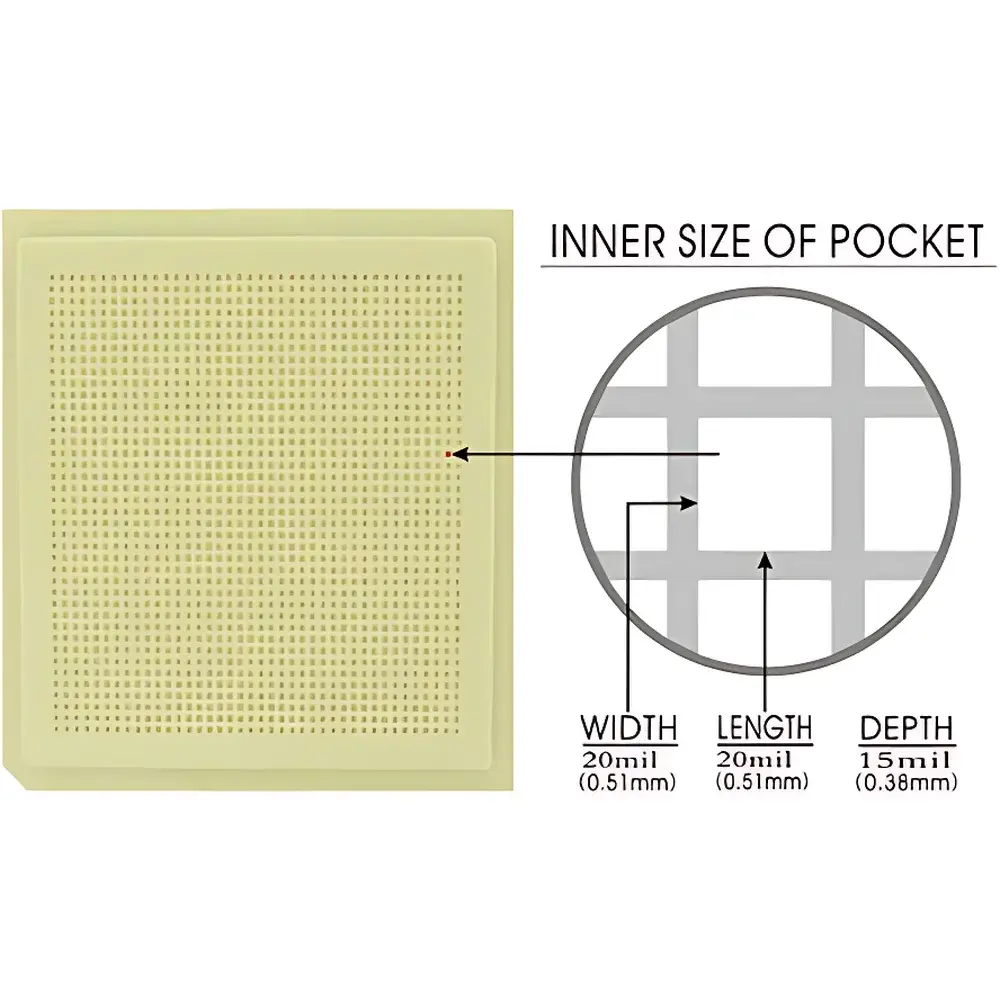
NH20-20*20-15 Quartz Crystal Microbalance Sensor Chip (QCM-D Compatible, 5 MHz Fundamental Frequency, 1600-Element Array)
| Brand | Hefei Kejing |
|---|---|
| Origin | Anhui, China |
| Manufacturer Type | Authorized Distributor |
| Origin Category | Domestic (PRC) |
| Model | NH20-20*20-15 |
| Pricing | Upon Request |
| Substrate Material | Antistatic ABS |
| Max Operating Temperature | 70 °C |
| Unit Cell Dimensions | 20 mil × 20 mil × 15 mil (0.51 mm × 0.51 mm × 0.38 mm) |
| Array Layout | 40 × 40 = 1600 elements |
| Overall Footprint | 50.67 mm × 50.67 mm × 3.94 mm |
Overview
The NH20-20*20-15 is a high-density, multi-element quartz crystal microbalance (QCM) sensor chip engineered for parallel, spatially resolved mass sensing in liquid and gas-phase environments. Designed to interface with commercial QCM-D (Quartz Crystal Microbalance with Dissipation monitoring) systems—including those from Biolin Scientific (Q-Sense), SRS, and custom-built resonator platforms—the chip operates at a fundamental resonance frequency of 5 MHz and supports simultaneous interrogation of all 1600 discrete sensing elements within a compact 50.67 mm × 50.67 mm footprint. Its antistatic ABS substrate ensures electrostatic discharge (ESD) safety during handling and integration into cleanroom-compatible instrumentation, while maintaining mechanical stability under controlled thermal conditions up to 70 °C. Unlike single-crystal QCM sensors, this array architecture enables high-throughput screening of surface adsorption kinetics, thin-film viscoelasticity, and localized binding events—critical for biosensor development, combinatorial material characterization, and real-time interface science.
Key Features
- 1600-element QCM array with uniform 0.51 mm × 0.51 mm × 0.38 mm unit cell geometry, enabling sub-millimeter spatial resolution in mass-per-area mapping
- Antistatic ABS carrier substrate—certified per IEC 61340-5-1 for ESD-safe handling in Class 100–1000 cleanrooms
- Thermally stable design validated for continuous operation at ≤70 °C, compatible with temperature-controlled QCM stages and environmental chambers
- Standardized 5 MHz fundamental frequency—fully compatible with industry-standard QCM-D electronics and impedance analyzers (e.g., Stanford Research Systems SR830, Keysight E4990A)
- Interchangeable mechanical interface: edge dimensions and mounting recesses conform to ISO/IEC 17025-aligned fixture templates used in automated QCM module loaders
- No integrated electrodes or wiring—designed for external electrode coupling via spring-pin contacts or vacuum chuck-based RF feedthroughs
Sample Compatibility & Compliance
The NH20-20*20-15 chip is intended for use with gold-, platinum-, or carbon-coated quartz resonators (AT-cut, 5 MHz), where the ABS frame serves solely as a passive mechanical support and alignment structure. It is not a standalone transducer but a precision-mounting platform for bare crystals or pre-fabricated QCM-D sensor modules. The chip complies with dimensional tolerances specified in ASTM E2581–22 (Standard Practice for Calibration of QCM Sensors) for array-based mass sensitivity validation. While the ABS material itself is non-biocompatible and not intended for direct biological exposure, it meets UL 94 HB flammability rating and RoHS Directive 2011/65/EU for restricted substances. For GLP/GMP-regulated workflows, full traceability documentation—including lot-specific dimensional inspection reports and thermal expansion coefficient verification—is available upon request.
Software & Data Management
The chip does not include embedded firmware or onboard memory. Data acquisition is fully dependent on host QCM instrumentation software (e.g., QSense Analyzer, QCM-I Control Suite, or LabVIEW-based custom DAQ). When used with synchronized multi-channel lock-in amplifiers or vector network analyzers, the 1600-element layout supports time-resolved frequency (Δf) and dissipation (ΔD) matrix generation at user-defined sampling intervals (down to 100 ms per element group). Raw data export formats include CSV, HDF5, and MATLAB .mat—enabling downstream analysis with open-source toolkits such as QCMtools or Python-based QCMpy. Audit trails, electronic signatures, and 21 CFR Part 11 compliance are enforced at the instrument-control software layer, not at the chip level.
Applications
- High-throughput screening of molecular binding affinities across immobilized ligand gradients (e.g., antibody arrays, peptide libraries)
- Spatially resolved monitoring of polymer film swelling, crosslinking, and solvent diffusion in microfluidic QCM cells
- Correlative QCM–electrochemical impedance spectroscopy (QCM-EIS) studies requiring mechanically stable, multi-site electrode alignment
- Calibration reference arrays for validating lateral homogeneity of coating thickness in sputtered or evaporated metal films
- Teaching platforms in advanced undergraduate and graduate labs focused on interfacial rheology and acoustic wave physics
FAQ
Is the NH20-20*20-15 chip pre-coated with gold or other electrode materials?
No. It is a passive mechanical substrate only. Users must mount separately fabricated AT-cut quartz crystals (typically 5 MHz, gold-sputtered, 14 mm diameter) into the array cavities.
Can this chip be autoclaved or sterilized using ethylene oxide?
No. ABS deforms above 70 °C and is incompatible with steam sterilization or EtO cycles. Surface decontamination should be limited to isopropanol wipe-down or UV-Ozone treatment.
What is the maximum recommended scan rate when interrogating all 1600 elements sequentially?
With standard QCM-D hardware and serial multiplexing, sustained acquisition at ≤2 Hz per element is achievable—yielding full-array refresh rates of ~13 minutes. Parallel readout requires custom RF switching matrices.
Does the chip support overtone measurements beyond the fundamental 5 MHz mode?
Yes—provided the mounted crystal supports harmonic excitation (e.g., 3rd, 5th, 7th overtones) and the host instrument provides appropriate drive voltage and filtering. The ABS frame introduces no acoustic damping at frequencies below 25 MHz.
Are dimensional inspection reports available for quality assurance purposes?
Yes. Certified metrology reports—including CMM-measured cavity depth uniformity (±0.005 mm), pitch tolerance (±0.01 mm), and flatness (≤2 µm PV)—are supplied with each production lot.





