
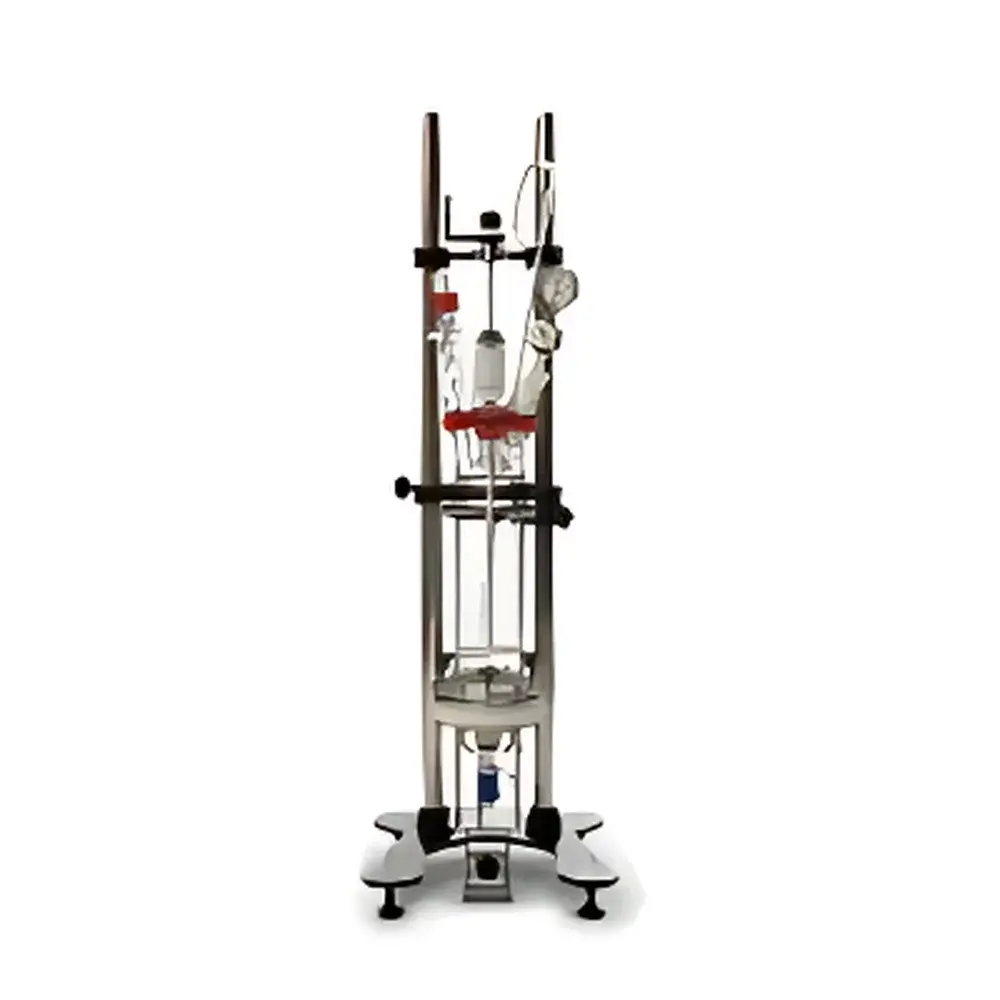
IKA 5L Pressurized Filtration Reactor with Glass Vessel
| Brand | IKA |
|---|---|
| Origin | Germany |
| Model | 5L Pressurized Filtration Reactor |
| Vessel Capacity | 5 L |
| Construction | Single-layer borosilicate glass 3.3 vessel |
| Operating Temperature Range | −90 °C to +200 °C |
| Thermal Shock Resistance (ΔT) | 110 °C |
| Pressure Rating | Full vacuum to 0.2 MPaG (2 barg) |
| Wetted Materials | Borosilicate glass 3.3, PTFE, FFKM, FKM |
| Lid Ports | 6 × standardized ground joints (SQG 29/42 × 2, SQG 24/40 × 4) |
| Maximum Stirring Speed | 200 rpm |
| Dimensions (W × D × H) | 455 mm × 432 mm × 1206 mm |
| Weight | 39 kg |
| Modular Configuration | Integrated filtration & drying capability |
| Sealing System | Reinforced magnetic or mechanical shaft seal with leak-proof base design |
| Filtration Base | Removable, pressure-rated sintered frit or filter plate assembly |
| Accessories Included | Pt100 temperature probe, analog pressure gauge, pressure relief valve, quick-connect fluid ports with integrated shut-off valves, PTFE/FFKM-sealed discharge valve |
Overview
The IKA 5L Pressurized Filtration Reactor is a modular, benchtop-scale synthesis platform engineered for controlled chemical reaction, in-situ solid–liquid separation, and vacuum-assisted drying—all within a single, sealed vessel system. It operates on the principle of pressurized filtration under inert or controlled-atmosphere conditions, enabling precise manipulation of reaction kinetics, phase separation efficiency, and solvent removal without sample transfer. The reactor’s core architecture integrates a high-integrity borosilicate glass 3.3 vessel (DIN ISO 3585 compliant), chemically resistant wetted components (PTFE, FFKM, FKM), and a mechanically reinforced sealing interface designed to maintain pressure integrity across its full operational envelope (−90 °C to +200 °C; vacuum to 0.2 MPaG). This configuration supports applications requiring strict exclusion of moisture/oxygen, crystallization under pressure, catalyst recovery, or multi-step batch processing where cross-contamination must be minimized.
Key Features
- Integrated pressure-rated filtration base with removable sintered glass or metal frit options—enabling rapid solid isolation without disassembly
- Leak-tight modular lid assembly with six standardized ground-glass ports (SQG 29/42 × 2, SQG 24/40 × 4) for flexible integration of condensers, addition funnels, gas inlets, sampling lines, or pH/DO probes
- Reinforced dual-stage shaft seal system rated for continuous operation at 200 rpm under pressure—minimizing torque-induced leakage and extending service life
- Quick-connect fluid handling system with PTFE/FFKM-sealed discharge valve and pressure-relief–integrated oil-free quick couplers—eliminating tool-dependent maintenance
- Built-in Pt100 Class A temperature sensor (IEC 60751) and calibrated analog pressure gauge (0–0.3 MPa range, ±1.0% FS) with overpressure protection per PED 2014/68/EU
- Compact footprint (455 × 432 × 1206 mm) optimized for fume hood compatibility and GMP-aligned lab layout planning
Sample Compatibility & Compliance
The reactor accommodates heterogeneous reaction mixtures containing suspensions, precipitates, slurries, or crystalline intermediates. Its all-glass + high-purity elastomer construction ensures compatibility with aggressive solvents (e.g., THF, DMF, chlorinated hydrocarbons), strong acids/bases (pH 0–14), and thermally labile compounds. All wetted materials conform to USP Class VI and FDA 21 CFR §177.1550 (PTFE) / §177.2600 (FFKM) requirements. The system meets essential safety directives including PED 2014/68/EU (Pressure Equipment Directive), EN 61000-6-3 (EMC), and EN 61000-6-2 (immunity). Optional documentation packages support IQ/OQ validation under GLP and GMP environments, including traceable calibration certificates for temperature and pressure instrumentation.
Software & Data Management
While the base configuration operates via manual controls, the reactor is compatible with IKA’s RV 10 digital controller (optional) for programmable ramp-soak temperature profiles and real-time rpm monitoring. When interfaced with third-party SCADA or LIMS platforms via 4–20 mA analog outputs (temperature, pressure), it supports audit-trail–capable data logging aligned with FDA 21 CFR Part 11 requirements. All recorded parameters—including timestamped pressure excursions, thermal cycles, and agitation duration—are exportable in CSV or PDF format for regulatory submission or internal process review.
Applications
- Catalyst filtration and recycling in homogeneous hydrogenation or cross-coupling reactions
- Crystallization and polymorph screening under controlled supersaturation and pressure
- Moisture-sensitive Grignard or organolithium chemistry requiring inert atmosphere maintenance during workup
- API intermediate isolation with minimal solvent exposure and reduced handling steps
- Process intensification studies supporting tech transfer from lab to pilot scale—leveraging geometric and dynamic similarity principles
- Stability testing of suspensions or colloidal dispersions under accelerated thermal–pressure stress conditions
FAQ
What pressure rating does the reactor support for filtration operations?
It is rated for continuous operation up to 0.2 MPaG (2 barg) during filtration, with integrated pressure relief protection set at 0.25 MPaG.
Can the filtration base be sterilized using autoclaving?
No—the borosilicate glass vessel and PTFE/FFKM components are not autoclavable; alternative sterilization methods include dry heat (≤180 °C) or solvent rinsing validated per ISO 14971.
Is the system compatible with reactive gas introduction (e.g., H₂, O₂, Cl₂)?
Yes—provided appropriate gas-handling accessories (mass flow controllers, back-pressure regulators, and explosion-proof electrical ratings) are added per ATEX/IECEx guidelines.
How is temperature uniformity maintained across the 5L volume?
Via external heating mantles or oil baths coupled with internal Pt100 feedback control; axial mixing at ≤200 rpm ensures radial homogeneity within ±2 °C under steady-state conditions.
Does the reactor meet ISO 14001 environmental compliance requirements?
The unit itself is not certified to ISO 14001, but its energy-efficient design (low thermal mass, optimized insulation) and solvent-reduction capability support institutional EMS objectives aligned with ISO 14001 Clause 6.2.



