
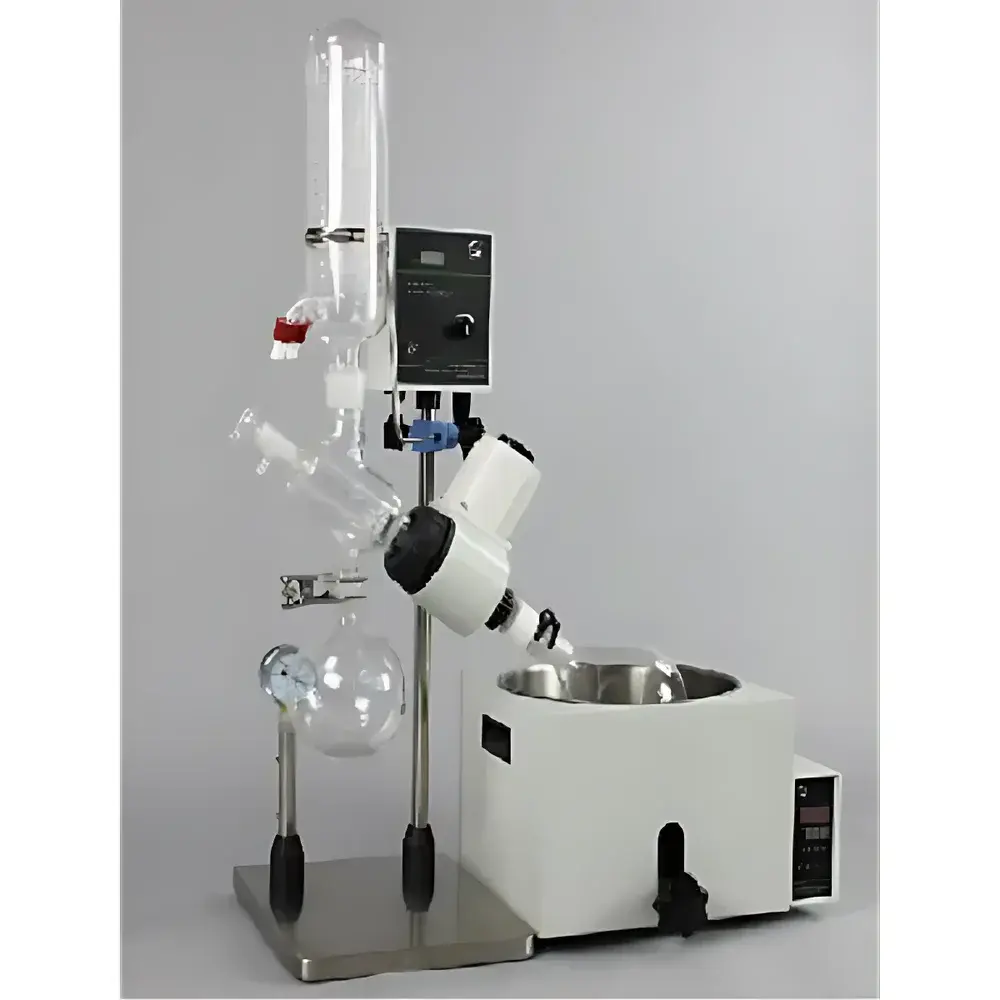
Santai RE-C2LE I Rotary Evaporator
| Brand | Santai |
|---|---|
| Model | RE-C2LE I |
| Type | Water/Oil Bath Heating Rotary Evaporator |
| Heating Bath Volume | 5 L |
| Temperature Range | 0–99 °C |
| Temperature Stability | ±1 °C |
| Heating Power | 1.5 kW |
| Rotation Speed | 0–200 rpm (infinitely variable) |
| Rotation Motor Power | 40 W |
| Lift Motor Power | 15 W |
| Lift Stroke | 150 mm |
| Voltage/Frequency | 220 V / 50 Hz |
| Bath Material | PTFE-coated stainless steel with fully enclosed heating element (230 × 120 mm) |
| Evaporation Flask | Standard 1 L (24/29 joint), optional 200–2000 mL |
| Collection Flask | Standard 1 L (35/20 ball joint) |
| Condenser | Vertical double-layer glass, 85 × 430 mm |
| Sealing System | Dual-seal with PTFE and fluorocarbon rubber |
| Continuous Feed Port | 19/22 standard taper joint |
| Temperature Sensor | PT100 platinum resistance thermometer |
| Display | Digital LED temperature readout |
| Control | Microprocessor-based intelligent temperature control |
| Frame Material | Anodized aluminum alloy |
| Glass Material | GG-17 borosilicate glass |
| Overall Dimensions (W×D×H) | 660 × 420 × 830 mm |
| Packing Volume | 0.19 m³ |
| Net Weight | 26 kg |
Overview
The Santai RE-C2LE I Rotary Evaporator is an engineered solution for efficient, reproducible solvent removal under reduced pressure in research laboratories, quality control environments, and pilot-scale synthesis workflows. Operating on the principle of thin-film evaporation, the system rotates a sample-containing flask at controlled speeds (0–200 rpm) while immersing its lower portion in a precisely regulated water or oil bath (0–99 °C). This rotation generates a uniform liquid film along the inner wall of the GG-17 borosilicate glass evaporation flask—maximizing surface area and thermal transfer efficiency. Simultaneously, a vacuum is applied to lower the boiling point of solvents, enabling gentle, low-temperature concentration or recovery without thermal degradation. The unit integrates a vertical double-layer condenser (85 × 430 mm) with high-surface-area cooling capacity, ensuring effective vapor recondensation and minimal solvent loss. Designed for operational safety and long-term reliability, the RE-C2LE I features a fully enclosed, PTFE-coated heating bath with uniform thermal distribution and a robust anodized aluminum frame.
Key Features
- Intelligent digital temperature control with PT100 sensor feedback, delivering ±1 °C stability across the full 0–99 °C range
- Infinitely variable motor-driven rotation (0–200 rpm) with precise speed regulation and low-noise operation
- Motorized vertical lift mechanism (150 mm stroke) for safe, repeatable flask immersion and removal under vacuum
- Dual-seal system combining PTFE and fluorocarbon rubber for high-vacuum integrity and chemical resistance
- Vertical condenser design optimized for spatial efficiency and consistent condensate collection
- Standard GG-17 glassware set: 1 L evaporation flask (24/29 joint) and 1 L collection flask (35/20 ball joint), both compatible with ISO-standard ground glass interfaces
- Continuous feed capability via 19/22 standard taper inlet valve, supporting uninterrupted addition of solvent or reaction mixture
- PTFE-coated stainless steel heating bath (230 × 120 mm) with fully enclosed heating elements for corrosion resistance and thermal uniformity
Sample Compatibility & Compliance
The RE-C2LE I accommodates a broad range of organic solvents (e.g., acetone, ethanol, dichloromethane, ethyl acetate), aqueous solutions, and heat-sensitive compounds typical in pharmaceutical intermediate purification, natural product extraction, and polymer synthesis. Its GG-17 glass construction resists thermal shock and common laboratory chemicals per ASTM E438 Type I, Class A specifications. The sealed heating bath and dual-fluoroelastomer sealing meet general laboratory safety requirements for operation under vacuum (≤10 mbar). While not certified to specific regulatory standards out-of-the-box, the system’s digital temperature logging capability, stable thermal performance, and traceable calibration points support alignment with GLP documentation practices and internal SOPs for method validation. Optional external vacuum controllers and cold traps may be integrated to extend compliance into GMP-relevant workflows.
Software & Data Management
The RE-C2LE I operates via an embedded microprocessor controller with real-time LED display of bath temperature and rotation speed. Though standalone (no PC connectivity), the unit supports manual data recording protocols required for audit trails: temperature setpoint, actual reading (via PT100), rotation speed, and operational duration can be logged manually or via external time-stamped video capture. For laboratories requiring electronic records, the system is compatible with third-party data acquisition modules that interface with analog outputs (e.g., 0–10 V temperature signal). All firmware logic adheres to deterministic timing behavior, ensuring repeatability across batches—critical for method transfer between R&D and QC labs.
Applications
- Concentration of dilute extracts in phytochemistry and nutraceutical development
- Solvent exchange in peptide synthesis and small-molecule API purification
- Removal of volatile reagents post-reaction in organic methodology screening
- Preparative-scale distillation of low-boiling fractions under mild conditions
- Lyophilization pre-concentration steps prior to freeze-drying
- Recycling of high-purity solvents in analytical chemistry labs (e.g., HPLC mobile phase recovery)
FAQ
What is the maximum recommended vacuum level for safe operation?
The system is rated for continuous operation at ≤10 mbar; optimal performance is achieved between 5–50 mbar depending on solvent vapor pressure and bath temperature.
Can the heating bath accommodate oil media for temperatures above 99 °C?
No—the bath is calibrated and safety-rated exclusively for water or low-viscosity silicone oils up to 99 °C. Exceeding this limit voids thermal protection and risks seal degradation.
Is the 1 L evaporation flask interchangeable with larger volumes?
Yes—flasks from 200 mL to 2000 mL (all with 24/29 standard taper joints) are mechanically and thermally compatible; load distribution must remain balanced at higher speeds.
Does the unit include vacuum pump and chiller?
No—vacuum source and coolant circulation (for condenser) are external accessories; recommended chiller range: −10 °C to +10 °C, flow rate ≥2 L/min.
How is temperature calibration verified?
A reference-grade PT100 probe (traceable to NIST or equivalent national metrology institute) can be immersed alongside the built-in sensor to validate offset; factory calibration certificate available upon request.



