
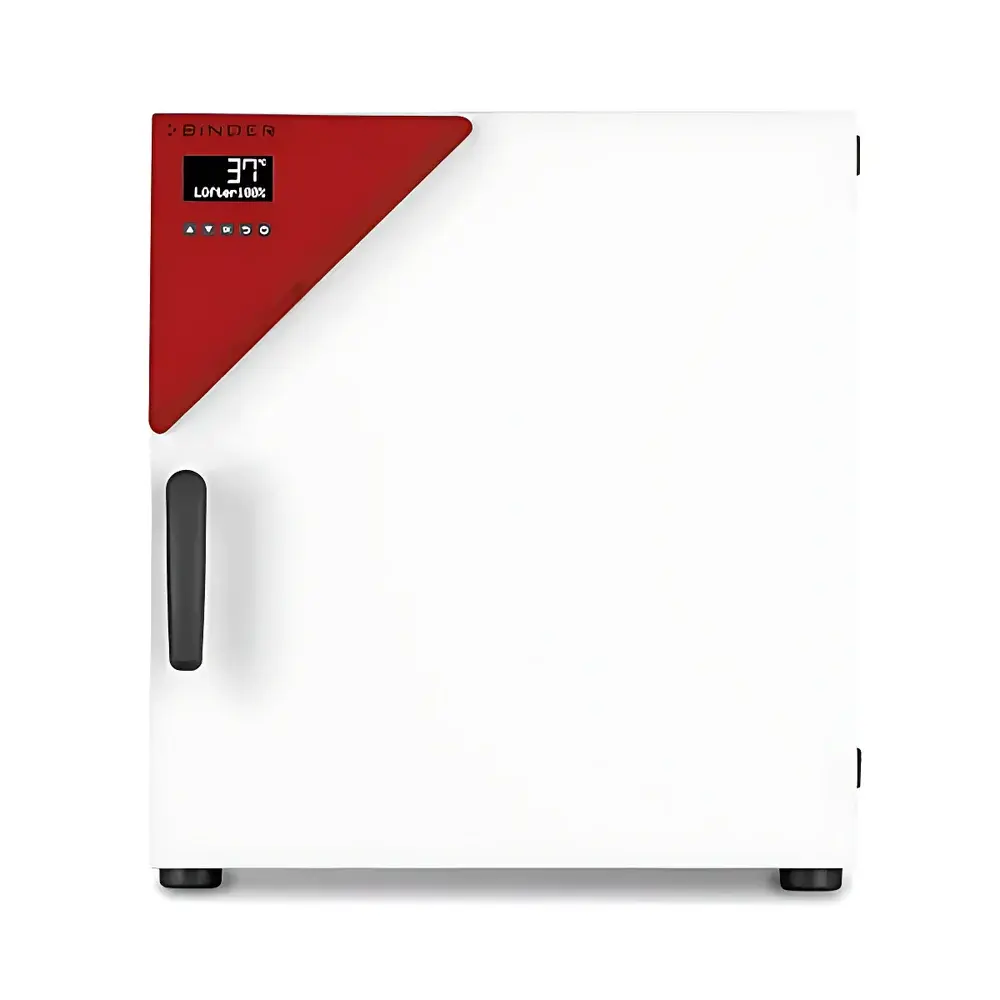
Binder BD Avantgarde.Line Free-Convection Incubator Series
| Brand | BINDER |
|---|---|
| Origin | Germany |
| Model | BD 56 / BD 115 / BD 260 / BD 720 |
| External Dimensions (W×H×D, mm) | 560×625×565 / 710×735×605 / 810×965×760 / 1165×1590×870 |
| Internal Dimensions (W×H×D, mm) | 360×420×380 / 510×530×420 / 610×760×545 / 960×1280×600 |
| Internal Volume (L) | 57 / 112 / 253 / 737 |
| Net Weight (kg) | 39 / 54 / 85 / 170 |
| Max. Total Load (kg) | 70 / 150 / 270 / — |
| Max. Load per Shelf (kg) | 30 / 30 / 40 / 40 |
| Temp. Range | Ambient +5 °C to 100 °C |
| Temp. Uniformity (±K @37°C) | 0.3 / 0.3 / 0.3 / 0.7 |
| Temp. Fluctuation (±K @37°C) | 0.1 / 0.1 / 0.2 / 0.1 |
| Heating Time to 37°C (min) | 42 / 55 / 60 / 70 |
| Recovery Time after 30s Door Opening (min @37°C) | 15 / 15 / 16 / 23 |
| Rated Power (230 V, kW) | 0.3 / 0.35 / 0.85 / 1.65 |
| Standard/Max. Shelving | 2/4 / 2/5 / 2/8 / 2/16 |
| Safety Class | Independent Temperature Safety Device Class 3.1 (DIN 12880) with Optical Alarm |
| Interior Door | Tempered Safety Glass (ESG) |
| Control Interface | LCD Display with APT.line™ Technology |
| Ventilation | Mechanical Exhaust Valve |
| Data Logging | USB Interface for Recording |
Overview
The Binder BD Avantgarde.Line free-convection incubators are precision-engineered laboratory instruments designed for reliable, uniform thermal conditioning of biological samples, cell cultures, microbiological media, and temperature-sensitive reagents. Operating on the principle of natural convection—without forced air circulation—these incubators eliminate airflow-induced desiccation and mechanical stress on delicate specimens, making them especially suitable for non-agitated static culture protocols, enzyme activity assays, and long-term stability studies where minimal environmental perturbation is critical. The series leverages Binder’s proprietary APT.line™ preheating chamber technology, which surrounds the inner chamber with a thermally insulated, independently controlled heating jacket. This architecture ensures exceptional spatial and temporal temperature stability—even during door openings or load changes—by minimizing thermal gradients and accelerating recovery dynamics. All models maintain a certified operating range from ambient +5 °C to 100 °C, supporting both routine incubation and validated dry-heat decontamination cycles compliant with ISO 14644-1 cleanroom-grade sterilization requirements.
Key Features
- APT.line™ preheating chamber technology for superior temperature uniformity (≤ ±0.3 K at 37 °C across BD 56–BD 260 models) and minimized overshoot during setpoint transitions
- Free-convection thermal management system—no internal fans or blowers—to preserve sample integrity in non-agitated applications
- Independent, DIN 12880 Class 3.1 temperature safety device with optical alarm, providing redundant overtemperature protection independent of the main controller
- Tempered safety glass (ESG) interior door for enhanced visibility, thermal insulation, and operator safety during routine observation
- Ergonomically optimized door handles and stackable chrome-plated shelves (standard: 2; expandable up to 4/5/8/16 depending on model) for modular workflow integration
- LCD-based controller with intuitive menu navigation, real-time parameter display, and programmable ramp-soak profiles
- Mechanically actuated exhaust valve for passive pressure equalization and controlled moisture retention
- USB interface enabling time-stamped data logging of temperature history (including alarms, door events, and setpoint changes) for GLP/GMP traceability
Sample Compatibility & Compliance
The BD Avantgarde.Line series accommodates a broad spectrum of life science workflows—including mammalian and insect cell culture, bacterial and fungal propagation, embryology staging, pharmaceutical stability testing (ICH Q1A–Q1E), and diagnostic reagent conditioning. Its absence of forced air eliminates shear stress on adherent monolayers and prevents evaporation artifacts in open Petri dishes or multiwell plates. Each unit is manufactured in Binder’s Tuttlingen, Germany facility under ISO 9001-certified quality management systems and conforms to IEC 61010-1 (Safety Requirements for Electrical Equipment for Measurement, Control, and Laboratory Use). The 100 °C dry-heat cycle satisfies EN 55011 emission standards and supports validation against USP sterility assurance requirements when integrated into documented cleaning and decontamination SOPs. Optional calibration certificates (traceable to PTB/NIST) and IQ/OQ documentation packages are available for regulated environments requiring FDA 21 CFR Part 11–compliant audit trails.
Software & Data Management
Data acquisition and archival are facilitated via the built-in USB port, allowing direct export of CSV-formatted temperature logs—including timestamps, measured values, alarm states, and user-triggered events (e.g., door openings, setpoint modifications). While no proprietary software is required for basic logging, Binder’s optional BINDER Software Suite (v5.x) enables remote monitoring, multi-device fleet management, automated report generation, and electronic signature support aligned with ALCOA+ data integrity principles. All logged parameters meet minimum retention requirements for GLP audits and can be exported for integration into LIMS or ELN platforms via standard file import protocols.
Applications
- Long-term static incubation of primary cell isolates and stem cell lines without agitation-induced differentiation
- Thermal conditioning of agarose gels, electrophoresis buffers, and enzymatic reaction mixtures prior to assay initiation
- Stability testing of biologics, vaccines, and diagnostic kits under ICH-defined storage conditions
- Dry-heat decontamination of glassware, stainless steel tools, and non-porous labware at 100 °C for ≥30 minutes
- Environmental simulation for entomological or botanical developmental studies requiring stable, low-turbulence thermal fields
- Pre-warming of culture media, serum supplements, and sterile solutions immediately prior to use in aseptic workstations
FAQ
What distinguishes free-convection operation from forced-air incubation?
Free-convection incubators rely solely on natural thermal buoyancy for heat distribution—eliminating fan-driven airflow that may cause desiccation, vibration, or localized cooling in open vessels. This is optimal for static cultures, gel solidification, and moisture-sensitive protocols.
Is the BD series compatible with CO₂ or humidity control?
No—the BD Avantgarde.Line series is strictly a dry, temperature-only incubator. For CO₂ or humidified environments, refer to Binder’s CB or C Series CO₂ incubators or the HPP series humidity chambers.
Can the USB data logger record events beyond temperature?
Yes—it captures door-open duration, alarm triggers (overtemp, sensor fault), setpoint changes, and controller power cycles—all time-stamped with millisecond resolution.
What validation support is provided for GxP-regulated labs?
Binder supplies factory calibration reports, IQ/OQ templates, and optional 3Q certification services performed by qualified field engineers—fully aligned with ISO/IEC 17025 and ASTM E2500 guidance.
Are replacement shelves and accessories available separately?
Yes—chrome-plated shelves, shelf supports, castor kits, and ESG door replacements are stocked globally and shipped with serialized traceability documentation.





