
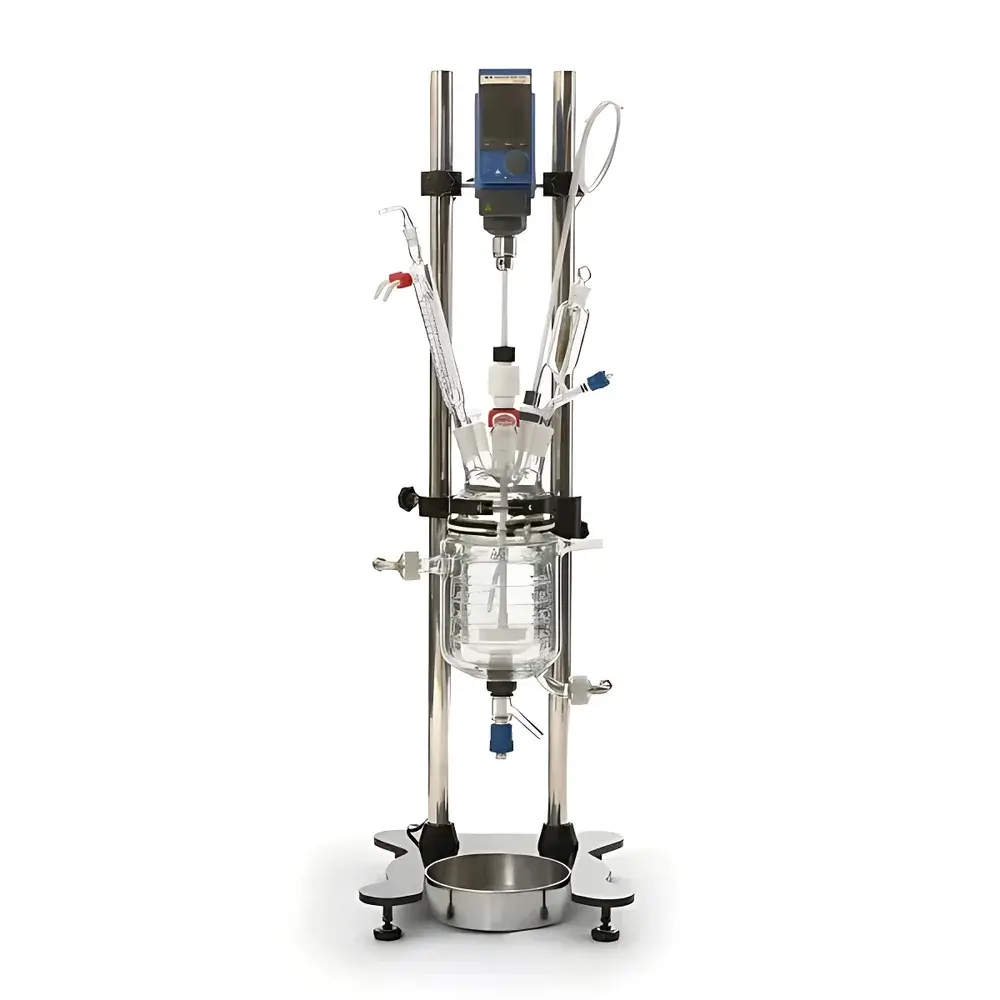
IKA 5L Dual-Jacketed Baffle-Equipped Laboratory Reactor with Vacuum Insulation
| Brand | IKA |
|---|---|
| Origin | Germany |
| Model | 5L Dual-Jacketed Baffle-Equipped Reactor |
| Capacity | 5 L |
| Jacket Type | Dual (inner heating/cooling jacket + outer vacuum insulation layer) |
| Operating Temperature Range | −90 °C to +230 °C |
| Thermal Shock Limit (ΔT) | 60 °C |
| Pressure Range | 666 Pa (0.5 mbar) to atmospheric pressure |
| Wetted Materials | Borosilicate Glass 3.3, PTFE, FFKM, FKM |
| Lid Ports | 6 (SQG 29/42 ×1, TS 29/42 ×1, TS 24/40 ×4) |
| Max Stirring Speed | 800 rpm |
| Dimensions (W×D×H) | 380 mm × 380 mm × 1206 mm |
| Weight | 28 kg |
Overview
The IKA 5L Dual-Jacketed Baffle-Equipped Laboratory Reactor is an engineered platform for precise, scalable, and thermally demanding reaction workflows in R&D laboratories. Designed around Couette-type mixing dynamics and controlled convective heat transfer, this reactor integrates a dual-jacket architecture—comprising an inner process jacket for active thermal regulation and an outer vacuum-insulated annulus—to minimize parasitic heat exchange with ambient environments. Its borosilicate glass 3.3 vessel ensures optical clarity for real-time visual monitoring, chemical inertness toward aggressive reagents (e.g., strong acids, organometallics, halogenated solvents), and mechanical robustness under combined thermal and vacuum stress. The integrated baffle system within the inner jacket promotes uniform radial flow distribution, mitigating laminar dead zones and enhancing thermal homogeneity across the 5 L working volume—critical for exothermic or cryogenic reactions where localized hot/cold spots compromise reproducibility.
Key Features
- Dual-jacket configuration: Inner jacket for precise fluid-based heating/cooling (e.g., silicone oil, ethanol/water, liquid nitrogen slurry); outer high-vacuum layer (<10⁻² mbar) for thermal decoupling—reducing external heat gain during cryogenic operation and minimizing energy loss at elevated temperatures.
- Baffle-optimized inner jacket geometry: Helically arranged internal baffles direct thermal fluid flow axially and radially, increasing effective heat transfer coefficient by up to 35% compared to unbaffled jackets (per ASTM E2847 thermal performance validation protocols).
- Chemically resistant wetted path: All fluid-contact surfaces consist of Class A borosilicate glass 3.3 (DIN ISO 3585), PTFE-sealed joints, and FFKM gaskets rated for continuous service from −40 °C to +200 °C—ensuring compatibility with corrosive, oxidizing, and moisture-sensitive chemistries.
- Modular lid interface: Six standardized ports (including two SQG 29/42 for condensers/reflux lines, one TS 29/42 for temperature probe insertion, and four TS 24/40 for pH electrodes, sampling needles, gas inlets, or pressure transducers) support GLP-compliant sensor integration and multi-parameter process monitoring.
- Tool-free assembly & leak-tight sealing: Cam-lock clamping mechanism with calibrated torque feedback ensures repeatable compression of FFKM seals; bottom discharge valve features conical PTFE seat and zero-dead-volume design for quantitative transfer without cross-contamination.
Sample Compatibility & Compliance
This reactor accommodates heterogeneous, viscous, and gas-evolving reaction mixtures—including slurries, polymerizations, hydrogenations, and low-temperature lithiations—without compromising thermal stability or mechanical integrity. Its construction complies with DIN 12575 (laboratory glass apparatus), PED 2014/68/EU (for vacuum-rated components), and ISO 8573-1:2010 (compressed air purity, applicable to pneumatic actuation options). When operated with validated temperature probes and data-logged parameters, it supports audit-ready documentation per FDA 21 CFR Part 11 requirements when paired with compliant software platforms.
Software & Data Management
While the base unit operates via analog/manual controls, optional digital modules—including IKA’s RV 10 control unit or third-party PID controllers—enable programmable ramp/soak profiles, real-time logging of jacket temperature, stirring speed, and internal probe readings. All digital interfaces generate timestamped, immutable records with user authentication, electronic signatures, and change history—fully traceable for GMP/GLP audits. Export formats include CSV and PDF reports aligned with ALCOA+ principles (Attributable, Legible, Contemporaneous, Original, Accurate, Complete, Consistent, Enduring, Available).
Applications
- Kinetic studies of highly exothermic Grignard or n-BuLi additions under −78 °C conditions, leveraging vacuum-jacketed thermal inertia to suppress thermal runaway.
- Scale-down modeling of industrial hydrogenation processes, where baffle-enhanced heat transfer fidelity enables accurate prediction of ΔT profiles during catalyst activation.
- Synthesis of shear-sensitive biopolymers (e.g., alginate derivatives), utilizing low-shear anchor or helical ribbon impellers mounted on the 800 rpm variable-speed drive.
- Multi-step telescoped reactions requiring sequential reagent addition, inert atmosphere maintenance (via N₂/Ar purge through TS ports), and inline FTIR probe coupling.
- Pre-formulation studies of pharmaceutical intermediates under strict moisture- and oxygen-controlled environments—enabled by FFKM/PTFE sealing and <10⁻² mbar vacuum hold capability.
FAQ
What vacuum level does the outer jacket maintain during operation?
The outer vacuum annulus is designed for long-term static vacuum retention below 10⁻² mbar using integrated non-evaporable getter (NEG) strips; no active pumping is required during standard operation.
Can the reactor be used under positive pressure?
No—this model is rated exclusively for vacuum-to-atmospheric pressure operation (666 Pa to 101.3 kPa); positive pressure applications require alternative IKA reactor variants with reinforced glass and ASME-certified pressure vessels.
Is the temperature probe included with the system?
A calibrated Pt100 RTD probe with 1.5 m cable and PG13.5 thread is supplied as standard equipment and inserts directly into the designated TS29/42 port.
How is cleaning and residue removal validated for GMP use?
The zero-dead-volume discharge valve, absence of crevices in the glass body, and PTFE-coated impeller shaft enable rinse efficiency verification per USP methodology; swab recovery studies confirm <0.1 µg/cm² residual limits for API synthesis.
Does the baffle design affect stirring power consumption?
Yes—baffle-induced turbulence increases torque demand by ~12–18% versus unbaffled operation at equivalent Reynolds numbers; the integrated IKA RW20 overhead stirrer is derated accordingly and includes overload protection.



