
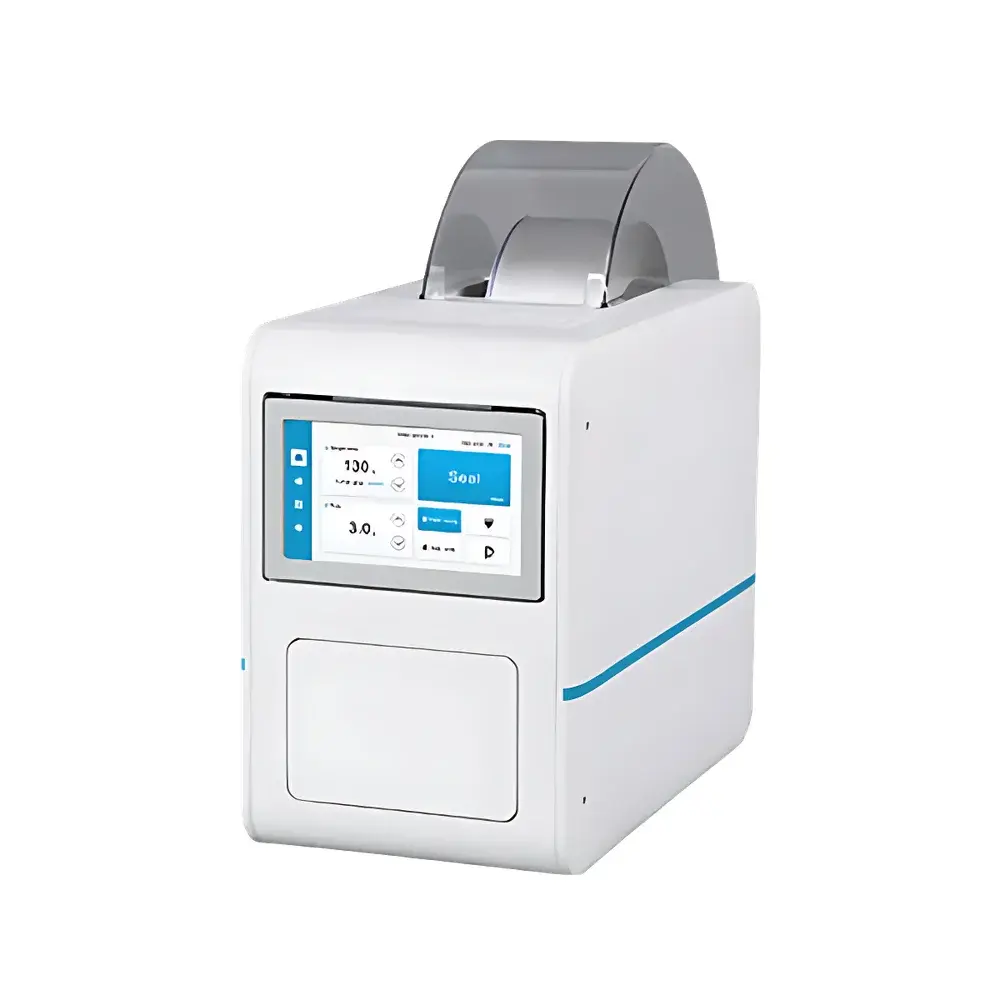
Allsheng SealBio-1 Automated Microplate Heat Sealer
| Brand | Allsheng |
|---|---|
| Origin | Zhejiang, China |
| Model | SealBio-1 Automated Microplate Heat Sealer |
| Temperature Range | Ambient to 200 °C (±1 °C accuracy) |
| Temperature Adjustment | 1 °C increments |
| Preheat Time | 5 min |
| Cycle Time | <20 s per plate |
| Sealing Time Adjustment | 0.5–9.9 s (0.1 s resolution) |
| Compatible Plate Heights | 3–62 mm |
| Plate Standards | ANSI/SBS-compliant (12-, 24-, 48-, 96-, and 384-well formats) |
| Roll Film Width | 78 mm |
| Film Types | Piercable film, aluminum foil, high-strength thermal sealing film |
| Loading | Automatic pre-load roll mechanism |
| Integrated Air Source | Yes (no external compressor required) |
| Interface | 7″ capacitive touchscreen (1024×600), USB-B port, Ethernet port |
| Power | AC 100–240 V, 50/60 Hz |
| Max Power Consumption | 300 W |
| Safety Features | Plate presence detection, film presence detection, standby mode (low-power idle) |
Overview
The Allsheng SealBio-1 Automated Microplate Heat Sealer is an engineered solution for high-integrity, reproducible thermal sealing of standard microplates in life science laboratories, clinical diagnostics workflows, and biopharmaceutical quality control environments. Utilizing resistive heating elements with closed-loop PID temperature control, the instrument delivers precise, uniform thermal energy across the entire sealing surface—ensuring consistent bond formation without plate warping or film delamination. Designed specifically for ANSI/SBS-compliant microplates (12- to 384-well), it accommodates variable-height plates—from shallow PCR plates (≥3 mm) to deep-well storage plates (up to 62 mm)—without manual adjustment. Its integrated pneumatic system eliminates dependency on external air compressors, reducing footprint and infrastructure requirements while maintaining stable sealing pressure across diverse film types.
Key Features
- Programmable temperature range from ambient to 200 °C with ±1 °C thermal stability and 1 °C resolution—enabling optimization for low-melt piercable films or high-adhesion aluminum laminates.
- Automated roll-film pre-loading mechanism with 78 mm width compatibility, minimizing operator intervention and ensuring continuous throughput during batch processing.
- Sub-20-second sealing cycle time per plate, supporting high-volume workflows such as reagent pre-aliquoting, qPCR setup, and biobank sample archiving.
- 7-inch high-resolution capacitive touchscreen interface (1024×600) with intuitive graphical workflow navigation, real-time status feedback, and multi-language support (English, Chinese, Spanish).
- On-device program storage for up to 50 user-defined sealing protocols—including temperature, dwell time (0.5–9.9 s, 0.1 s increments), and pressure profile—enabling rapid recall and audit-ready parameter consistency.
- Dual-sensor safety architecture: integrated plate presence detection and film depletion monitoring prevent dry-heating events and ensure process continuity.
Sample Compatibility & Compliance
The SealBio-1 accepts all ANSI/SBS-standard microplates within the 3–62 mm height envelope, including thin-wall PCR plates, skirted and semi-skirted 96-well plates, V-bottom and U-bottom assay plates, 384-well high-density plates, and deep-well storage plates (e.g., 2 mL capacity). It supports three certified film classes: piercable polypropylene-based films (for downstream pipetting access), metallized aluminum laminates (for long-term vapor barrier integrity), and high-tack polymer films (for solvent-resistant sealing in ELISA or cell culture applications). The device complies with IEC 61010-1:2010 for laboratory electrical equipment safety and meets electromagnetic compatibility (EMC) requirements per EN 61326-1:2013. While not a regulated medical device, its repeatable sealing performance supports adherence to GLP documentation standards and facilitates integration into FDA 21 CFR Part 11–aligned environments when paired with validated LIMS or ELN systems.
Software & Data Management
The embedded firmware provides local protocol editing, execution logging, and timestamped event history (e.g., seal start/end time, temperature setpoint, actual dwell duration, plate ID if barcode-scanned via optional peripheral). All logs are exportable via USB-B to CSV format for traceability. Ethernet connectivity enables remote monitoring and centralized fleet management in core facilities. The interface supports audit trail configuration—recording user login, parameter changes, and seal completion events—with tamper-evident timestamps. No cloud dependency is required; data remains on-device unless explicitly exported. Firmware updates are delivered via signed USB packages to maintain system integrity and version control.
Applications
- Pre-analytical sealing of qRT-PCR and digital PCR reaction plates prior to thermal cycling.
- Long-term cryogenic storage preparation of compound libraries and clinical biospecimens using vapor-barrier aluminum films.
- High-throughput reagent dispensing lines where sealed plates undergo automated liquid handling, centrifugation, and incubation.
- QC release testing in IVD manufacturing, ensuring seal integrity meets internal specifications for leak resistance and thermal stability.
- Biobanking operations requiring ISO 20387-compliant sample encapsulation workflows with full parameter traceability.
FAQ
Does the SealBio-1 require an external air compressor?
No—the instrument includes a built-in, oil-free diaphragm air source rated for continuous duty at pressures sufficient for uniform film adhesion across all supported plate geometries.
Can I validate sealing parameters for regulatory submissions?
Yes—each sealing cycle records temperature, dwell time, and plate presence data locally; these logs are exportable and support IQ/OQ documentation when used with defined SOPs and calibration schedules.
Is the touchscreen interface compatible with glove use in biosafety cabinets?
The capacitive screen responds reliably to standard nitrile and latex gloves; no stylus is required for routine operation.
What maintenance is required for long-term reliability?
Annual verification of temperature sensor calibration and periodic cleaning of the heat platen surface with isopropyl alcohol are recommended; no consumable parts beyond film rolls are specified.
How does the system detect improper plate placement?
Dual infrared proximity sensors confirm both plate presence and approximate height before initiating the sealing sequence, preventing misfires or incomplete seals.
Related Products





