
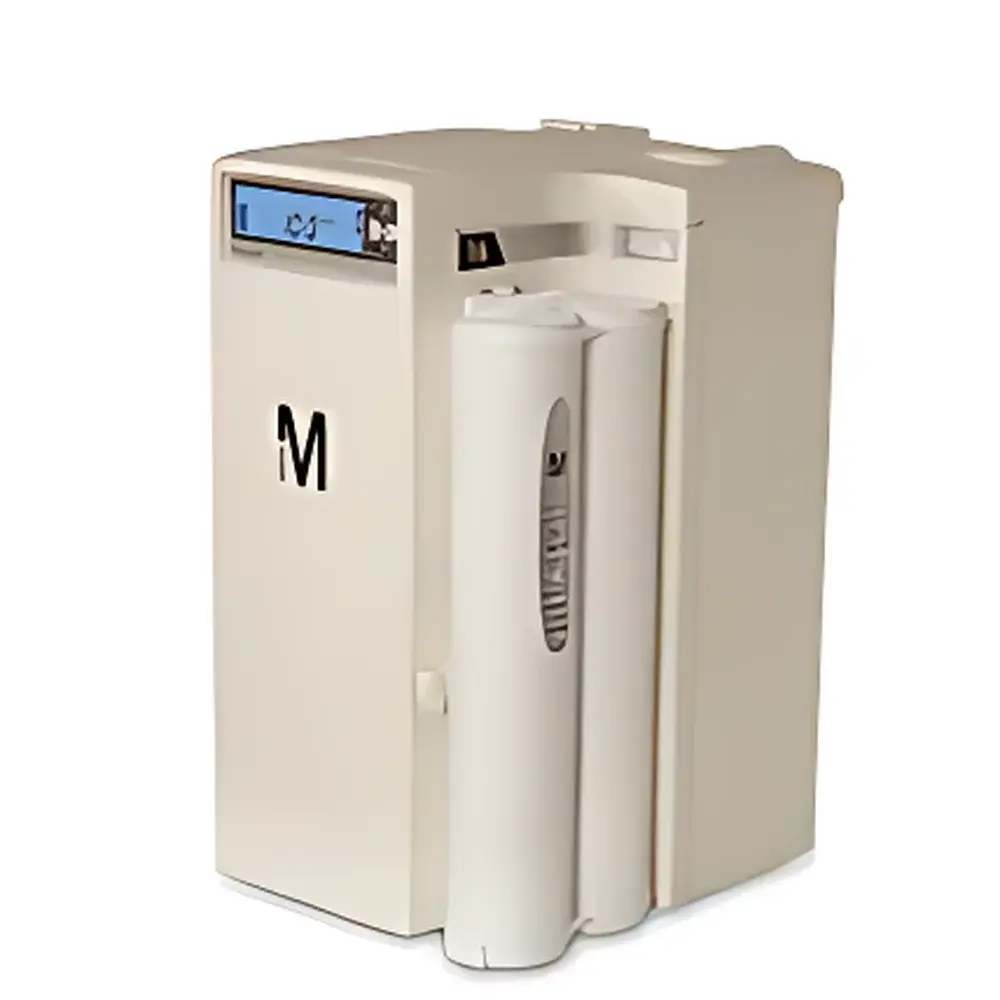
Millipore Rios Essential Pure Water System
| Brand | Millipore |
|---|---|
| Origin | France |
| Manufacturer Type | Authorized Distributor |
| Origin Category | Imported |
| Model | Rios Essential |
| Price Range | USD 6,800–13,600 (est.) |
| Water Grade | ASTM Type III / ISO 3696 Grade 3 |
| Resistivity | >0.05 MΩ·cm (at 25 °C) |
| Total Organic Carbon (TOC) | <200 ppb |
| Particulates (>0.1 µm) | Not Specified |
| Microbial Content | Not Specified |
| Heavy Metals & Soluble Silica | Not Specified |
| Ion Rejection Rate | >95% |
| Organic & Particle Rejection Rate | >99% |
| Flow Rates | 5 / 8 / 16 / 24 L/h (±15%, at 7–35 °C) |
| Daily Output Capacity | 30–480 L (model-dependent) |
| Recovery Rate | 25.0–44.4% (model-dependent) |
Overview
The Millipore Rios Essential Pure Water System is an engineered solution for the reliable, continuous production of ASTM Type III (ISO 3696 Grade 3) laboratory-grade pure water. Designed for integration into routine lab workflows, it serves as a primary feed source for downstream ultra-pure water systems—including Milli-Q platforms—as well as critical ancillary equipment such as autoclaves, glassware washers, humidifiers, and water baths. Its core purification architecture employs a two-stage process: first, a Progard pre-treatment cartridge containing three complementary filtration media (activated carbon, sediment filter, and scale inhibitor) protects the reverse osmosis (RO) membrane from chlorine, particulates, and hardness ions; second, a high-efficiency thin-film composite (TFC) RO membrane removes ≥95% of dissolved ions and ≥99% of organic molecules and submicron particles. This configuration ensures consistent output quality under variable municipal feedwater conditions while minimizing operational drift and extending membrane service life.
Key Features
- Intuitive LCD interface with real-time display of system status, flow rate, and key operational parameters—no interpretation required.
- Color-coded visual indicators for system state: green for normal operation, amber for maintenance alerts, red for critical faults—enabling rapid situational awareness without technical training.
- Automated daily RO membrane flush cycle to prevent biofilm formation and reduce scaling risk—operates without user intervention during non-production hours.
- Modular design with four scalable flow-rate variants (5, 8, 16, and 24 L/h), each optimized for distinct daily demand profiles (30–480 L/day) and ambient temperature ranges (7–35 °C).
- Integrated pressure monitoring and flow control ensure stable delivery across fluctuating inlet pressures and temperature gradients—critical for reproducible instrument feeding.
- Low-maintenance architecture: Progard cartridges and RO membranes are field-replaceable with tool-free access; service intervals aligned with ISO/IEC 17025 preventive maintenance guidelines.
Sample Compatibility & Compliance
The Rios Essential system delivers water compliant with ASTM D1193-20 (Type III) and ISO 3696:1987 (Grade 3) specifications—suitable for general laboratory applications where stringent purity is not required for analytical or cell-culture use. It meets the foundational water quality requirements for reagent preparation, buffer dilution, equipment rinsing, and feedwater supply to secondary purification units. While not certified for USP Purified Water or EP WFI standards, its design supports GLP-aligned documentation: all alarm events and maintenance logs are timestamped and retained in non-volatile memory. The system’s construction materials (FDA-compliant wetted components, USP Class VI-certified tubing) ensure chemical inertness and low leachables—validated per ISO 10993-5 cytotoxicity testing protocols.
Software & Data Management
The Rios Essential operates as a standalone, embedded-control system with no external software dependency. All operational data—including cumulative runtime, total volume dispensed, cartridge usage hours, and fault history—are stored locally in EEPROM with battery-backed retention. Audit trails comply with basic 21 CFR Part 11 principles: each event entry includes operator ID (via manual input), timestamp, and action type (e.g., “Progard replacement,” “RO flush initiated”). Optional RS-232 or analog 4–20 mA output enables integration into centralized building management systems (BMS) for remote status monitoring—though full electronic record archiving requires third-party SCADA or LIMS linkage.
Applications
- Feedwater supply to Milli-Q and other ultra-pure water systems requiring consistent Type III input.
- Routine cleaning of glassware, stainless-steel instruments, and plastic labware in automated washers.
- Operation of steam autoclaves, environmental chambers, and ultrasonic baths where mineral-free water prevents scaling and corrosion.
- Preparation of non-critical buffers, saline solutions, and microbiological media diluents.
- Support of histology processing equipment, including tissue processors and embedding stations.
- General-purpose rinsing in QC/QA labs performing titrations, spectrophotometry, and gravimetric analysis.
FAQ
What water quality standard does the Rios Essential meet?
It produces ASTM Type III / ISO 3696 Grade 3 purified water—suitable for non-critical applications but not for HPLC, cell culture, or molecular biology.
Can the Rios Essential be connected to a Milli-Q system?
Yes—its stable, low-particulate, low-TOC output is specifically engineered as feedwater for Milli-Q platforms and equivalent ultra-pure water generators.
How often must the Progard cartridge be replaced?
Typically every 6–12 months depending on feedwater quality and daily usage; the system displays a service countdown timer and alerts at 90% depletion.
Is the system compatible with hard water sources?
Yes—the Progard pre-treatment stage includes scale inhibition, and the RO membrane tolerates feedwater hardness up to 250 ppm CaCO₃ equivalent when operated within specified pressure and temperature limits.
Does the Rios Essential require a dedicated drain line?
Yes—a gravity-fed or pumped drain connection is mandatory to accommodate the RO concentrate stream, with minimum slope and diameter specified in the installation manual.



