
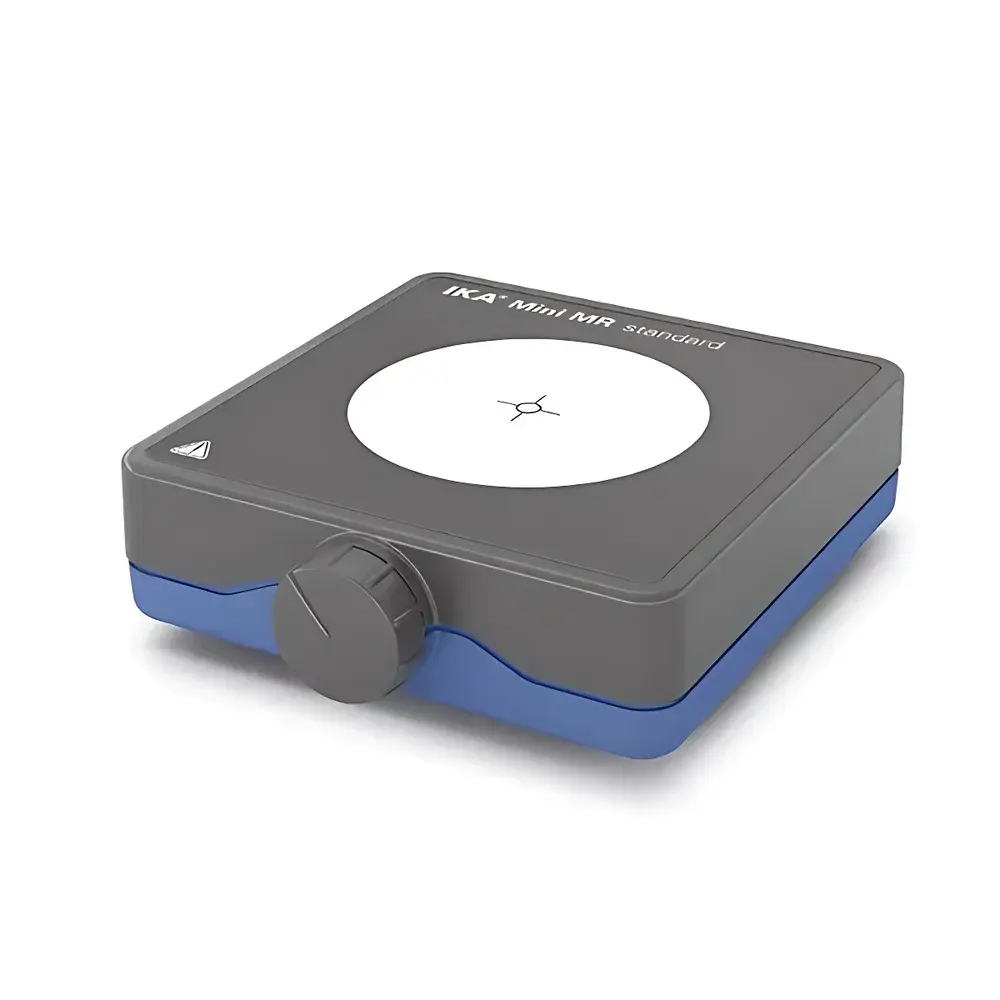
IKA Mini MR standard Magnetic Stirrer
| Brand | IKA |
|---|---|
| Origin | Germany |
| Model | Mini MR standard |
| Motor Output Power | 2 W |
| Max. Stirring Volume (H2O) | 1 L |
| Speed Range | 0–2500 rpm |
| Speed Control | Analog Knob |
| Rotation Direction | Clockwise |
| Stir Bar Length Compatibility | 20–40 mm |
| Plate Material | Polyester Film |
| Plate Dimensions | 115 × 115 mm |
| Device Dimensions (W × H × D) | 115 × 37 × 129 mm |
| Weight | 0.22 kg |
| Ambient Temperature Range | 5–40 °C |
| Relative Humidity Limit | 80 % RH |
| Ingress Protection | IP42 (per DIN EN 60529) |
| Input Voltage | 100–240 V AC, 50/60 Hz |
| Input Power | 3 W |
| DC Output | 12 V = |
| Current Draw | 300 mA |
| Plate Color | White (optimized for visual monitoring of colorimetric reactions) |
Overview
The IKA Mini MR standard is a compact, analog-controlled magnetic stirrer engineered for precision, reliability, and ease of use in routine laboratory environments. Designed around the fundamental principle of magnetic coupling—where a rotating permanent magnet beneath a non-magnetic plate induces synchronous rotation of a magnetic stir bar immersed in the sample—the device delivers consistent torque transfer without mechanical contact or seals. Its brushless DC motor architecture ensures low heat generation, minimal electromagnetic interference, and long-term operational stability. With a maximum stirring capacity of 1 L (water-equivalent) and a continuously adjustable speed range from 0 to 2500 rpm, the Mini MR standard supports applications ranging from gentle homogenization of cell suspensions to vigorous mixing of low-viscosity aqueous and organic solutions. The white polyester film-coated stirring plate enhances contrast for real-time visual assessment of colorimetric reactions, pH indicator transitions, or precipitation kinetics—making it especially valuable in teaching labs, QC testing, and small-scale synthesis workflows.
Key Features
- Compact footprint (115 × 37 × 129 mm) and lightweight design (0.22 kg) enable flexible placement on crowded benchtops, fume hoods, or inside incubators with limited vertical clearance.
- Analog speed control via precision potentiometer offers intuitive, tactile feedback and eliminates software dependencies or calibration drift associated with digital interfaces.
- IP42-rated enclosure provides protection against solid objects ≥1 mm and vertically falling water droplets—suitable for general lab use under controlled ambient conditions (5–40 °C, ≤80 % RH).
- Dual-voltage universal input (100–240 V AC, 50/60 Hz) ensures global compatibility without external transformers or voltage converters.
- Low-power DC drive system (12 V =, 300 mA) minimizes energy consumption and thermal load, supporting extended unattended operation during overnight experiments.
- Stir bar compatibility optimized for lengths between 20 mm and 40 mm—covering standard micro, standard, and extended geometries used across volumetric flasks, beakers, and test tubes.
Sample Compatibility & Compliance
The Mini MR standard is intended for use with chemically inert, non-ferromagnetic containers—including borosilicate glass, polypropylene, and PTFE-lined vessels—up to 1 L nominal volume. It is not rated for viscous media (>500 mPa·s), high-density slurries, or sealed pressure systems. While not certified for hazardous area use (ATEX/IECEx), its low-energy design and absence of sparking components reduce risk in standard chemical handling environments. The device complies with DIN EN 60529 (IP42), IEC 61010-1 (Safety Requirements for Electrical Equipment for Measurement, Control, and Laboratory Use), and meets EMC requirements per EN 61326-1. It is compatible with GLP documentation practices when paired with manual log entries; however, it does not support electronic audit trails or 21 CFR Part 11-compliant data recording natively.
Software & Data Management
As an analog-only instrument, the Mini MR standard operates independently of software, drivers, or connectivity protocols. No firmware updates, USB interfaces, or cloud synchronization are provided. All operational parameters—including speed setting and runtime—are manually recorded by the user. This architecture eliminates cybersecurity vulnerabilities, reduces validation burden in regulated environments, and ensures deterministic behavior over decades of service life. For laboratories requiring traceable operation logs, integration with external timer modules or video-based process monitoring is recommended.
Applications
- Routine dissolution testing and reagent preparation in pharmaceutical QC labs.
- pH adjustment and buffer equilibration in molecular biology workflows.
- Colorimetric titration endpoint detection where visual clarity is critical.
- Pre-incubation mixing of enzyme assays and immunoassay reagents.
- Undergraduate chemistry instruction—demonstrating stoichiometric reactions, redox equilibria, and complexometric titrations.
- Small-volume catalyst dispersion in academic catalysis research.
FAQ
Is the Mini MR standard suitable for use with corrosive solvents such as concentrated acids or halogenated organics?
Yes—provided the vessel material (e.g., glass or chemically resistant plastic) and stir bar coating (e.g., PTFE or glass-coated) are compatible. The unit itself has no exposed metal parts in contact with vapors or spills.
Can this stirrer maintain consistent speed under increasing solution viscosity?
It maintains set speed up to ~500 mPa·s at mid-to-high rpm; beyond that, torque limitation may cause slippage. For viscous media, consider IKA’s RCT basic or Eurostar series with digital torque monitoring.
Does the white plate affect temperature uniformity during heated stirring?
No heating function is integrated. When used atop external hotplates, the white polyester surface does not impede thermal conduction and remains dimensionally stable below 60 °C.
What safety certifications does this model carry?
It bears CE marking per EU Directive 2014/30/EU (EMC) and 2014/35/EU (LVD), and conforms to IEC 61010-1:2010 + A1:2019 for laboratory electrical safety.
Is calibration required or supported?
No factory or field calibration is defined for this analog device. Speed accuracy is specified as ±5 % of set value at 25 °C ambient, verified during production testing.



