
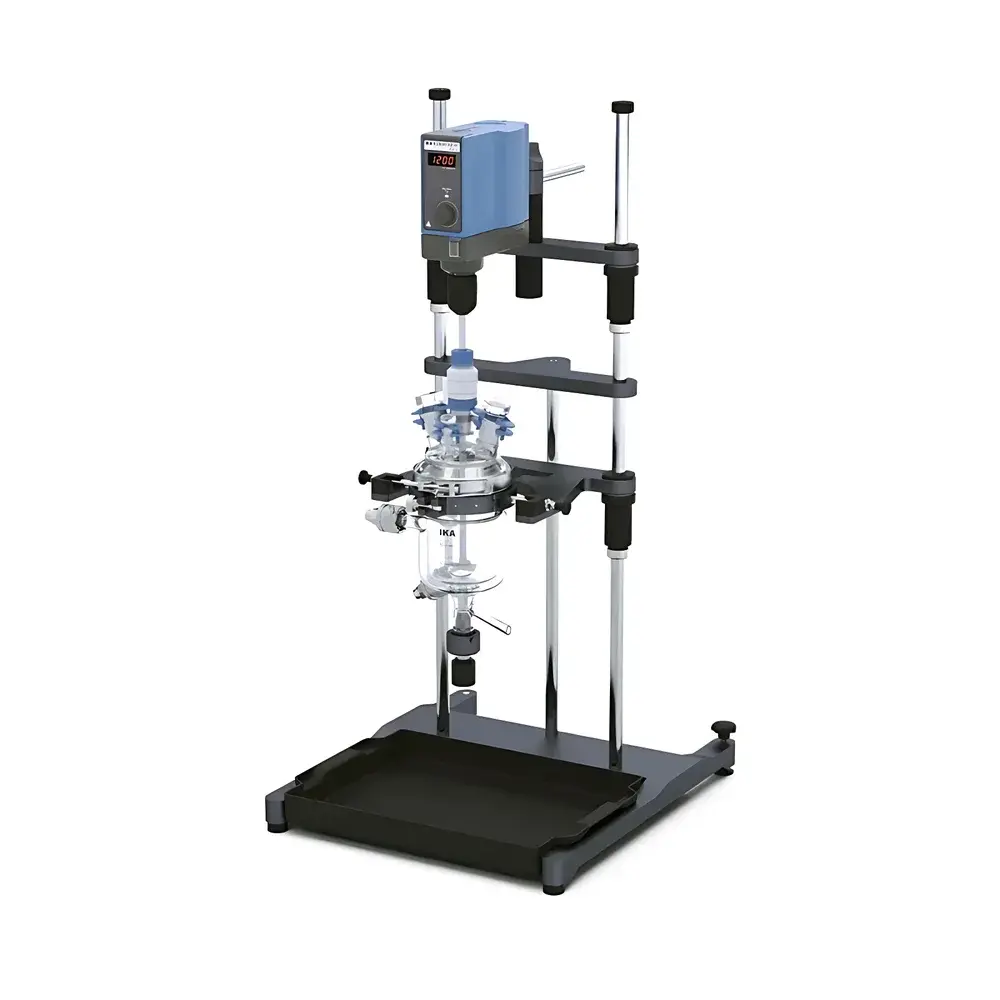
IKA EasySyn 500 Starter Reactor System
| Brand | IKA |
|---|---|
| Origin | Germany |
| Model | EasySyn 500 Starter Reactor System |
| Rated Volume | 0.5 L |
| Minimum Usable Volume | 30 mL |
| Minimum Sample Volume with Temperature Sensor | 260 mL |
| Operating Temperature Range | −50 to 200 °C |
| Maximum Vacuum | 3 mbar |
| Stirring Shaft Max Torque | 60 N·cm |
| Flange Size | DN 100 |
| Dimensions (W × H × D) | 500 × 950 × 580 mm |
| Jacketed Vessel Material | Borosilicate Glass 3.3 |
| Stirrer Type | Overhead Digital Motor (EUROSTAR 60 digital) |
| Sealing | High-Vacuum PTFE/FEP-Coated Shaft Seal |
| Vessel Bottom Valve | Spring-Loaded Glass-Compatible Valve |
| Port Configuration | 1× NS 29/32 (center), 2× NS 29/32, 1× NS 14/23 |
Overview
The IKA EasySyn 500 Starter Reactor System is a fully integrated, benchtop-scale glass reactor platform engineered for safe, reproducible, and scalable chemical synthesis under controlled temperature, pressure, and agitation conditions. Designed around Couette-type mixing dynamics and jacketed thermal management, the system supports both organic and aqueous reaction chemistries across a broad operational envelope—from cryogenic synthesis at −50 °C to high-temperature reflux or distillation up to 200 °C. Its modular architecture centers on a DIN-standard DN 100 flanged interface, enabling rapid vessel exchange while maintaining vacuum integrity and chemical compatibility. The system complies with fundamental laboratory safety principles defined in EN 61000-6-3 (EMC) and EN 61010-1 (electrical safety), and its borosilicate glass 3.3 construction meets ISO 3585 specifications for hydrolytic resistance and thermal shock tolerance. As a starter configuration, it provides foundational functionality for method development, reaction optimization, and small-batch process validation—serving as a technically coherent bridge between discovery-phase screening and pilot-scale process transfer.
Key Features
- DN 100 standardized flange interface with FEP-coated O-ring seal ensures repeatable, leak-tight assembly under vacuum down to 3 mbar and positive pressure up to 2 bar (gauge)
- Jacketed 500 mL reactor vessel fabricated from ASTM E438 Type I, Class A borosilicate glass 3.3—resistant to strong acids, alkalis, and halogenated solvents
- Ergonomic, height-adjustable support frame with tool-free clamping mechanism accommodates operator anthropometry and minimizes repetitive strain during vessel loading/unloading
- EUROSTAR 60 digital overhead stirrer delivering precise speed control (0–600 rpm) and constant torque output up to 60 N·cm, compatible with IKA’s QuickLock chuck system for rapid impeller attachment
- PTFE-coated helical impeller optimized for axial flow generation and uniform suspension of heterogeneous reagents or catalysts
- Spring-loaded bottom discharge valve engineered to relieve mechanical stress on glass during valve actuation—critical for vacuum-integrated crystallization or filtration workflows
- Multi-port lid configuration (1× NS 29/32 center port, 2× NS 29/32 side ports, 1× NS 14/23 auxiliary port) enables simultaneous integration of temperature probes, condensers, addition funnels, gas inlets, or sampling lines
Sample Compatibility & Compliance
The EasySyn 500 Starter is validated for use with standard laboratory solvents—including acetone, THF, DMF, chloroform, and concentrated sulfuric acid—under static and agitated conditions. Its glass-wetted surfaces exhibit no measurable leachables per USP , and all elastomeric seals conform to FDA 21 CFR §177.2600 for repeated food-contact exposure (a proxy for low extractables in GMP-aligned synthesis). While not certified for explosion-proof operation, the system adheres to ATEX Category 3G guidelines when used with appropriate external ventilation and inert gas purging protocols. It supports GLP-compliant documentation when paired with external calibrated temperature loggers (e.g., accredited Pt100 sensors traceable to NIST standards) and meets baseline requirements for ASTM E2500-22 (verification of laboratory equipment).
Software & Data Management
This starter configuration operates as a stand-alone hardware platform without embedded software or digital connectivity. All parameter monitoring—including stirring speed, setpoint temperature (via external circulator), and vacuum level (via external gauge)—must be recorded manually or synchronized via third-party data acquisition systems. For laboratories implementing electronic lab notebooks (ELNs) or LIMS, the system interfaces seamlessly with analog outputs from external controllers (e.g., Huber chiller analog voltage signals or VAT vacuum gauge 4–20 mA loops). No firmware or cybersecurity controls are present; therefore, it imposes no regulatory burden under FDA 21 CFR Part 11 or EU Annex 11—making it suitable for early-stage development where audit-trail requirements are minimal.
Applications
- Development and optimization of Grignard, lithiation, and hydrogenation reactions requiring strict moisture/oxygen exclusion and sub-ambient temperature control
- Acid-catalyzed esterifications and transesterifications under reduced pressure to shift equilibrium and remove volatile byproducts
- Crystallization studies involving controlled cooling ramps and anti-solvent addition through NS 29/32 side ports
- Two-phase catalytic reactions (e.g., phase-transfer catalysis) benefiting from high-shear mixing and interfacial area maximization
- Process analytical technology (PAT) readiness: the open-port architecture allows retrofitting with inline FTIR probes, Raman cells, or focused beam reflectance measurement (FBRM) sensors
- Teaching laboratories conducting thermally sensitive experiments where visual observation of reaction progress through transparent glass is essential
FAQ
What is the minimum volume required for accurate temperature measurement using the integrated sensor?
The system requires a minimum sample volume of 260 mL to ensure full immersion of the temperature probe tip and representative thermal equilibration.
Can the reactor be operated under nitrogen or argon blanket without vacuum?
Yes—the DN 100 sealing system maintains inert atmosphere integrity at ambient pressure; optional gas inlet adapters (not included) enable continuous purge or pressure-controlled operation.
Is the EUROSTAR 60 stirrer compatible with external speed regulation via PLC or LabVIEW?
No—the motor features only local keypad control and lacks analog/digital communication interfaces; for automated integration, consider upgrading to the EUROSTAR 60 control version with 0–10 V input.
Does the glass vessel include a calibration certificate for volumetric accuracy?
No—vessels are manufactured to DIN 12331 tolerances (±1% for Class B); certified volumetric calibration is available as an optional service through IKA’s metrology division.
What maintenance intervals are recommended for the shaft seal under continuous vacuum operation?
Under normal usage (<4 hr/day, ≤100 °C, ≤10 mbar), inspect the FEP-PTFE seal annually; replace every 24 months or after 2000 operating hours—whichever occurs first.



