
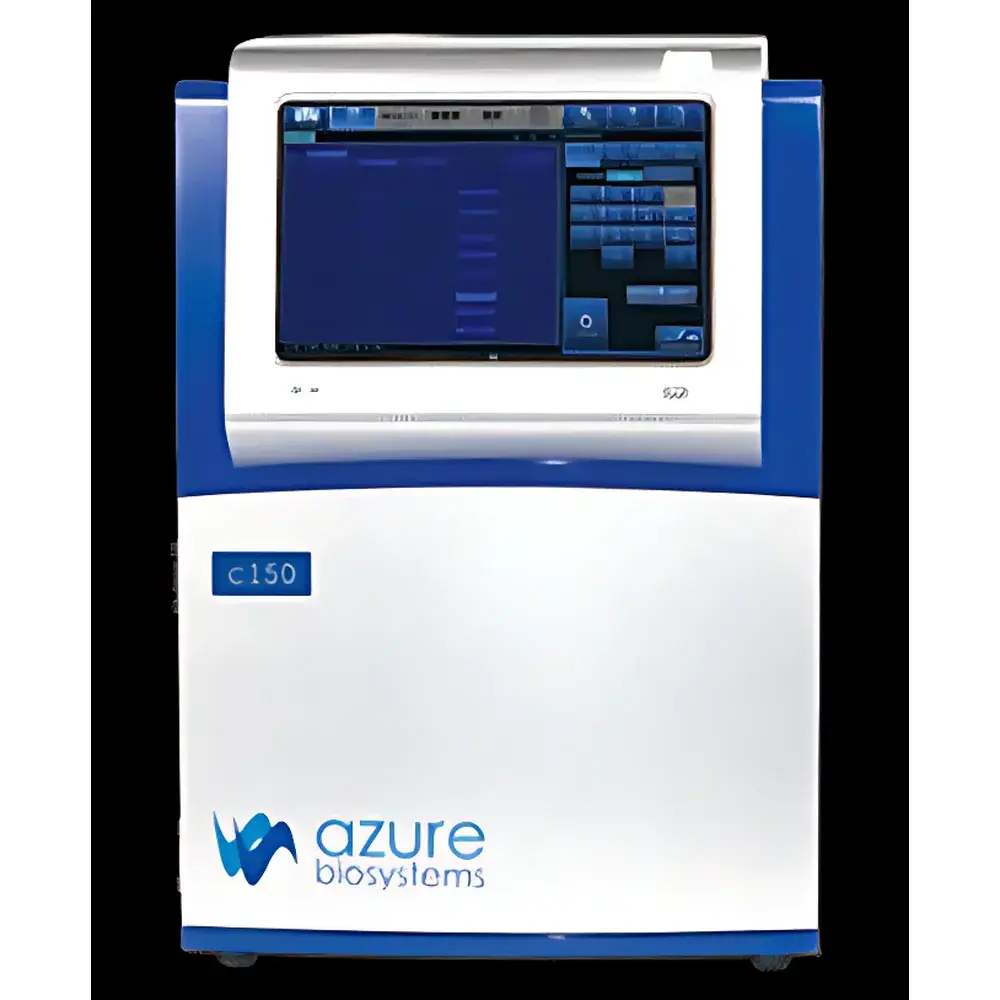
Azure Biosystems C400 Multi-Channel Fluorescent Gel Imaging System
| Brand | Azure Biosystems |
|---|---|
| Origin | USA |
| Model | C400 |
| Instrument Type | Multi-color Fluorescent Gel Imaging System |
| CCD Resolution | 8.3 MP |
| Bit Depth | 16-bit |
| Dynamic Range | 4.8 OD |
| CCD Sensor Size | 3/4-inch |
| Detection Sensitivity | >0.05 ng (for fluorescent protein bands) |
| Signal-to-Noise Ratio | >56 dB |
| Lens | 6x Zoom Motorized Objective |
Overview
The Azure Biosystems C400 Multi-Channel Fluorescent Gel Imaging System is a high-performance, integrated benchtop platform engineered for quantitative molecular imaging across multiple detection modalities—including UV transillumination, white-light reflectance, chemiluminescence, and multi-spectral fluorescence. Built upon a cooled monochrome CCD architecture with thermoelectric stabilization, the C400 employs a precision 6x motorized zoom lens and high-transmission optical path to deliver consistent, low-noise image acquisition across diverse sample formats. Its core measurement principle relies on photon capture under controlled excitation conditions—fluorescence imaging utilizes discrete LED-based excitation sources matched to common fluorophore emission profiles (e.g., Cy2, Cy3, Cy5), while chemiluminescence detection leverages ultra-low-noise integration over extended exposure times to resolve femtogram-level signal intensity. Designed for routine use in academic, clinical, and pharmaceutical laboratories, the system supports reproducible densitometric analysis of electrophoretic gels, blots, microplates, and tissue sections without requiring external PCs or complex alignment procedures.
Key Features
- Integrated 16-bit cooled CCD sensor (8.3 MP resolution) with 4.8 optical density (OD) dynamic range for high-fidelity linear quantification
- Motorized 6x zoom lens enabling precise field-of-view adjustment and consistent magnification calibration across experiments
- Multi-modal illumination suite: UV (302 nm), blue light (470 nm), white LED reflectance, and tunable narrow-band fluorescence excitation (Cy2/Cy3/Cy5-compatible)
- Chemiluminescence mode optimized for low-background detection with sensitivity down to <1 fg of horseradish peroxidase (HRP)-conjugated target
- Touchscreen-driven interface with embedded Linux OS—no external computer required for basic operation or image acquisition
- One-touch “stain-free” imaging protocol for rapid visualization of proteins in SDS-PAGE gels without chemical staining
- Modular upgrade path to Azure C600 configuration, supporting additional excitation wavelengths, near-infrared (NIR) channels, and enhanced software modules
Sample Compatibility & Compliance
The C400 accommodates standard and custom sample carriers including mini- and midi-format polyacrylamide and agarose gels, nitrocellulose and PVDF membranes, X-ray film, glass slides, Petri dishes, and 96-/384-well microplates. All illumination sources comply with IEC 62471 photobiological safety standards; UV transilluminators include interlocked shielding to meet OSHA and institutional biosafety requirements. The system supports documentation workflows aligned with GLP and GMP environments—image metadata (exposure time, gain, lens position, lamp status) is automatically embedded in TIFF files and retained in audit trails when used with AzureSpot software’s optional 21 CFR Part 11 compliance module. Regulatory reference methods—including ASTM E2555 (densitometry of protein gels) and ISO 15195 (clinical laboratory instrumentation validation)—inform its calibration and performance verification protocols.
Software & Data Management
AzureSpot™ software provides full instrument control, automated exposure optimization, background subtraction, band/spot detection, and relative quantification using internal or external standards. It supports programmable acquisition sequences—users define multi-step protocols (e.g., “UV scan → Cy5 fluorescence → chemiluminescence”) that are saved, versioned, and recalled with one tap. Export options include publication-ready TIFF, PNG, and PDF formats; quantitative results are exportable to CSV or Excel for statistical analysis. Batch processing enables parallel analysis of multiple gels or blots using identical parameters. Software updates are delivered via secure HTTPS and validated against Azure’s internal QA framework prior to release.
Applications
- Quantitative Western blotting with multiplex fluorescent detection (e.g., simultaneous visualization of target protein and loading control)
- DNA fragment sizing and purity assessment in agarose and polyacrylamide gels using SYBR® Safe, GelRed™, or ethidium bromide
- Stain-free total protein normalization in SDS-PAGE prior to immunoblotting
- High-sensitivity chemiluminescent detection of low-abundance phosphoproteins or post-translationally modified targets
- Cell-based assays in microplates (e.g., GFP reporter expression, caspase activity, mitochondrial membrane potential)
- Documentation and analysis of histological sections stained with fluorescent dyes (e.g., DAPI, FITC-phalloidin)
FAQ
Does the C400 support near-infrared (NIR) fluorescence imaging?
No—the C400 is configured for visible-light fluorescence (Cy2/Cy3/Cy5). NIR capability requires the C600 platform with dedicated 700/800 nm channels.
Can images be acquired and analyzed remotely?
Yes—AzureSpot software supports network deployment; authorized users may initiate acquisitions and retrieve processed data via secure web interface or SMB share.
Is calibration traceable to NIST standards?
Yes—optional calibration kits include NIST-traceable step tablets for OD verification and fluorescence intensity standards for channel-specific linearity validation.
What maintenance is required for long-term stability?
Annual optical alignment verification and CCD dark-current profiling are recommended; no consumables or lamp replacements are needed—the solid-state LEDs have >20,000-hour lifetimes.
How does the system ensure reproducibility across users and labs?
Through hardware-enforced parameter locking, standardized acquisition templates, and embedded metadata logging—enabling cross-laboratory method transfer per ISO/IEC 17025 guidelines.





