
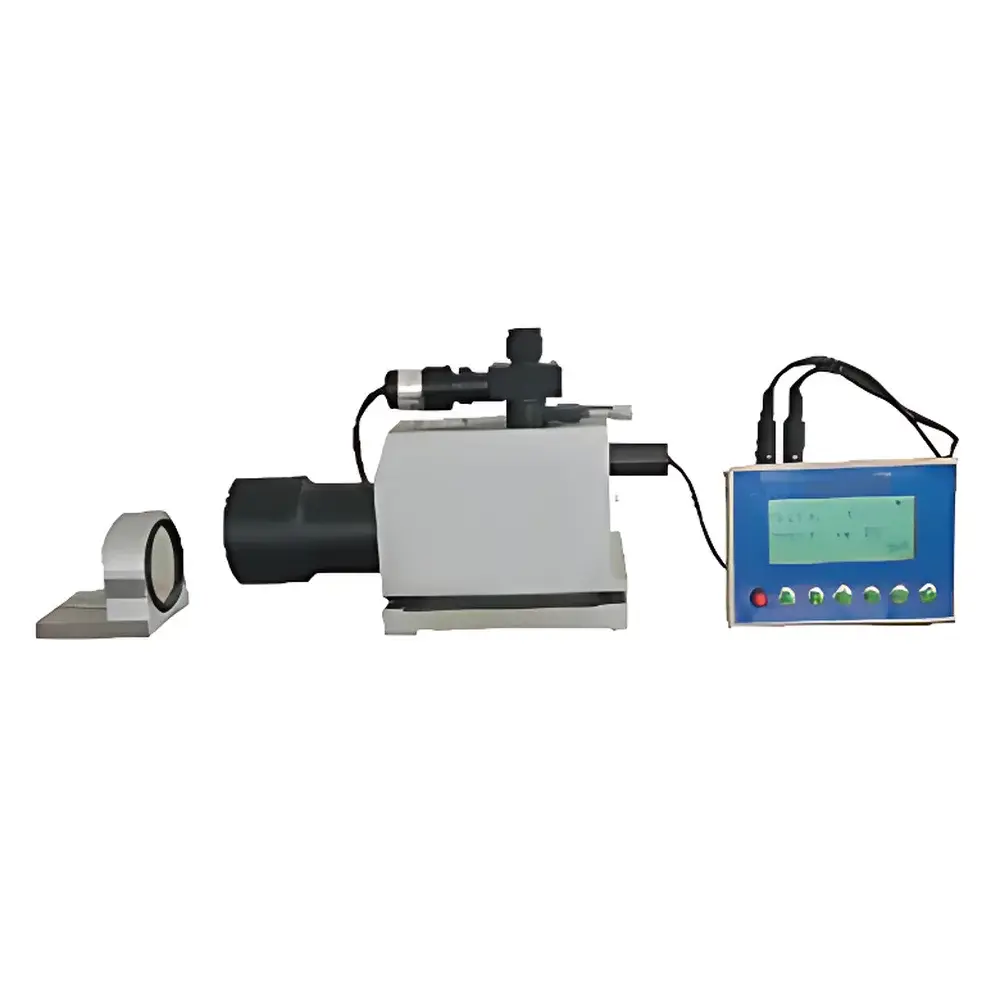
YANRUN S1401 Digital Dual-Axis Autocollimator
| Brand | YANRUN |
|---|---|
| Origin | Shanghai, China |
| Manufacturer Type | Direct Manufacturer |
| Country of Origin | China |
| Model | S1401 |
| Price | USD 3,200 (FOB Shanghai) |
| Working Distance | 6 m |
| Objective Focal Length | 400 mm |
| Aperture Diameter | 42 mm |
| Mirror Diameter | 52 mm |
| Eyepiece Magnification | 15× |
| Field of View (Micrometer Eyepiece) | 8 mm |
| Angular Resolution | 0.2 arcseconds |
| Grating Encoder | 400-line optical grating |
| Angular Measurement Range | ±800 arcseconds |
| Accuracy | ≤ ±2 arcseconds within ±100 arcseconds |
| Linearity Calculation | Automatic real-time compensation |
| Data Storage | Internal non-volatile memory |
| PC Interface | USB 2.0 |
| Illumination | High-power LED |
| Power Supply | Rechargeable Li-ion battery (USB-charged), dual-output (for display & light source) |
| Dimensions (L×W×H) | 254 × 57 × 157 mm |
Overview
The YANRUN S1401 Digital Dual-Axis Autocollimator is a precision optical metrology instrument engineered for high-accuracy angular and straightness measurement in industrial metrology, machine tool calibration, and precision assembly environments. Based on the fundamental principle of optical autocollimation—where a collimated beam is reflected back from a plane mirror and its angular deviation is quantified by displacement of the returned image on a calibrated reticle—the S1401 implements a dual-axis architecture to simultaneously capture pitch and yaw deviations. Unlike conventional single-axis autocollimators or mechanically coupled bi-directional systems, the S1401 integrates orthogonal photodetector arrays and a high-resolution 400-line optical grating encoder, enabling independent, real-time acquisition of angular displacement in both horizontal and vertical planes. Its 400 mm focal length objective lens delivers optimal beam collimation over a 6-meter working distance, while the 15× micrometer eyepiece with 8 mm field of view ensures unambiguous target alignment and sub-arcsecond resolution (0.2″). Designed for traceable calibration workflows, the instrument conforms to foundational geometrical metrology practices aligned with ISO 230-1 (machine tool acceptance testing) and supports error mapping per ASME B89.3.7.
Key Features
- Dual-axis simultaneous measurement capability eliminates sequential reorientation, reducing setup time and cumulative alignment uncertainty.
- Integrated USB-rechargeable lithium-ion power system supplies both the digital display unit and high-intensity LED illumination—enabling fully portable operation without external AC adapters.
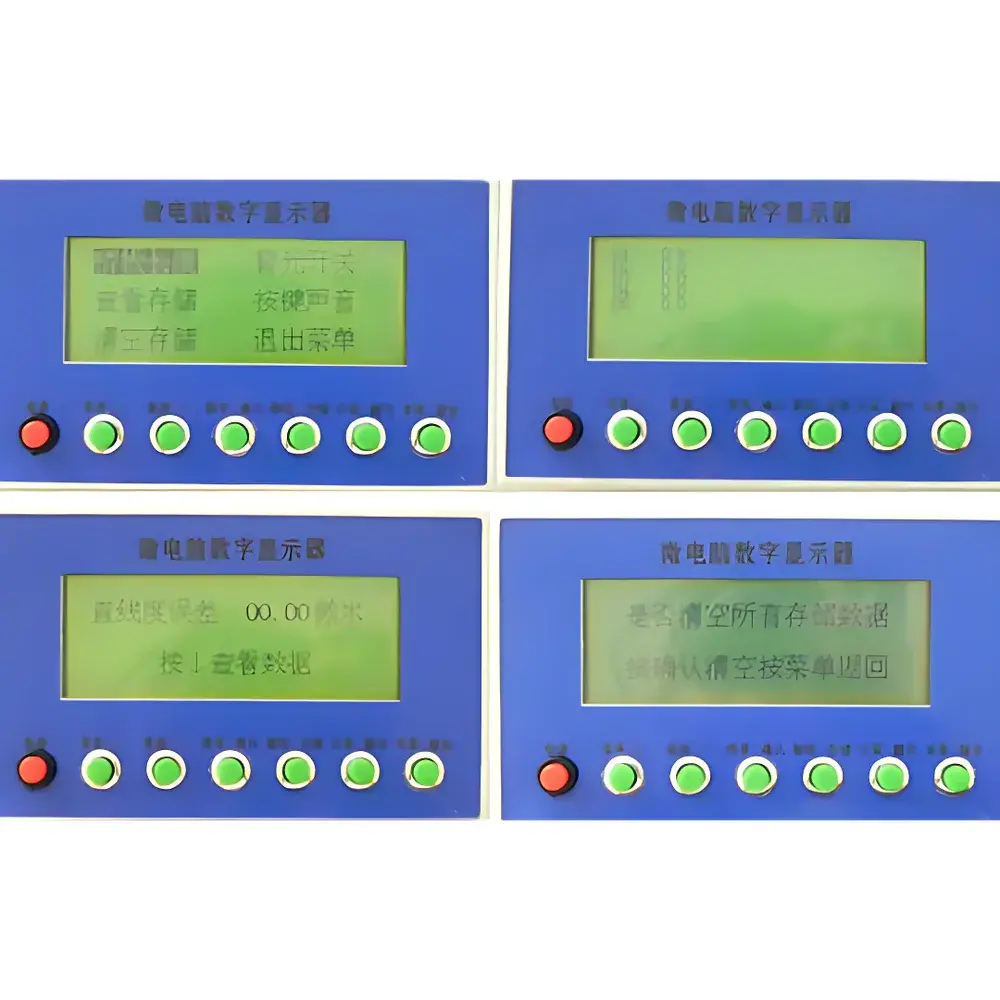
- Upgraded 7-button digital readout interface with dedicated function keys streamlines navigation, data recall, zeroing, and unit toggling (arcseconds/microradians/mm/m).
- Real-time automatic straightness calculation applies least-squares fitting per ISO 10360-2, directly outputting maximum deviation, total indicator reading (TIR), and slope-corrected residual error.
- Onboard non-volatile memory stores up to 1,000 measurement records with timestamp, position index, and raw angular values—accessible via intuitive scroll-and-select menu.
- Optical path optimized for minimal thermal drift: all critical components—including objective lens mount and baseplate—are fabricated from low-expansion aluminum alloy with controlled surface finish.
- Modular accessory compatibility includes adjustable kinematic mirror mounts, extended-range retroreflectors, and motorized translation stages for automated scanning protocols.
Sample Compatibility & Compliance
The S1401 is designed for use with standard optical flat mirrors (e.g., 52 mm diameter, λ/20 surface flatness) and accommodates custom reflectors up to 80 mm diameter across extended-range variants (S1401-30). It meets mechanical and electromagnetic compatibility requirements per IEC 61326-1 for laboratory and light-industrial environments. While not certified to FDA 21 CFR Part 11, its data logging architecture supports audit-ready documentation when deployed under GLP/GMP-aligned SOPs—particularly where angular stability of CNC guideways, coordinate measuring machine (CMM) bridges, or optical benches must be verified against internal tolerance limits. Calibration certificates are issued with NIST-traceable angular standards; recommended recalibration interval is 12 months or after 200 hours of continuous operation.
Software & Data Management
The S1401 supports bidirectional USB 2.0 communication using CDC ACM class drivers—requiring no proprietary software installation on Windows/macOS/Linux hosts. Exported datasets follow CSV format with columns: Timestamp, Position_ID, Pitch_Arcsec, Yaw_Arcsec, Temperature_C, Battery_Voltage. Third-party integration is enabled via ASCII command protocol (e.g., “:READ?”, “:SAVE”, “:CAL?”), allowing direct ingestion into MATLAB, Python (PySerial), or LabVIEW-based metrology dashboards. All stored measurements retain firmware-generated checksums to ensure data integrity during transfer. The instrument’s internal firmware implements write-protection for factory calibration constants and supports user-defined offset tables for multi-mirror array setups.
Applications
- Linear axis straightness verification of precision machine tools per ISO 230-2, including lathe beds, milling machine columns, and grinding wheel spindles.
- In-process alignment of laser interferometer retroreflectors and multi-axis optical tables in cleanroom photolithography facilities.
- Calibration of angular encoders and tilt sensors used in aerospace inertial navigation subsystems.
- Flatness assessment of granite surface plates and ceramic reference artifacts using reversal techniques (e.g., reversal method per ISO 230-7).
- Thermal deformation monitoring of large-scale structures (e.g., telescope mounts, particle accelerator girders) via time-series angular drift logging.
- Educational demonstration of wavefront sensing principles and Abbe error analysis in undergraduate optics laboratories.
FAQ
What is the maximum permissible ambient temperature for stable operation?
The S1401 maintains specified accuracy between 15 °C and 25 °C; operation outside this range requires thermal stabilization or correction via optional external temperature sensor input.
Can the instrument measure absolute angle or only relative deviation?
It measures relative angular displacement from a user-defined zero reference; absolute angular positioning requires pre-calibration against a known datum (e.g., precision rotary table or laser tracker).
Is the optical grating encoder subject to wear or recalibration?
The 400-line glass scale is hermetically sealed and non-contact; no periodic recalibration is required unless physical impact compromises housing integrity.
Does the USB interface support live streaming of angular data?
Yes—continuous polling at up to 10 Hz is supported via ASCII command loop; latency is <15 ms end-to-end under standard USB host conditions.
How is measurement uncertainty estimated for straightness reports?
Combined standard uncertainty is calculated per GUM (JCGM 100:2008), incorporating contributions from angular resolution (0.2″), repeatability (≤±0.8″), thermal expansion of mirror mount (±0.3″/°C), and interpolation error (±0.1″).




