
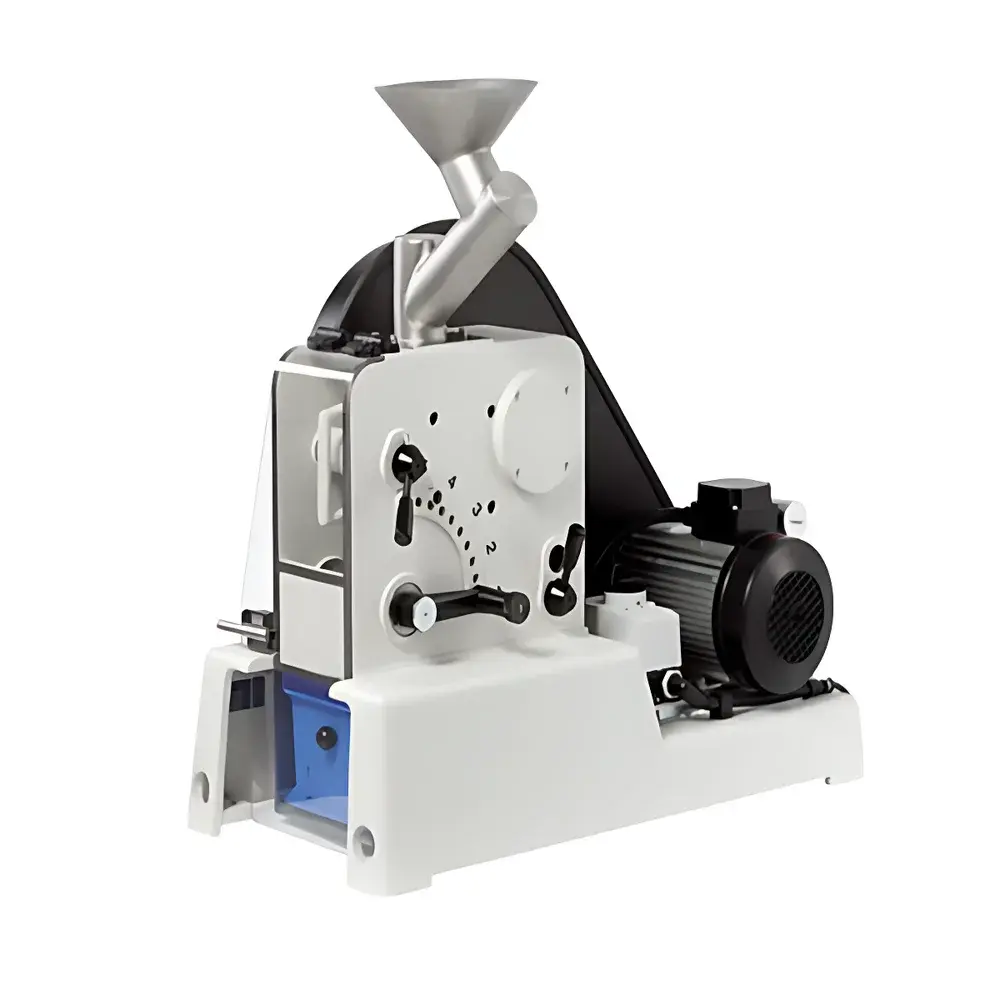
FRITSCH PULVERISETTE 1 Classic Jaw Crusher
| Brand | FRITSCH |
|---|---|
| Origin | Germany |
| Model | PULVERISETTE 1 Classic |
| Max. Feed Size (Type I) | 60 mm × 60 mm |
| Max. Feed Size (Type II) | 95 mm × 95 mm |
| Throughput (Type I) | 140 kg/h |
| Throughput (Type II) | 200 kg/h |
| Final Particle Size (both types) | 1–15 mm |
| Motor Power (Type I) | 1.1 kW |
| Motor Power (Type II) | 2.2 kW |
| Weight (Type I) | 177 kg |
| Weight (Type II) | 205 kg |
| Dimensions | 40 × 80 × 80 cm |
| Minimum Jaw Gap | 1 mm |
| Adjustable Jaw Gaps | 10 preset positions |
| Grinding Chamber Materials | Stainless steel, zirconium oxide, tempered steel, chromium-free steel, manganese steel, tungsten carbide |
Overview
The FRITSCH PULVERISETTE 1 Classic Jaw Crusher is a robust, precision-engineered primary crushing instrument designed for reliable size reduction of brittle, medium-hard, hard, and very hard materials in analytical, geological, metallurgical, and industrial R&D laboratories. Operating on the principle of compressive crushing—where material is fed between two opposing jaws (one fixed, one movable) and subjected to high mechanical pressure—the device delivers consistent, reproducible coarse to intermediate particle size reduction. Its design adheres to DIN EN ISO 17025-compliant mechanical integrity standards and supports GLP-aligned sample preparation workflows. The PULVERISETTE 1 Classic serves as the foundational stage in multi-step comminution protocols, particularly when paired with downstream equipment such as the FRITSCH P-13 Disc Mill for secondary fine grinding to ≤1 mm.
Key Features
- Two standardized configurations: Type I (60 mm max feed size, 1.1 kW drive) and Type II (95 mm max feed size, 2.2 kW drive), enabling scalability across sample volume and hardness requirements.
- Precision-adjustable jaw gap with 10 discrete settings, permitting fine-tuned control over final particle size distribution—minimum gap fixed at 1 mm to ensure process repeatability.
- Modular grinding chamber system with six certified material options: stainless steel (AISI 304/316), zirconium oxide (ZrO₂), tempered tool steel, chromium-free steel (for trace-metal-sensitive applications), manganese steel (high wear resistance), and tungsten carbide (for ultra-abrasive samples).
- Tool-free, rapid disassembly of jaw plates and feed hopper—facilitating full accessibility for cleaning and minimizing cross-contamination risk between heterogeneous sample batches.
- Integrated dust extraction port compatible with standard laboratory vacuum systems (e.g., HEPA-filtered industrial vacuums), ensuring operator safety and compliance with OSHA 1910.94 and EU Directive 2004/37/EC (carcinogens and mutagens).
- Stable base frame and vibration-dampened mounting reduce operational noise (<75 dB(A)) and prevent transmission of mechanical resonance to adjacent instrumentation.
Sample Compatibility & Compliance
The PULVERISETTE 1 Classic processes a broad spectrum of inorganic and organic solids—including ores, ceramics, concrete, slag, coal, limestone, feldspar, polymers, and pharmaceutical excipients—provided they exhibit sufficient brittleness and compressive strength below 2,500 MPa. It is unsuitable for fibrous, elastic, or highly ductile materials (e.g., copper turnings, rubber). All wetted components comply with FDA 21 CFR §177.2400 for food-contact polymers where applicable, and grinding chambers meet ISO 8502-3 for surface cleanliness validation. The instrument supports audit-ready documentation per ISO/IEC 17025:2017 Clause 7.7 (sampling and sample handling) and aligns with ASTM C136/C136M (sieve analysis preparation) and ISO 679 (cement testing sample preparation).
Software & Data Management
As a standalone mechanical crusher, the PULVERISETTE 1 Classic operates without embedded firmware or digital interface. However, its deterministic mechanical behavior—fixed speed (Type I: 150 rpm; Type II: 120 rpm), calibrated jaw displacement, and repeatable gap settings—enables full traceability through manual logbooks or LIMS-integrated SOPs. Users may document batch-specific parameters (feed size, gap setting, run time, throughput) directly into electronic lab notebooks (ELNs) compliant with 21 CFR Part 11 (audit trail, electronic signature support). Optional FRITSCH LabSuite™ workflow templates facilitate standardized reporting for QA/QC audits.
Applications
- Geochemical sample preparation prior to XRF, ICP-OES, or fusion bead analysis.
- Reduction of construction aggregates for gradation testing per ASTM D6913.
- Pre-crushing of battery cathode materials (e.g., NMC, LFP) before laser diffraction or BET surface area analysis.
- Homogenization of heterogeneous environmental soil cores for TCLP extraction (EPA Method 1311).
- Primary size reduction of catalyst supports (alumina, silica) prior to BET or mercury porosimetry.
- Routine QC crushing of raw pharmaceutical granules for content uniformity testing (USP ).
FAQ
What safety certifications does the PULVERISETTE 1 Classic hold?
It complies with CE marking per Machinery Directive 2006/42/EC, EMC Directive 2014/30/EU, and Low Voltage Directive 2014/35/EU. Full conformity documentation is supplied with each unit.
Can the jaw gap be adjusted during operation?
No—gap adjustment must be performed only when the machine is de-energized and locked out per LOTO procedures (OSHA 1910.147).
Is routine calibration required?
No formal calibration is mandated; however, periodic verification of jaw parallelism and gap accuracy using certified gauge blocks (traceable to NIST or DAkkS) is recommended every 6 months or after 500 operating hours.
How is cross-contamination prevented between dissimilar samples?
Through complete disassembly of jaws and feed chute, followed by ultrasonic cleaning in appropriate solvents (e.g., acetone for organics, dilute HNO₃ for metals), validated via blank runs and elemental wipe tests.
Does FRITSCH offer application support for method development?
Yes—application engineers provide free pre-purchase feasibility studies and post-installation SOP optimization, including gap selection guidance and throughput modeling based on Mohs hardness and bulk density data.



