
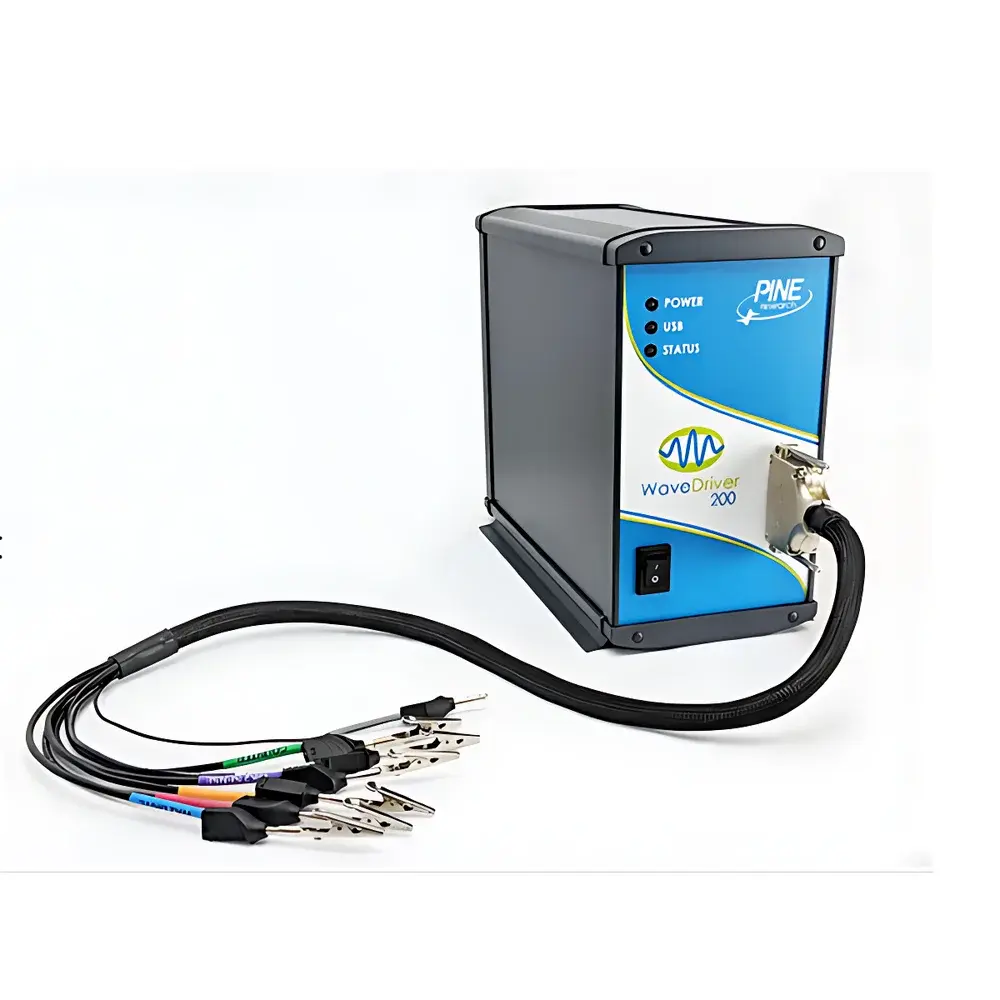
WaveDriver 200 Dual Potentiostat
| Brand | — |
|---|---|
| Origin | Imported |
| Manufacturer Type | General Distributor |
| Model | WaveDriver 200 |
| Price | Upon Request |
| Working Electrode Configuration | Single or dual WE with shared RE and CE |
| Current Range | ±100 nA to ±1 A |
| Potential Range | ±2.5 V / ±10 V / ±15 V (selectable) |
| EIS Frequency Range | 10 µHz – 1 MHz |
| DC Techniques | CV, LSV, CA, DPV, SWV, NPV, ASV, OCP, ZRA, RCP, BE, etc. |
| AC Techniques | EIS, Mott-Schottky, iR Compensation Measurement |
| Optional Accessories | RRDE, RDE, Spectroelectrochemical Cells |
| Software | AfterMath (EIS equivalent circuit fitting, Kramers–Kronig validation, data transformation, advanced analysis modules) |
Overview
The WaveDriver 200 Dual Potentiostat is a high-performance, modular electrochemical workstation engineered for precision control and simultaneous measurement across two independent working electrodes within a single three-electrode (or four-electrode) cell configuration. Operating on the principle of bipotentiostatic control—where each working electrode maintains its own defined potential versus a common reference electrode—the instrument enables true parallel electrochemical interrogation under identical solution conditions. This architecture is essential for kinetic studies involving coupled redox processes, differential detection in sensor arrays, ring-disk current collection in rotating ring-disk electrode (RRDE) experiments, and controlled-potential electrolysis with real-time monitoring of both oxidation and reduction sites. The system supports full compliance with electrochemical conventions per ASTM G59, G102, and ISO 16773-2, and is designed for integration into GLP-compliant laboratories requiring audit-ready experimental traceability.
Key Features
- Bipotentiostatic operation with fully independent potential and current control for two working electrodes (WE1/WE2), sharing one reference electrode (RE) and one counter electrode (CE)
- Three user-selectable potential ranges: ±2.5 V, ±10 V, and ±15 V—optimized for aqueous, non-aqueous, and high-voltage battery electrolyte systems
- Current measurement range spanning eight decades: from ±100 nA (1 pA resolution in low-current mode) to ±1 A, with automatic ranging and adaptive gain switching
- Integrated high-fidelity EIS capability covering 10 µHz to 1 MHz, supporting multi-sine and single-sine acquisition modes with built-in Kramers–Kronig validation
- Dedicated hardware support for iR compensation via positive feedback, current-interrupt, and EIS-based un-compensated resistance (Ru) determination
- Modular front-panel connectivity with standardized BNC and banana-jack interfaces—no proprietary adapters required for RDE, RRDE, spectroelectrochemical cells, or microelectrode holders
Sample Compatibility & Compliance
The WaveDriver 200 accommodates a broad spectrum of electrochemical configurations, including but not limited to conventional three-electrode cells, zero-resistance ammetry (ZRA) setups, galvanic corrosion cells, bipolar electrode arrangements, and optically transparent thin-layer electrochemical (OTTLE) cells. It is routinely deployed in applications aligned with USP , , and for pharmaceutical electroanalysis; ASTM D1148 and D2190 for coating corrosion evaluation; and IEC 62660-1 for lithium-ion battery half-cell characterization. All firmware and driver-level communication protocols comply with FDA 21 CFR Part 11 requirements when used with validated AfterMath software configurations—including electronic signatures, audit trails, and user-access tiering.
Software & Data Management
AfterMath software serves as the native analytical environment for the WaveDriver 200, providing ISO/IEC 17025-aligned data handling workflows. It includes integrated tools for baseline correction, peak deconvolution, derivative analysis, and time-domain filtering. EIS data are processed using non-linear least-squares fitting against user-defined equivalent circuits (e.g., R(QR)(QR), R(C(RW)), or custom topologies), with statistical error estimation (χ², parameter correlation matrix). Raw datasets retain full metadata—timestamp, instrument ID, technique parameters, cell configuration, and environmental annotations—for reproducible reprocessing. Export formats include ASCII (.txt), MATLAB (.mat), and mzXML-compatible electrochemical data interchange (EC-DI) schema for third-party chemometrics platforms.
Applications
- Rotating ring-disk electrode (RRDE) studies of oxygen reduction reaction (ORR) intermediates and catalyst selectivity
- Simultaneous anodic/cathodic scanning in battery electrode material screening (e.g., LiCoO2 vs. graphite half-cells)
- Corrosion rate quantification via linear polarization resistance (LPR) and electrochemical noise analysis (ENA)
- Spectroelectrochemical coupling with UV-Vis, FTIR, or Raman spectrometers for in situ identification of transient species
- Electrocatalytic mechanism elucidation using staircase voltammetry combined with phase-sensitive AC detection
- Stability testing of redox-active polymers and molecular mediators under potentiostatic hold conditions
FAQ
Can the WaveDriver 200 operate in true bipotentiostatic mode with two independent reference electrodes?
No—it uses a shared reference electrode configuration. Independent RE control requires external analog voltage referencing or auxiliary potentiostat coupling.
Is AfterMath software validated for GxP environments?
Yes, when installed and operated per the manufacturer’s Validation Guide (Document No. AM-VG-2023), including IQ/OQ protocols and change control procedures.
What is the maximum sampling rate for chronoamperometry at 1 MS/s?
The system supports up to 100 kS/s (10 µs resolution) in high-speed transient mode, with onboard 16-bit ADC buffering and DMA streaming to host memory.
Does the instrument support floating measurements for grounded-cell configurations?
Yes—via optional isolated analog output module (Part No. WD200-ISO), enabling measurements in battery packs or fuel cell stacks where ground loops are unavoidable.
How is electrode fouling compensated during long-term OCP monitoring?
AfterMath includes automated drift-correction algorithms based on polynomial baseline fitting and moving-window median filtering, configurable per experiment series.



