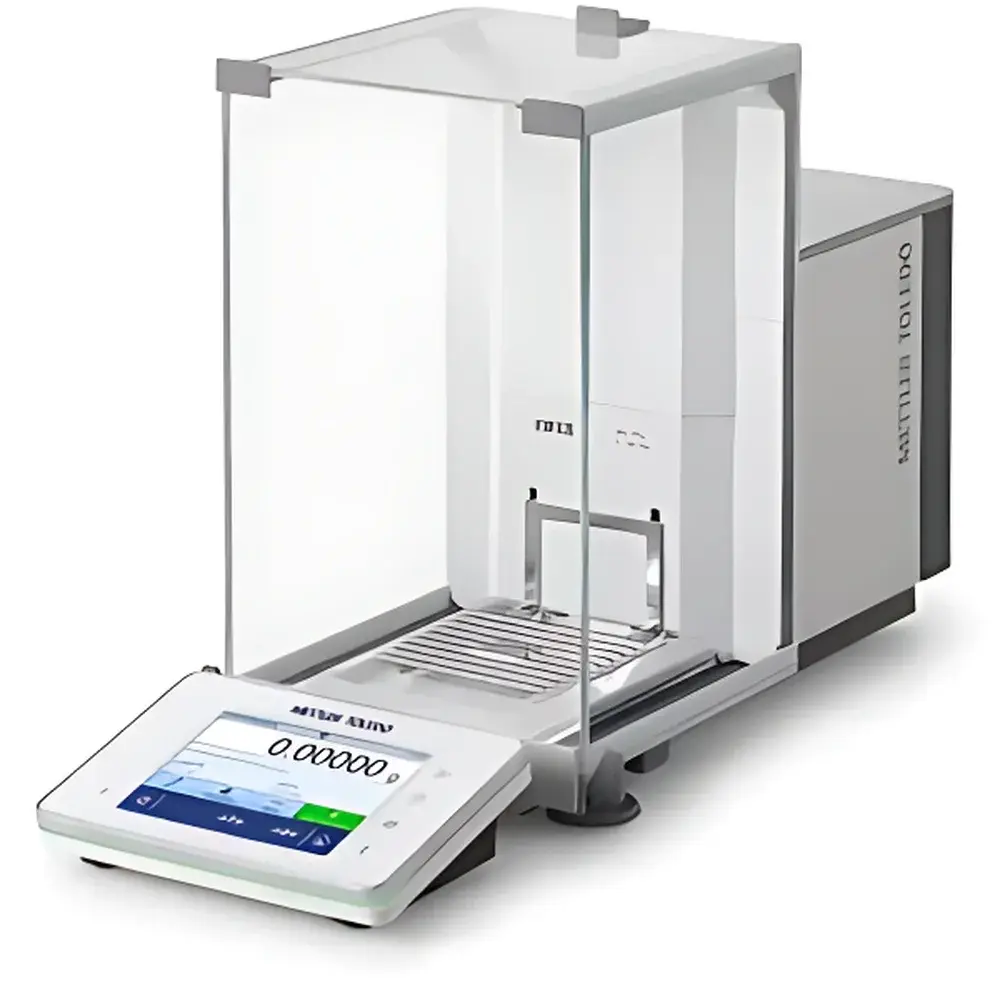
METTLER TOLEDO XSR105/AC Analytical Balance
| Brand | METTLER TOLEDO |
|---|---|
| Origin | Germany |
| Model | XSR105/AC |
| Type | Analytical Balance |
| Max Capacity | 120 g |
| Readability | 0.01 mg |
| Repeatability (typ.) | 0.008 mg |
| Minimum Weight (USP <41>, 0.1% tolerance, typ.) | 16 mg |
| Stabilization Time | 3 s |
| Calibration | Internal, Fully Automatic (FACT) |
| Weighing Pan Dimensions (W × D) | 78 mm × 73 mm |
| Linearity Error (typ.) | ±0.2 mg |
| Dimensions (H × W × D) | 292 mm × 195 mm × 482 mm |
| Interface Options | USB-B, RS232 (integrated/optional), USB-A, Bluetooth (optional), Ethernet (LAN) |
| Compliance | 21 CFR Part 11–ready, GLP/GMP-supportive documentation, password-protected user management, audit trail logging |
Overview
The METTLER TOLEDO XSR105/AC is a high-performance analytical balance engineered for precision mass measurement in regulated laboratory environments. Utilizing electromagnetic force compensation (EMFC) technology, it delivers traceable, reproducible results with 0.01 mg readability and exceptional long-term stability. Designed for applications demanding strict adherence to pharmacopeial standards—including USP , USP , and EP 2.1.3—the XSR105/AC integrates FACT (Fully Automatic Calibration Technology) for real-time temperature-driven recalibration, ensuring metrological integrity across diurnal thermal fluctuations. Its robust monolithic weighing cell, combined with an optimized mechanical damping system and low-center-of-gravity suspension design, minimizes vibration sensitivity and enhances repeatability (typ. 0.008 mg). The balance meets ISO/IEC 17025 requirements for calibration laboratories and supports routine verification per ASTM E898 and ISO 17034.
Key Features
- Electromagnetic force compensation (EMFC) transducer with zero-point drift compensation and active temperature control
- FACT dual-interval internal calibration—performed automatically at predefined intervals or triggered by temperature change ≥1.5 °C
- Motorized draft shield with one-touch opening via capacitive touch interface; optimized airflow dynamics for rapid stabilization (≤3 s)
- ErgoClip sample handling system enabling single-hand, tool-free placement of vials, crucibles, or weighing boats without cross-contamination risk
- Hanging weighing pan architecture (78 mm × 73 mm) mounted on a rigid, low-noise suspension—reducing mechanical hysteresis and improving load distribution uniformity
- Full-color 5.7″ capacitive touchscreen with intuitive icon-based navigation, multilingual support (12 languages), and customizable home screen layouts
- Integrated result notebook with timestamped entries, operator ID tagging, and method recall—supporting full traceability without external software
Sample Compatibility & Compliance
The XSR105/AC accommodates standard laboratory vessels including volumetric flasks (up to 100 mL), porcelain crucibles, aluminum weighing pans, and glass vials (10–30 mL). Its low-profile pan height (12 mm above base plate) and wide front access enable ergonomic arm positioning during manual dosing. All firmware and embedded software comply with IEC 62304 Class B safety standards. For regulated workflows, the balance provides 21 CFR Part 11–compliant features: role-based password protection (administrator/operator/auditor profiles), electronic signature capture, immutable audit trails with metadata (user, timestamp, action, before/after values), and tamper-evident electronic documentation export (PDF/A-1b, CSV, XML). It supports GLP/GMP documentation requirements through LabX integration or standalone printing (via USB-connected label printers or networked laser printers).
Software & Data Management
Native firmware enables direct data export via USB-A (to flash drives), USB-B (to PCs), RS232 (legacy instruments), Ethernet (TCP/IP), or optional Bluetooth 4.2 (BLE). All communication protocols are configurable for secure transmission (TLS 1.2 when used with LabX). The balance stores up to 1,000 method templates locally—including tare sequences, statistical averaging, density determination, and percent deviation calculations—with version-controlled backup via LabX cloud synchronization. Audit trail logs retain ≥12 months of activity history (configurable retention period) with SHA-256 hashing for data integrity verification. Raw measurement data includes raw analog counts, digital filter settings, environmental sensor readings (temperature, humidity), and calibration event metadata.
Applications
- Quantitative analysis in pharmaceutical QC labs: assay validation, reference standard weighing, and content uniformity testing per USP
- High-purity reagent dispensing in synthetic chemistry and catalysis research
- Gravimetric preparation of certified reference materials (CRMs) under ISO 17034 accreditation
- Moisture content determination via loss-on-drying (LOD) when interfaced with METTLER TOLEDO HX204 moisture analyzer
- Microgram-level formulation development for inhalable dry powder aerosols and nanoparticle suspensions
- Calibration of pipettes and volumetric glassware using gravimetric methods per ISO 8655-6
FAQ
What is the minimum weight requirement for compliance with USP ?
The minimum weight is 16 mg (based on typical repeatability of 0.008 mg and 0.1% tolerance threshold), verified daily using certified test weights traceable to NIST SRM 31a.
Does the XSR105/AC support automated data archiving without LabX?
Yes—internal memory retains all weighing events and method executions; data can be exported manually via USB-A or scheduled via Ethernet-triggered FTP/SFTP push to a designated server.
Can the balance be integrated into a LIMS environment?
Yes—through LabX middleware or direct ASCII/CSV output over RS232/Ethernet using configurable delimiter formats and header structures compatible with major LIMS platforms (e.g., Thermo Fisher SampleManager, LabWare LIMS).
Is FACT calibration sufficient for ISO/IEC 17025 accreditation?
FACT satisfies intermediate verification requirements; however, accredited calibration laboratories must perform periodic external verification using certified weights annually, documented per ISO/IEC 17025 clause 6.5.2.
How does the hanging pan design improve measurement reliability?
By eliminating mechanical linkages between the pan and transducer, the suspended geometry reduces friction-induced hysteresis, improves load centering tolerance (±5 mm), and isolates the weighing cell from lateral forces generated during manual handling.