
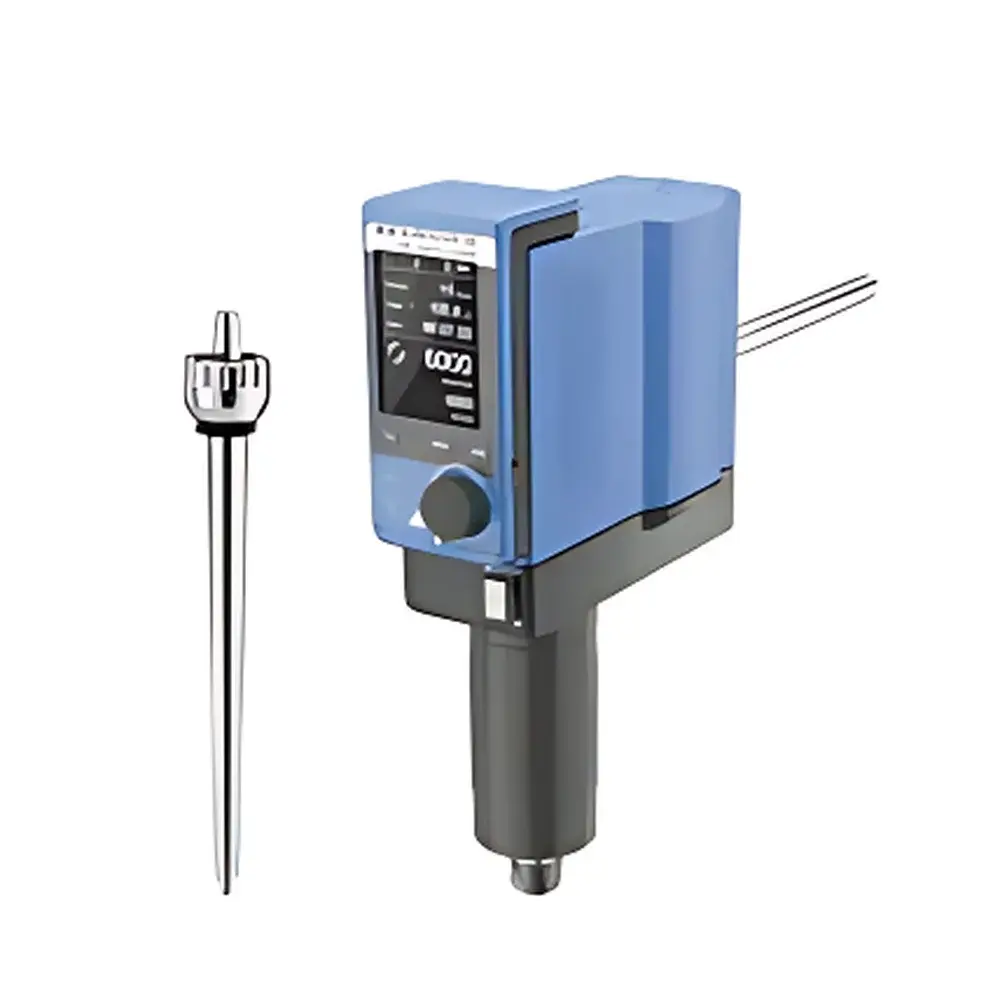
IKA Eurostar 20 High-Speed Controlled Stirrer
| Brand | IKA |
|---|---|
| Origin | Germany |
| Model | Eurostar 20 High-Speed Controlled |
| Max. Mixing Volume | 20 L |
| Speed Range | 0/150–6000 rpm |
| Temperature Control Range | –10 °C to +350 °C |
| Motor Output Power | 125 W |
| Max. Torque | 20 N·cm |
| Torque Measurement Accuracy | ±0.6 N·cm |
| Speed Setting Accuracy | ±1 rpm (n > 300 rpm) |
| Temp. Sensor | PT1000 (DIN IEC 751 Class A, ±0.5 K) |
| Display | Multilingual TFT |
| Interfaces | RS232, USB |
| IP Rating | IP40 |
| Dimensions | 86 × 325 × 230 mm |
| Weight | 4.7 kg |
Overview
The IKA Eurostar 20 High-Speed Controlled Stirrer is a precision-engineered laboratory stirrer designed for demanding mixing, dispersion, and homogenization tasks in R&D, quality control, and production environments. Based on brushless DC motor technology, it delivers high torque stability and exceptional speed reproducibility across its full operational range of 0/150–6000 rpm. Unlike conventional geared or induction-driven stirrers, the Eurostar 20 employs microprocessor-based closed-loop speed regulation—continuously monitoring and dynamically compensating for load fluctuations to maintain setpoint accuracy within ±1 rpm above 300 rpm. Its integrated torque trend display enables real-time monitoring of viscosity changes during shear-sensitive processes, supporting empirical rheological assessment without requiring external viscometers. The device supports continuous operation at 100% duty cycle and features an intelligent thermal management system that ensures stable performance even during extended high-load runs.
Key Features
- Brushless DC motor with 125 W output power and 20 N·cm maximum torque—eliminates carbon brush wear and enables maintenance-free long-term operation
- High-resolution multilingual TFT display with intuitive navigation and real-time visualization of speed, torque trend, temperature, and timer status
- Wireless remote control (up to 150 m line-of-sight range) with ergonomic handheld interface for safe operation in fume hoods or gloveboxes
- Integrated PT1000 temperature sensor interface (DIN IEC 751 Class A) supporting external probe connection for inline temperature monitoring and feedback-controlled heating/cooling systems
- Programmable interval operation and countdown timer (1–6000 min) with automatic start/stop functionality for unattended batch processing
- Comprehensive safety architecture including overload protection, short-term overtorque capability (up to 2× rated torque), electronic speed lock, and configurable safety cutoff thresholds
- Robust housing constructed from powder-coated cast aluminum and heat-resistant thermoplastic polymers; IP40-rated enclosure suitable for standard laboratory environments
- Dual digital communication interfaces (RS232 and USB) enabling seamless integration into LIMS, ELN, or automated lab platforms with full parameter logging and remote configuration
Sample Compatibility & Compliance
The Eurostar 20 accommodates a wide range of sample viscosities—from low-viscosity aqueous solutions (<1 mPa·s) up to highly viscous suspensions and pastes (≤10,000 mPa·s)—when paired with appropriate impellers (e.g., propeller, anchor, or dissolver types). Its 280 mm stainless-steel stirring shaft (220 mm max immersion depth) and 16 mm diameter extension arm support standardized clamp mounting per DIN ISO 8513. The instrument complies with EN 61010-1:2019 for electrical safety in laboratory equipment and meets EMC requirements per EN 61326-1:2013. While not intrinsically explosion-proof, its design adheres to cleanroom-compatible material specifications (non-shedding, low outgassing polymers) and supports GLP/GMP-aligned workflows through audit-trail-capable data export via RS232/USB.
Software & Data Management
All operational parameters—including speed setpoint, actual rpm, torque trend, elapsed time, temperature input, and error codes—are timestamped and recordable via built-in serial/USB protocols. IKA Labworld software (Windows-compatible, optional) provides graphical trend analysis, CSV export, and user-defined report templates compliant with FDA 21 CFR Part 11 requirements when configured with electronic signatures and access controls. Raw data logs include metadata such as operator ID, session start/end timestamps, and firmware revision—enabling traceability in regulated QC laboratories. No proprietary cloud dependency: local storage and manual export ensure full data sovereignty.
Applications
- Preparation of polymer emulsions and nanoparticle dispersions requiring precise shear history control
- Accelerated stability testing of pharmaceutical suspensions and topical formulations under controlled thermal conditions
- Homogenization of catalyst slurries in fine chemical synthesis prior to filtration or centrifugation
- Viscosity profiling of non-Newtonian fluids (e.g., xanthan gum solutions, CMC gels) using torque trend correlation
- Batch-wise dissolution testing in compliance with USP and Ph. Eur. 2.9.3 methodologies
- Cell culture media conditioning with oxygen transfer optimization via impeller geometry selection
FAQ
Does the Eurostar 20 support external temperature feedback control loops?
Yes—it features a dedicated PT1000 input channel compatible with Class A sensors, allowing integration with external heating mantles or Peltier modules for closed-loop thermal regulation.
Can torque data be exported in real time for external analysis?
Yes—via RS232 or USB, torque values (with ±0.6 N·cm resolution), speed, and temperature are streamed at configurable intervals (default: 1 Hz) in ASCII format.
Is the stirring shaft autoclavable?
No—the stainless-steel shaft is chemically resistant but not rated for repeated autoclaving; validated cleaning protocols using ethanol or alkaline detergents are recommended instead.
What impeller types are certified for use with this model?
IKA supplies ISO-standardized propeller (R 120), anchor (A 120), and dissolver (D 120) impellers; third-party impellers must conform to DIN 12697-33 mechanical coupling specifications.
How is calibration traceability maintained?
Speed and torque calibration certificates (traceable to PTB, Germany) are provided with each unit; periodic verification can be performed using NIST-traceable tachometers and calibrated torque standards.



