
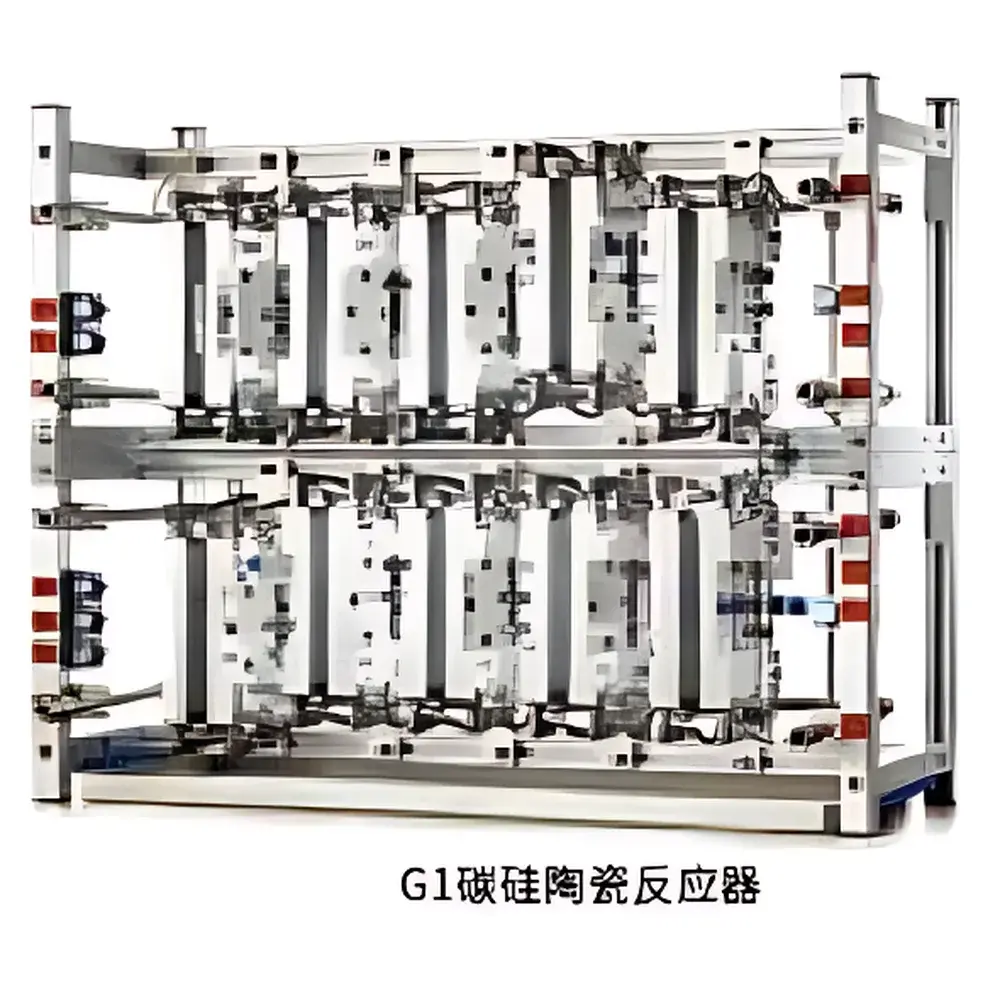
Corning Advanced-Flow® G1 Silicon Carbide Reactor
| Brand | Corning |
|---|---|
| Origin | USA |
| Model | Advanced-Flow® G1 |
| Reactor Type | Continuous Flow Microreactor |
| Construction Material | Silicon Carbide (SiC) with Aluminum Heat Exchange Module, PFA Tubing, and Perfluoroelastomer (FFKM) Seals |
| Operating Temperature Range | –60 °C to 200 °C |
| Maximum Operating Pressure | 18 barg (reaction channel), 6 barg (heat exchange layer) |
| Volumetric Flow Rate | 15–250 mL/min |
| Internal Hold-up Volume per Module | ~10 mL |
| Chemical Resistance | HF-compatible, caustic-resistant up to 200 °C |
| Modular Compatibility | Interchangeable with Corning Advanced-Flow® G1 Glass Modules |
| Metal-Free Fluid Path | Yes |
| Scale-up Pathway | Seamless transition from G1 lab-scale to G4 production-scale with no scale-up effect |
Overview
The Corning Advanced-Flow® G1 Silicon Carbide Reactor is a precision-engineered continuous flow microreactor designed for demanding synthetic chemistry applications where extreme chemical resistance, thermal stability, and reproducible mass/heat transfer performance are critical. Built upon Corning’s proprietary silicon carbide (SiC) monolithic architecture, the G1 SiC reactor leverages the intrinsic material advantages of SiC—including exceptional resistance to hydrofluoric acid (HF), hot concentrated alkalis (e.g., 50% NaOH at 200 °C), and aggressive oxidants—while maintaining structural integrity under sustained thermal and pressure cycling. Unlike glass or stainless-steel alternatives, the SiC core eliminates metal leaching, enabling catalytic reactions involving sensitive transition metals and photochemical processes requiring UV transparency in hybrid configurations. The reactor operates on the principle of laminar flow-based residence time control within precisely defined microchannels, ensuring narrow residence time distribution (RTD) and high interfacial area-to-volume ratios (>10,000 m²/m³), which directly enhance reaction kinetics, selectivity, and safety profile for exothermic transformations.
Key Features
- Chemically inert silicon carbide fluidic path—validated for compatibility with HF, molten alkalis, chlorine-containing reagents, and strong oxidizers (e.g., HNO₃/H₂SO₄ mixtures) across –60 °C to 200 °C.
- Dual-layer design: Reaction channels embedded within an integrated aluminum heat exchange manifold enables rapid, uniform thermal management with ΔT < ±0.5 °C across full flow range (15–250 mL/min).
- Modular interoperability: G1 SiC modules mechanically and fluidically interface with existing Corning G1 glass modules using standardized flange geometry and FFKM gaskets—enabling hybrid reactor trains combining optical monitoring (glass segments) and corrosion-resistant quenching or neutralization (SiC segments).
- Zero-metal contact fluid path: All wetted surfaces consist solely of SiC, PFA, and FFKM—critical for organometallic synthesis, pharmaceutical intermediate manufacturing, and electrochemical flow cell integration.
- No scale-up effect: Identical channel geometry, surface roughness, and thermal boundary conditions between G1 (lab), G2 (pilot), and G4 (production) platforms ensure direct process transfer validated per ICH Q5A and Q5C guidelines.
Sample Compatibility & Compliance
The G1 SiC Reactor supports a broad spectrum of chemistries—including lithiation, nitration, diazotization, hydrogenation, and enzymatic cascades—under GLP-compliant operation when paired with Corning’s validated control systems. Its construction meets ASTM F2798 (standard specification for polymeric components in pharmaceutical processing equipment) and complies with USP Analytical Instrument Qualification requirements for hardware qualification (IQ/OQ). The absence of extractables and leachables—confirmed via LC-MS/MS testing per USP Annex 3—ensures suitability for API synthesis under FDA 21 CFR Part 211 and EMA Annex 15. Full documentation packages—including material traceability certificates (ASTM E2928), pressure vessel certification (ASME BPVC Section VIII Div. 1), and corrosion resistance test reports (NACE TM0169)—are available upon request.
Software & Data Management
When integrated with Corning’s FlowManager™ software (v4.2+), the G1 SiC Reactor supports automated method execution, real-time PID-controlled temperature/pressure logging, and synchronized data capture from external analytical interfaces (e.g., inline FTIR, Raman, or UV-Vis). Audit trails comply with 21 CFR Part 11 requirements, including electronic signatures, role-based access control, and immutable event logs. Process parameters are exportable in CSV and ASTM E2500-compliant XML formats for integration into LIMS and MES platforms. Calibration records and preventive maintenance schedules are tracked within the software’s built-in asset management module, supporting ISO 9001:2015 and ISO/IEC 17025:2017 laboratory accreditation frameworks.
Applications
- High-risk nitrations and halogenations requiring sub-zero temperature control and HF handling (e.g., fluorination of aryl diazonium salts).
- Base-catalyzed condensations (e.g., Claisen, aldol) at elevated temperatures (>150 °C) where glass erosion or stainless-steel passivation failure occurs.
- Multi-step telescoped syntheses combining photoredox activation (in G1 glass segments) followed by immediate quenching in SiC modules to suppress overreaction.
- Continuous crystallization and nanoparticle synthesis leveraging SiC’s superior nucleation control and fouling resistance in supersaturated alkaline media.
- Process safety studies (RC1, ARC) for highly exothermic reactions, enabled by the reactor’s 0.25 W/K thermal conductance and sub-second thermal response time.
FAQ
Can the G1 SiC reactor be used for photochemical reactions?
Yes—when coupled with G1 glass modules in hybrid configurations, the system retains full UV-Vis transparency (200–800 nm) for photoredox, [2+2] cycloadditions, or singlet oxygen generation.
Is cleaning validation supported for GMP manufacturing?
Yes—SiC’s non-porous surface (Ra < 0.05 µm) enables validated cleaning protocols per PDA TR29; residue detection limits ≤1 ppm are routinely achieved using swab + HPLC-UV methods.
What is the maximum allowable thermal gradient across the reactor block?
Under steady-state operation at 200 °C and 18 barg, finite element analysis confirms a maximum axial gradient of 1.2 °C/cm and radial gradient of 0.3 °C/cm—well within recommended limits for kinetic modeling fidelity.
Does Corning provide engineering support for custom manifold integration?
Yes—Corning’s Application Engineering Group offers DQ/IQ protocol development, hydraulic modeling (ANSYS Fluent), and ASME code-stamped mechanical interface design for turnkey skid integration.
How is leak integrity verified during factory acceptance testing?
Each unit undergoes helium mass spectrometry leak testing per ISO 10648-2 Class 2 (≤1 × 10⁻⁹ mbar·L/s), followed by hydrostatic pressure hold at 1.5× MAWP for 30 minutes with zero pressure decay observed.



