
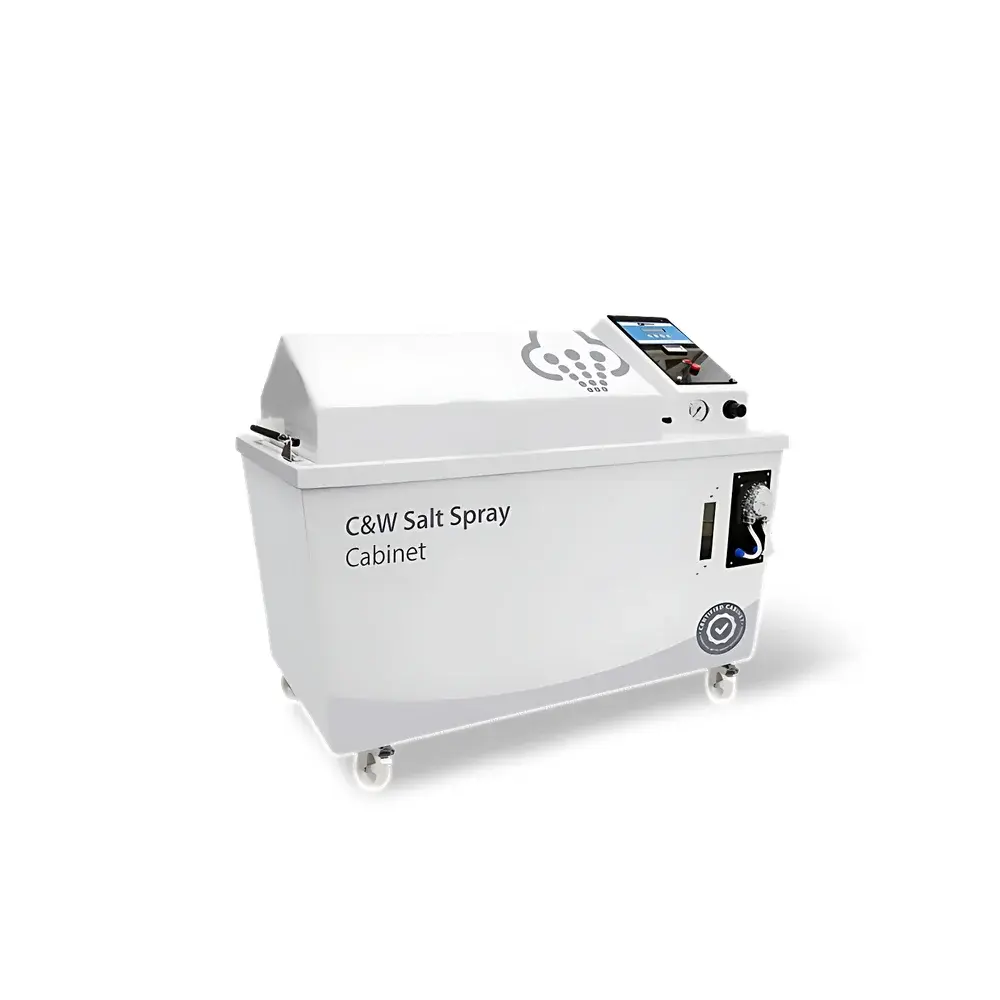
C&W CW Series Cyclic Corrosion Test Chamber
| Brand | C&W |
|---|---|
| Origin | Netherlands |
| Model | CW Series Cyclic Corrosion Test Chamber |
| External Dimensions (L×W×H) | 1000×600×645 mm to 2750×1220×1630 mm |
| Internal Dimensions (L×W×H¹×H²) | 600×450×375×565 mm to 2000×1000×850×1175 mm |
| Power Supply | Single-phase or three-phase 380 V, 50/60 Hz |
| Compressed Air Requirement | Oil-free, dry, clean air |
| Humidity Range | 15% to 98% RH (controlled) |
| Temperature Control | Integrated refrigeration compressor system (continuous or standby operation) |
| Optional Features | Deionizer & sediment filter (recommended for water with >50 mg/L TDS), low-water-level alarm, external salt fog collection vessel, condensate-controlled fog generation, variable ventilation, ergonomic control panel, GRP composite enclosure with chemical/thermal resistance, pneumatic lid support, modular sample mounting fixtures |
Overview
The C&W CW Series Cyclic Corrosion Test Chamber is a precision-engineered environmental test system designed to replicate and accelerate complex, multi-stage corrosion environments encountered in real-world automotive, aerospace, marine, and industrial coating applications. Unlike conventional salt spray chambers operating under static ASTM B117 conditions, the CW Series implements programmable cyclic exposure sequences—including neutral salt fog (NSS), acidic salt fog (AASS), drying phases, and high-humidity condensation stages—per ISO 16701, ASTM G85 Annex A5, VDA 621-415, and GMW 14872 protocols. Its core architecture integrates a dual-mode humidity generation system, refrigerated dehumidification, and closed-loop temperature control to maintain tight tolerances across all cycle segments. The chamber’s GRP (glass-reinforced polyester) enclosure provides long-term resistance to chloride-induced degradation, while its modular internal geometry supports standardized specimen racks and custom fixture integration.
Key Features
- Programmable multi-phase corrosion cycles compliant with ISO 16701, ASTM G85 Annexes, and OEM-specific standards (e.g., Ford CETP, VW PV1210)
- Integrated oil-free refrigerated compressor system enabling continuous or duty-cycled operation with thermal stability ±1.5°C
- Humidity control from 15% to 98% RH via PID-regulated steam injection and chilled coil dehumidification
- Automated salt solution delivery with adjustable nozzle pressure (2–4 bar), flow regulation, and calibrated fog density monitoring
- Ergonomic touchscreen HMI with password-protected user levels, audit trail logging, and real-time parameter visualization
- GRF-reinforced composite construction with UL94-V0 flame rating, chemical resistance to 10% NaCl, HNO₃, and organic solvents
- Pneumatically assisted hinged lid with safety interlock and quick-release mechanism for unrestricted access during sample loading
- Optional deionization and particulate filtration unit for feed water with TDS >50 mg/L—critical for reproducible fog chemistry
Sample Compatibility & Compliance
The CW Series accommodates flat panels (up to 1000 mm × 1000 mm), 3D components, fasteners, and assembled subassemblies using standardized ISO 1461-compliant sample holders and customizable mounting brackets. All models meet CE marking requirements under the EU Machinery Directive 2006/42/EC and Electromagnetic Compatibility Directive 2014/30/EU. Environmental compliance includes adherence to ISO/IEC 17025 calibration traceability pathways for temperature, humidity, and pH of collected fog. Data integrity meets FDA 21 CFR Part 11 requirements when paired with optional electronic signature and audit trail modules. The system supports GLP/GMP validation documentation packages including IQ/OQ/PQ protocols and uncertainty budgeting per ISO/IEC 17025 Clause 7.6.
Software & Data Management
Control and data acquisition are managed through C&W’s proprietary CycliSoft™ software suite, compatible with Windows 10/11 and deployable on local PCs or networked servers. CycliSoft™ enables full-cycle programming with up to 999 steps per test sequence, real-time deviation alerts, and automatic export of CSV/Excel-compatible reports with timestamps, setpoint tracking, and alarm history. The software supports configurable electronic signatures, role-based access control, and encrypted database storage. Optional cloud synchronization allows remote monitoring via secure HTTPS interface with TLS 1.2 encryption. All logged parameters—including chamber temperature, relative humidity, fog deposition rate (measured via ASTM D1654-compliant collectors), and compressor runtime—are stored with millisecond timestamp resolution and retained for ≥10 years per internal SSD archive.
Applications
This chamber serves as a primary qualification tool for evaluating corrosion resistance of electroplated zinc-nickel coatings, automotive body-in-white assemblies, aluminum alloy die-cast housings, marine-grade stainless steels, and polymer-coated fasteners. It is routinely deployed in R&D labs for formulation screening of anti-corrosion primers, QC release testing of supplier parts per IATF 16949 clause 8.4.2.3, and durability validation against OEM-specific material specifications (e.g., BMW GS 90010, Toyota TSL 0401G). Academic users apply it in fundamental studies of pitting initiation kinetics, galvanic coupling behavior, and atmospheric chloride transport modeling under controlled hygrothermal stress.
FAQ
What international corrosion testing standards does the CW Series support?
It natively executes test profiles defined in ISO 16701, ASTM G85 Annex A1–A5, JASO M609, VDA 621-415, and GMW 14872, with customizable cycle definitions for proprietary OEM methods.
Is compressed air supply mandatory—and what quality specifications apply?
Yes: oil-free, desiccated air at 3.5 cfm and 2–4 bar is required for consistent fog atomization; C&W recommends inline coalescing filters and refrigerated dryers meeting ISO 8573-1 Class 2:2:2.
Can the chamber operate unattended for extended durations (e.g., 30+ days)?
Yes—equipped with redundant level sensors, auto-refill reservoirs, thermal cutouts, and remote alarm relay outputs compatible with building management systems (BMS).
How is fog deposition rate verified and maintained over time?
ASTM D1654-compliant collection vessels are positioned per ISO 9227 orientation guidelines; deposition volume is measured gravimetrically every 24 h and logged automatically via integrated scale interface.
Does the system support IQ/OQ/PQ validation out of the box?
Yes—factory-supplied validation kits include temperature/humidity mapping protocols, fog uniformity test plans, and electronic record templates aligned with ISO/IEC 17025 and 21 CFR Part 11 requirements.



