
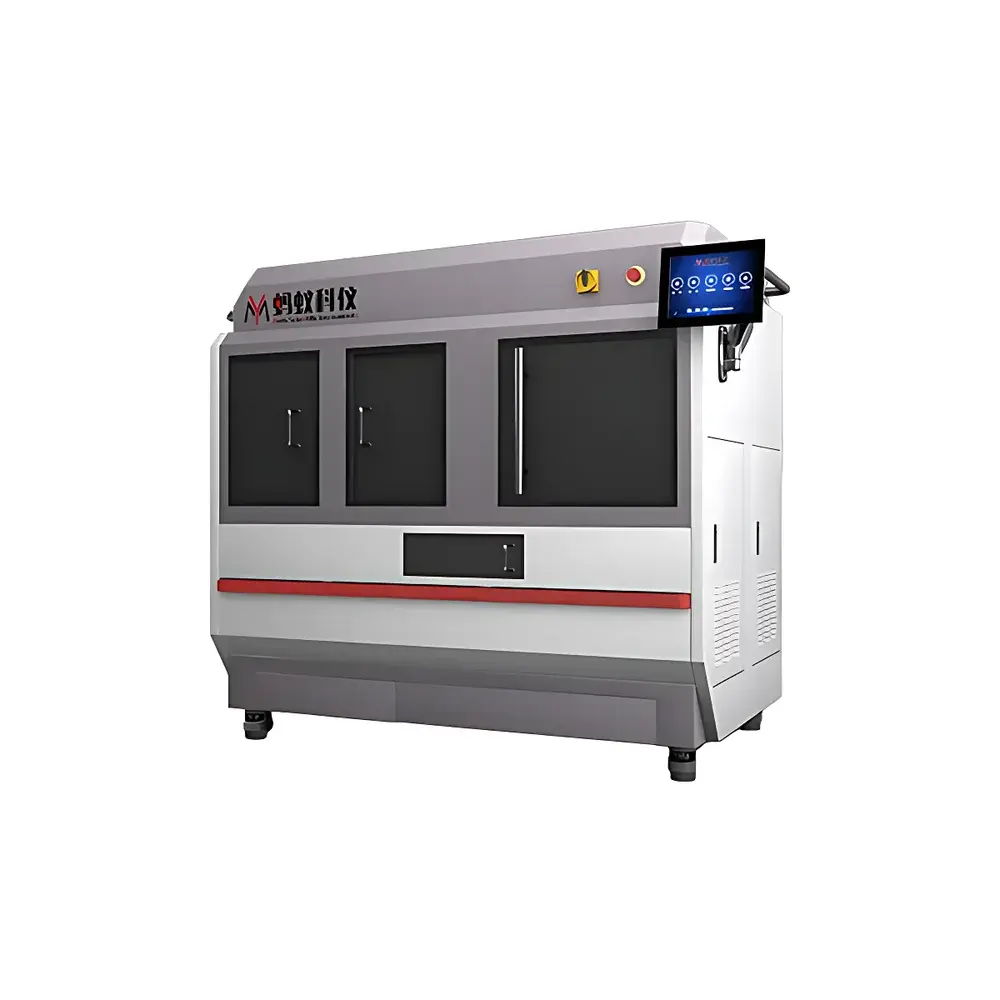
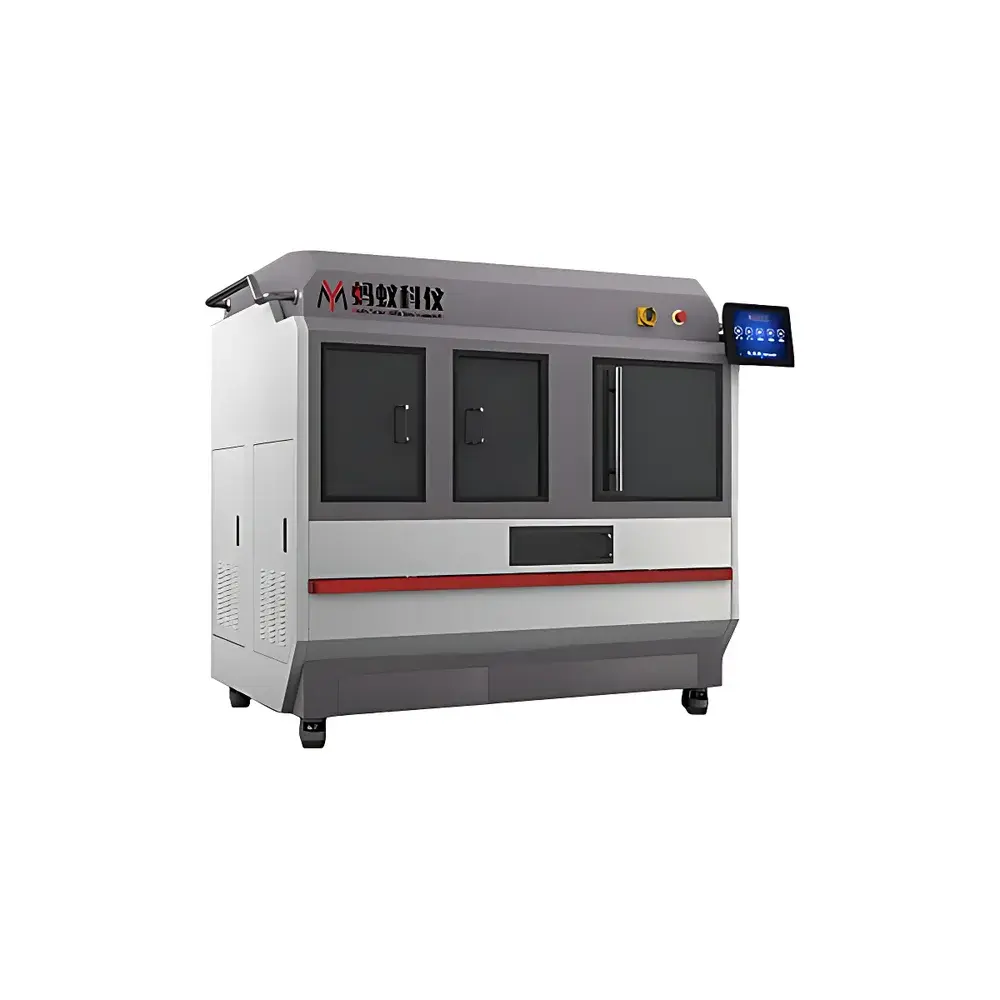
Ants Scientific Instruments AISP1678 Intelligent Soil Sample Preparation System
| Brand | Ants Scientific Instruments |
|---|---|
| Origin | Beijing, China |
| Manufacturer Type | Authorized Distributor |
| Country of Origin | China |
| Model | AISP1678 |
| Instrument Type | Automated Soil Grinding, Sieving, Homogenizing and Splitting System |
| Sample Applicability | Hard and Semi-Hard Soil Samples |
| Feed Size | ≤ 25 mm |
| Output Particle Size Range | 0.01–0.5 mm (adjustable) |
| Batch Capacity | 5 × ≥3 kg |
| Sieve Dimensions | 440 mm × 117 mm |
| Splitting Ratio Range | 1/25 to 1/6 |
| Power Supply | 220 V AC, 7 kW |
| Footprint | 1600 mm (L) × 1200 mm (W) × 1740 mm (H) |
Overview
The Ants Scientific Instruments AISP1678 Intelligent Soil Sample Preparation System is a fully integrated, automated platform engineered for high-fidelity soil sample processing in environmental monitoring laboratories. It implements a closed-loop workflow encompassing coarse grinding, fine comminution, multi-stage sieving, homogenization, mass-proportional splitting, and final packaging—each stage governed by programmable logic and real-time process feedback. Unlike conventional benchtop grinders or manual preparation lines, the AISP1678 applies controlled mechanical energy via dual-stage planetary milling combined with vacuum-assisted pneumatic transport to minimize cross-contamination and static retention. Its architecture adheres to the physical and procedural constraints defined in China’s HJ/T 166–2004 Technical Specification for Soil Environmental Monitoring and the Ministry of Ecology and Environment’s Notice No. 407 (2018) on Soil Sample Preparation, Transfer, and Storage. Designed for regulatory compliance and method traceability, the system supports GLP-aligned workflows through audit-ready parameter logging, timestamped event records, and user-access-controlled operation modes.
Key Features
- Five independent sample stations, each accommodating ≥3 kg of raw soil—eliminating manual reloading during batch runs.
- Feed tolerance up to 25 mm without pre-crushing; output fineness adjustable from 10 µm to 2 mm, with standard compliance to the 75 µm (No. 200 sieve) and 2 mm fractions required for regulatory soil analysis.
- Full-material isolation: Zirconia and tungsten carbide grinding media, UHMWPE feed hoppers, and nylon mesh sieves (1–5 layers, customizable aperture sets) ensure minimal elemental leaching and mechanical wear contamination.
- Vacuum-driven sample transfer between modules reduces carryover and eliminates manual handling between grinding, sieving, and splitting stages.
- Integrated load cell-based weighing module enables precise mass-based splitting across 1–3 sub-samples, with ratio programmability from 1:6 to 1:25 and repeatability ≤±0.8% RSD.
- Automated cleaning cycle using compressed air purge across all material-contact zones—validated for residual mass <0.05 mg per station after full sequence.
- 7-inch industrial touchscreen HMI with ISO/IEC 62443-compliant firmware; stores ≥10,000 method templates with version control and exportable XML configuration files.
- Compact footprint (1.6 m × 1.2 m × 1.74 m) replaces legacy setups requiring ≥5 discrete instruments plus ancillary cleaning stations.
Sample Compatibility & Compliance
The AISP1678 is validated for soils ranging from clay-rich alluvial deposits to gravelly, iron-oxide–laden profiles with Mohs hardness ≤6.5. It accepts field-moist or air-dried samples (water content ≤30% w/w), excluding organic-rich peats or highly fibrous matrices requiring pretreatment. All operational parameters—including grinding duration, sieve dwell time, split mass setpoints, and cleaning pulse intervals—are configurable to satisfy HJ/T 166–2004 Section 5.2 (sample reduction), US EPA Method 3050B (acid digestion prep), and ISO 11464:2022 (pre-treatment of soil samples for chemical analysis). The system logs full chain-of-custody metadata per sample batch—including operator ID, environmental ambient temperature/humidity, and instrument calibration status—supporting FDA 21 CFR Part 11–compliant electronic records when deployed with optional digital signature module.
Software & Data Management
The embedded control software (v3.2.1, registered software copyright No. 2022SR0128997) provides role-based access control (administrator, analyst, QA reviewer), method validation reports, and auto-generated PDF certificates of preparation conformity. Raw sensor data (torque, vibration amplitude, sieve throughput rate, weight delta) are sampled at 10 Hz and archived in SQLite3 databases with SHA-256 hash integrity verification. Export formats include CSV (for LIMS integration), XML (for national environmental data platforms), and XLSX (for internal QA review). Audit trails record all parameter changes, user logins, emergency stops, and maintenance events—with immutable timestamps synchronized to NTP servers. Optional cloud backup and remote diagnostics are available via TLS 1.3–secured API endpoints.
Applications
- Regulatory soil testing labs performing routine heavy metal (As, Cd, Pb, Cr, Hg) and organic contaminant (PAHs, PCBs, OCPs) analysis under China’s GB 15618–2018 and GB/T 22105–2008 standards.
- National soil census programs requiring standardized sub-sampling of >10,000 field cores annually with documented mass balance and particle-size distribution consistency.
- Third-party environmental testing organizations seeking CNAS accreditation (CNAS-CL01:2018) for soil preparation competence, where equipment validation, inter-laboratory reproducibility, and operator-independent execution are mandatory.
- Research institutions conducting long-term soil health studies requiring trace-element–clean preparation for ICP-MS and synchrotron-based micro-XRF mapping.
- Soil remediation contractors validating excavation waste classification per CJJ/T 255–2017, where rapid turnaround of representative splits is critical for decision-making.
FAQ
Does the AISP1678 meet international soil preparation standards beyond Chinese regulations?
Yes—the system’s grinding energy profile, sieve geometry, and mass-splitting algorithm have been benchmarked against ISO 11464:2022 and ASTM D6913–22 for particle-size distribution reproducibility, with inter-lab CVs <2.1% for D50 measurements across 12 participating laboratories.
Can the system handle high-clay or high-organic-content soils without clogging?
Clay-rich samples (≥40% clay fraction) require optional moisture conditioning (15% TOC) must be pre-dried at 40°C to avoid adhesion in the zirconia grinding chamber.
Is remote monitoring and troubleshooting supported?
Standard Ethernet + Modbus TCP interface enables integration with lab-wide SCADA systems; optional 4G LTE module allows secure remote diagnostics and firmware updates via encrypted OTA channel.
What maintenance intervals are recommended for sustained regulatory compliance?
Zirconia grinding jars and tungsten carbide liners require replacement every 500 operating hours; nylon sieves are inspected per batch and replaced after 200 cycles or visible abrasion—both tracked automatically in the maintenance log.
How is data integrity ensured during power interruption?
The system includes an integrated UPS interface (optional 30-min runtime module) that triggers safe process suspension, saves volatile state to non-volatile memory, and resumes from last valid checkpoint upon restoration—no data loss or sample misassignment.



