
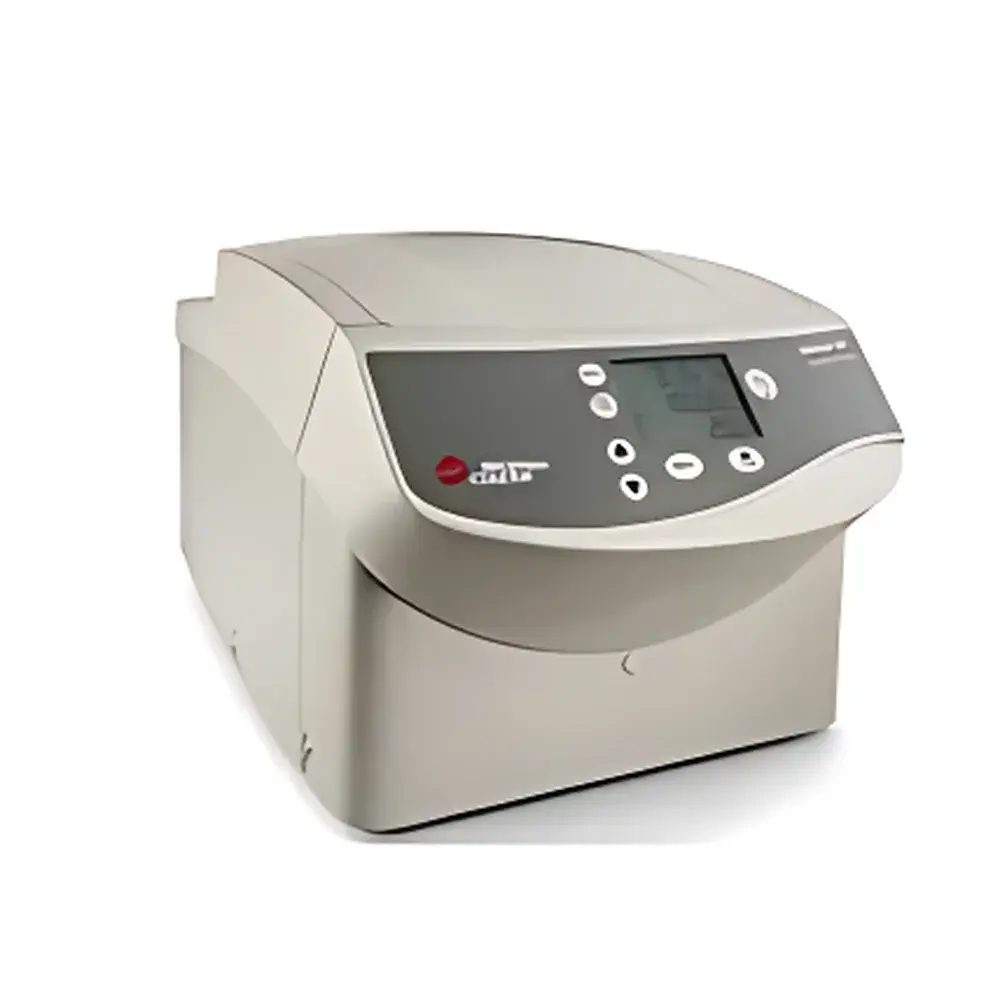
Beckman Coulter Microfuge 20 Series Benchtop Microcentrifuge
| Brand | Beckman Coulter |
|---|---|
| Origin | USA |
| Manufacturer Type | Authorized Distributor |
| Product Category | Imported Instrument |
| Model | Microfuge 20 |
| Instrument Type | Benchtop Centrifuge |
| Speed Range | Up to 15,000 rpm |
| Maximum RCF | 20,627 × g |
| Maximum Capacity | 36 × 1.5/2.0 mL tubes |
| Temperature Control | Non-refrigerated (Microfuge 20) |
| Rotor Options | 4 interchangeable fixed-angle rotors including biocontainment-certified rotor |
| Dimensions (W×D×H) | 31 × 42 × 27 cm |
| Compliance | Meets IEC 61010-1 safety standards |
Overview
The Beckman Coulter Microfuge 20 Series benchtop microcentrifuge is an engineered solution for high-efficiency, low-volume sample separation in molecular biology, clinical diagnostics, and cell culture laboratories. Designed around fixed-angle rotor architecture and optimized for routine centrifugation of biological suspensions, it operates on the principle of sedimentation force generation via angular acceleration—delivering precise and reproducible g-force application across diverse sample types. Its non-refrigerated configuration (Microfuge 20) supports ambient-temperature protocols such as plasmid DNA pelleting, bacterial cell harvesting, and protein precipitation, while the refrigerated variant (Microfuge 20R) extends utility to temperature-sensitive applications including enzyme isolation and RNA stabilization. With a maximum rotational speed of 15,000 rpm and corresponding relative centrifugal force (RCF) of 20,627 × g, the system achieves rapid pellet formation without compromising structural integrity of nucleic acids or subcellular organelles.
Key Features
- Four interchangeable fixed-angle rotors—including a biocontainment-certified rotor validated for aerosol containment during high-speed operation, compliant with WHO Laboratory Biosafety Manual (4th ed.) and CDC/NIH guidelines for BSL-2 workflows
- Direct digital display toggling between rpm and ×g units, enabling immediate interpretation of centrifugal conditions without manual conversion
- Programmable memory for up to six user-defined protocols, supporting GLP-compliant workflow repeatability and reducing operator-dependent variability
- Compact footprint (31 × 42 × 27 cm) optimized for limited bench space while maintaining full 36-tube capacity (1.5/2.0 mL conical tubes)
- Brushless induction motor delivering consistent torque output and extended service life under continuous daily use
- Automatic rotor recognition logic prevents mismatched speed settings and enforces safe operational limits per rotor specifications
Sample Compatibility & Compliance
The Microfuge 20 Series accommodates standard microcentrifuge tubes (0.2–2.0 mL), PCR strips, and skirted 8-tube racks. Rotors are certified for autoclaving at 121 °C for 20 minutes, ensuring compatibility with stringent decontamination requirements in regulated environments. All rotors undergo individual dynamic balancing verification and are traceable to NIST-traceable calibration records. The system complies with IEC 61010-1 for electrical safety and meets mechanical stability criteria defined in ISO 15189 Annex A.4 for centrifuge validation in accredited medical laboratories. Biocontainment rotors carry independent third-party verification for aerosol suppression efficiency ≥99.99% at 15,000 rpm, satisfying CLSI EP25-A2 recommendations for infectious agent handling.
Software & Data Management
While the Microfuge 20 operates via embedded firmware without external software dependency, its programmable interface supports audit-ready documentation through optional RS-232 or USB serial logging (via compatible data acquisition modules). Protocol parameters—including time, speed, RCF, and brake profile—are stored in non-volatile memory with timestamped access logs. When integrated into LIMS or ELN ecosystems, instrument-generated metadata can be mapped to electronic batch records in accordance with FDA 21 CFR Part 11 requirements for electronic signatures and record retention. Firmware updates follow Beckman Coulter’s validated change control process, documented per ISO 13485:2016 clause 7.5.2.
Applications
- Routine pelleting of E. coli, yeast, and mammalian cells at speeds sufficient for cytoplasmic fractionation without nuclear lysis
- Nucleic acid purification workflows requiring rapid clarification of lysates prior to column binding or ethanol precipitation
- Preparative isolation of extracellular vesicles from conditioned media using differential centrifugation steps (e.g., 2,000 × g → 10,000 × g → 20,000 × g)
- Protein concentration and desalting via spin-column formats compatible with 1.5 mL tube geometry
- High-throughput sample preparation for next-generation sequencing library construction where minimal thermal drift and consistent RCF delivery are critical
FAQ
Is the Microfuge 20 suitable for BSL-2 laboratory operations?
Yes—the optional biocontainment rotor is independently tested for aerosol containment and approved for use with risk group 2 (RG2) agents under CDC/NIH guidelines.
Can rotor calibration certificates be provided for ISO 17025-accredited labs?
Yes, Beckman Coulter provides NIST-traceable rotor calibration reports upon request, aligned with ISO/IEC 17025:2017 clause 6.4.10.
Does the Microfuge 20 support regulatory compliance for pharmaceutical QC labs?
It meets foundational requirements for equipment qualification (IQ/OQ) per ASTM E2500-13 and supports GMP-aligned documentation when used with validated protocols and logbook practices.
What maintenance intervals are recommended for sustained performance?
Annual preventive maintenance is advised, including dynamic rotor balance verification, drive shaft inspection, and brake wear assessment per Beckman Coulter Service Bulletin SB-MF20-004.
How does the Microfuge 20 compare to refrigerated models in terms of thermal management?
The Microfuge 20R maintains ±2 °C setpoint accuracy from 4–40 °C across full speed range; the non-refrigerated Microfuge 20 relies on ambient lab conditions and passive heat dissipation via aluminum housing.



