
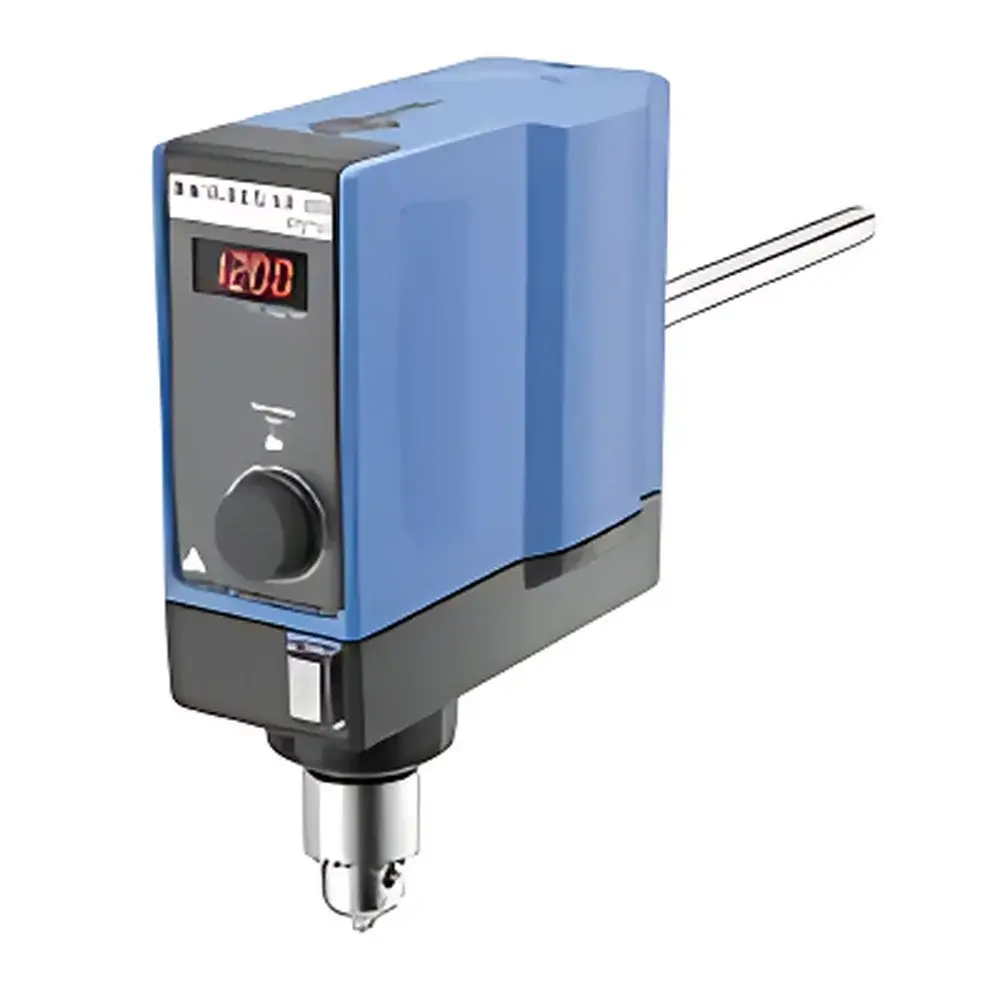
IKA EUROSTAR 100 digital Overhead Stirrer
| Brand | IKA |
|---|---|
| Origin | Germany |
| Model | EUROSTAR 100 digital |
| Max. Stirring Volume (H₂O) | 100 L |
| Motor Input Power | 186 W |
| Motor Output Power | 136 W |
| Drive Type | Brushless DC Motor |
| Speed Range | 0/30–1300 rpm |
| Speed Display | LED, 7-segment |
| Speed Control | Electronic, Continuously Variable |
| Speed Setting Accuracy | ±1 rpm |
| Speed Measurement Deviation | ±1% (n > 300 rpm), ±3 rpm (n < 300 rpm) |
| Max. Viscosity | 70,000 mPa·s |
| Max. Torque | 100 N·cm |
| Duty Cycle | 100% continuous operation |
| Stirring Shaft Clamp | Quick-fit chuck, 0.5–10 mm diameter range |
| Hollow Shaft | Ø11 mm internal diameter, insertable during standstill |
| Support Arm | Ø16 mm, 220 mm length |
| Housing Material | Cast aluminum with thermoplastic polymer coating |
| Dimensions (W×H×D) | 86 × 248 × 208 mm |
| Weight | 3.9 kg |
| Ambient Temperature Range | 5–40 °C |
| Relative Humidity Limit | ≤80% RH |
| Protection Class | IP42 (DIN EN 60529) |
| Supply Voltage | 230 V AC |
| Frequency | 50/60 Hz |
| Safety Features | Automatic motor shutdown on stall/overload, real-time speed monitoring & correction, error code display |
| Acoustic Noise Level | Low-noise operation |
Overview
The IKA EUROSTAR 100 digital is a high-performance overhead stirrer engineered for precision, reliability, and long-term stability in demanding laboratory environments. Designed around a brushless DC motor architecture, it eliminates carbon brush wear—ensuring consistent torque delivery, extended service life, and minimal maintenance over thousands of operational hours. Its core measurement principle relies on closed-loop electronic speed regulation: an integrated microprocessor continuously compares actual shaft rotation (measured via optical or Hall-effect sensing) against the user-defined setpoint and dynamically adjusts power output to maintain nominal speed—even under dynamic viscosity shifts or load fluctuations. This capability is critical for reproducible mixing in applications ranging from polymer dissolution and suspension homogenization to high-viscosity emulsion preparation. With a maximum rated torque of 100 N·cm and capacity to handle media up to 70,000 mPa·s, the EUROSTAR 100 digital supports scalable process development from benchtop to pilot-scale volumes, including full 100 L aqueous systems.
Key Features
- Brushless DC motor delivering 136 W continuous output power and stable torque across the entire speed range (0/30–1300 rpm)
- High-resolution LED display with 7-segment readout for real-time speed monitoring and intuitive parameter navigation
- True continuous (stepless) speed control with ±1 rpm setting resolution and closed-loop feedback correction
- Hollow stirring shaft (11 mm internal diameter) enabling insertion of temperature probes, pH electrodes, or sampling needles without interrupting agitation
- Integrated safety circuitry that detects motor stall or thermal overload and initiates immediate shutdown—compliant with IEC 61000-6-2/6-4 EMC requirements
- Robust cast aluminum housing with thermoplastic polymer coating for chemical resistance and mechanical durability
- IP42-rated enclosure providing protection against solid objects >1 mm and vertically falling water droplets—suitable for standard wet-lab conditions
- Error-code diagnostics displayed directly on the front panel for rapid troubleshooting and preventive maintenance planning
Sample Compatibility & Compliance
The EUROSTAR 100 digital accommodates a broad spectrum of sample types—from low-viscosity buffers and solvents to highly structured gels, pastes, and non-Newtonian suspensions. Its wide clamping range (0.5–10 mm) supports standard glass, PTFE-coated, and custom-engineered impellers—including propeller, anchor, paddle, and helical geometries. The device meets essential regulatory prerequisites for GLP-compliant laboratories: its deterministic speed control architecture supports audit-ready documentation when paired with external data loggers; firmware revision history and calibration traceability are maintained per IKA’s ISO 9001-certified quality system. While not intrinsically certified for hazardous-area use, its design adheres to DIN EN 61010-1 safety standards for electrical equipment used in laboratory settings.
Software & Data Management
Although the EUROSTAR 100 digital operates as a standalone instrument, its RS232 interface enables integration into centralized lab automation networks. When connected to IKA’s Labworldsoft® software (v4.0+), users gain access to time-stamped speed profiles, torque trend logging, remote parameter adjustment, and exportable CSV datasets compatible with LIMS and ELN platforms. All digital interactions—including parameter changes and fault events—are timestamped and stored locally, supporting 21 CFR Part 11 readiness when deployed with appropriate system validation protocols and user-access controls.
Applications
- Homogenization of ceramic slurries and battery electrode pastes in materials R&D
- Controlled dispersion of nanomaterials in solvent-based matrices
- Batch-wise synthesis of hydrogels and viscoelastic polymers under shear-defined conditions
- Long-duration microbial culture agitation where speed constancy directly impacts oxygen transfer efficiency
- Preparation of pharmaceutical suspensions and ointment bases requiring uniform particle distribution
- Environmental testing of sediment-water interaction kinetics under simulated flow regimes
FAQ
Can the EUROSTAR 100 digital be used with corrosive solvents?
Yes—provided the stirring shaft and impeller are chemically compatible. The unit’s housing resists common lab reagents, but direct solvent exposure to electronics should be avoided.
Is it possible to calibrate the speed sensor independently?
No field calibration is required; factory calibration is traceable to national metrology institutes. Users may verify performance using a certified tachometer per ISO 5725 guidelines.
Does the device support external start/stop signals?
Not natively—only via optional Labworldsoft®-driven serial command sequences or third-party PLC interfacing through the RS232 port.
What is the expected service life of the brushless motor?
Rated for ≥20,000 hours of continuous operation under nominal load, assuming ambient conditions within specification limits.
Can multiple units be synchronized for parallel reactor operation?
Synchronization is not hardware-supported, but coordinated timing can be achieved programmatically via Labworldsoft® or external SCADA systems.



