
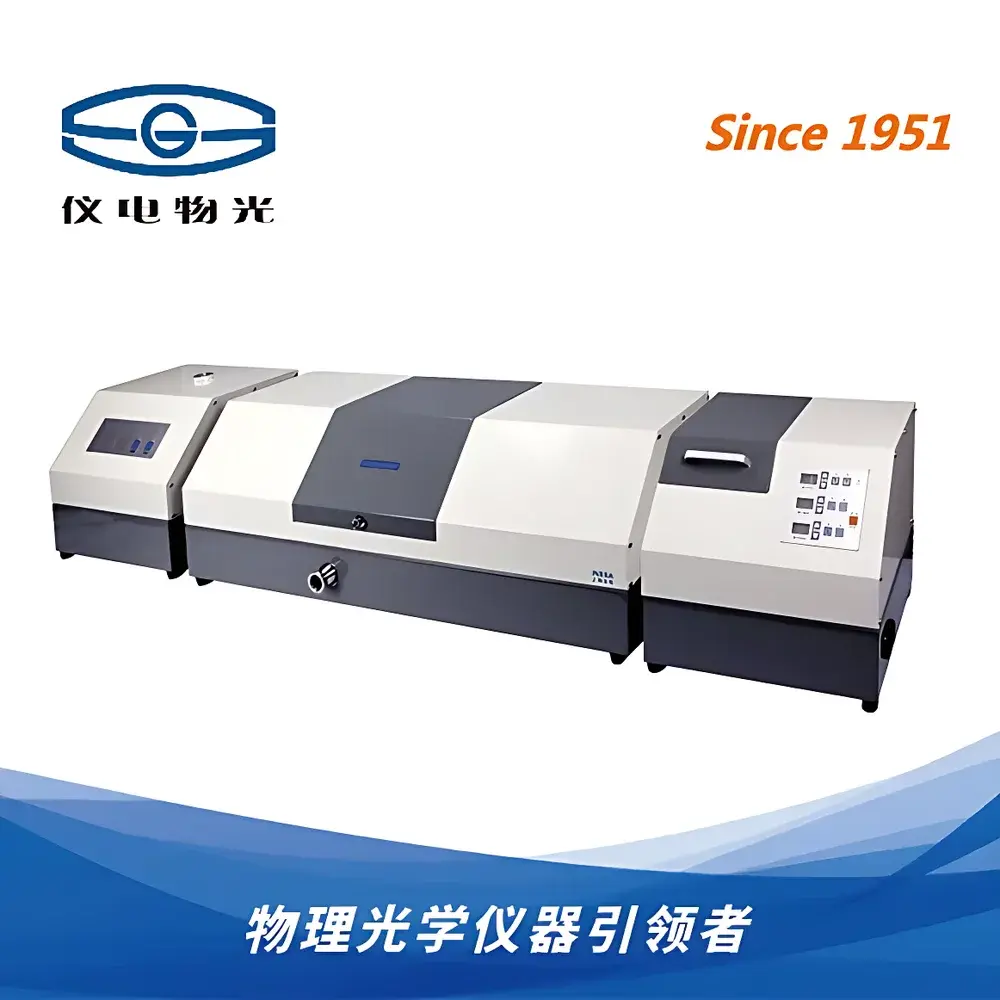
YDWO WJL-Series Dry/Wet Laser Particle Size Analyzer
| Brand | YDWO (Shanghai Instrumentation & Physical Optics) |
|---|---|
| Origin | Shanghai, China |
| Model | WJL-612 / WJL-616 / WJL-618 / WJL-622 / WJL-626 / WJL-628 |
| Measurement Range | 0.02–2000 µm (wet), 0.1–2000 µm (dry) |
| Repeatability | ≤ ±0.5% (D50, NIST-traceable standard reference materials) |
| Analysis Time | <60 s per sample |
| Dispersion Methods | Dry dispersion via pneumatic jet disperser |
| Compliance | ISO 13320:2020 (Laser diffraction methods for particle size analysis) |
| Power Supply | AC 220 V ±10%, 50 Hz, 200 W |
| Dimensions (main unit) | 1000 × 330 × 300 mm |
| Weight | 40–50 kg |
Overview
The YDWO WJL-Series Dry/Wet Laser Particle Size Analyzer is a laboratory-grade instrument engineered for high-precision, rapid particle size distribution (PSD) measurement across diverse industrial and research applications. Based on Mie scattering theory—rigorously applied across the full detection angular range—the system accounts for complex optical parameters including particle refractive index, absorption coefficient, and dispersion medium properties to deliver physically accurate size distributions. This theoretical foundation ensures compliance with ISO 13320:2020, the international standard governing laser diffraction methodology. The dual-mode architecture supports both dry dispersion (for moisture-sensitive, non-soluble, or volatile powders) and wet dispersion (for agglomerated, cohesive, or density-mismatched samples), enabling method flexibility without hardware reconfiguration. All models feature real-time data acquisition, with complete PSD output generated within 60 seconds from sample introduction—making the WJL-Series suitable for high-throughput quality control laboratories, R&D environments, and regulatory-compliant manufacturing settings.
Key Features
- Full-range Mie-based optical inversion algorithm, validated against NIST-traceable standard reference materials (e.g., SRM 1963, SRM 2800)
- Dry dispersion module with integrated oil-free silent air compressor, refrigerated air dryer, and vortex-type disperser—eliminates need for solvents or surfactants
- Wet dispersion system with programmable ultrasonication (0–100 W, 0–300 s duration), variable stirrer speed (0–3000 rpm), and adjustable recirculation flow rate (0–5 L/min)
- Simultaneous ultrasonication and measurement capability, enabled by electromagnetic shielding and synchronized trigger logic
- Modular design: interchangeable dry and wet sample modules mount directly onto the same optical bench, minimizing alignment drift and calibration overhead
- Robust mechanical architecture with vibration-damped optical platform and temperature-stabilized laser diode (638 nm, Class II)
- Comprehensive data reporting engine supporting differential, cumulative, Rosin-Rammler (R-R), log-normal, and user-defined binning schemes
Sample Compatibility & Compliance
The WJL-Series accommodates a broad spectrum of particulate materials—including metal oxides, pharmaceutical actives, catalysts, battery cathode/anode powders, ceramic precursors, food additives, and polymer microspheres. Dry mode is optimized for free-flowing or moderately cohesive powders (e.g., silica, talc, TiO₂), while wet mode handles highly aggregated systems (e.g., nano-clays, carbon black, API suspensions) using aqueous or organic media. Instrument validation protocols align with ASTM E2917, ISO 13320, and USP <429> requirements. Data integrity features include electronic audit trails, user access levels, and exportable raw scattering pattern files—supporting GLP/GMP environments and FDA 21 CFR Part 11 readiness when deployed with compliant LIMS or ELN integration.
Software & Data Management
YDWO ParticleStudio™ v4.x provides intuitive workflow-driven operation—from method setup and instrument calibration to statistical batch comparison and report generation. The software supports multi-sample averaging, outlier rejection (based on chi-square goodness-of-fit), and comparative overlay of up to eight distributions. All results are stored in an encrypted SQLite database with timestamped metadata (operator ID, environmental conditions, dispersion parameters). Export formats include CSV, PDF, XML (ASTM E1382-compliant), and image-ready PNG/SVG. Batch processing scripts allow automated sequence execution, while API endpoints enable integration with MES and SAP QM modules. Calibration verification logs and maintenance records are retained for internal audit and regulatory review cycles.
Applications
- Pharmaceutical solid dosage development: excipient sizing, blend uniformity assessment, and inhaler aerosol characterization
- Advanced materials R&D: synthesis optimization of nanocatalysts, quantum dots, and MOF particles
- Quality assurance in ceramics and abrasives: monitoring grinding efficiency and detecting oversized fractions
- Battery manufacturing: cathode active material (NMC, LFP) and graphite anode sizing per IEC 62620
- Food & cosmetics: emulsion droplet analysis, pigment dispersion stability, and starch granule sizing
- Environmental testing: airborne particulate matter (PM₁₀/PM₂.₅) surrogate characterization and filtration efficiency validation
FAQ
What optical model does the WJL-Series use for size inversion?
It applies the full Mie scattering solution—not Fraunhofer approximation—with user-definable complex refractive indices for both particles and dispersant.
Is the instrument compliant with ISO 13320:2020?
Yes—optical design, angular detection range (0.016°–140°), and inversion algorithm are certified per ISO 13320:2020 Annex A requirements.
Can wet and dry modules be used interchangeably without recalibration?
Yes—the optical path remains invariant; only the sample presentation module changes. A single factory calibration covers all configurations.
Does the system support 21 CFR Part 11 compliance?
Out-of-the-box functionality includes audit trail, electronic signatures, and role-based access control—full Part 11 compliance requires validated network configuration and documented SOPs.
What is the minimum detectable particle size in wet mode?
WJL-626 and WJL-628 models achieve 20 nm detection limit (d50) in optimized aqueous suspensions using low-noise CCD detection and extended backscatter collection.
How is sample carryover mitigated during dry dispersion?
The system employs a dual-stage cyclonic separator and integrated industrial vacuum cleaner with HEPA filtration, reducing residual mass carryover to <0.01% between runs.



