
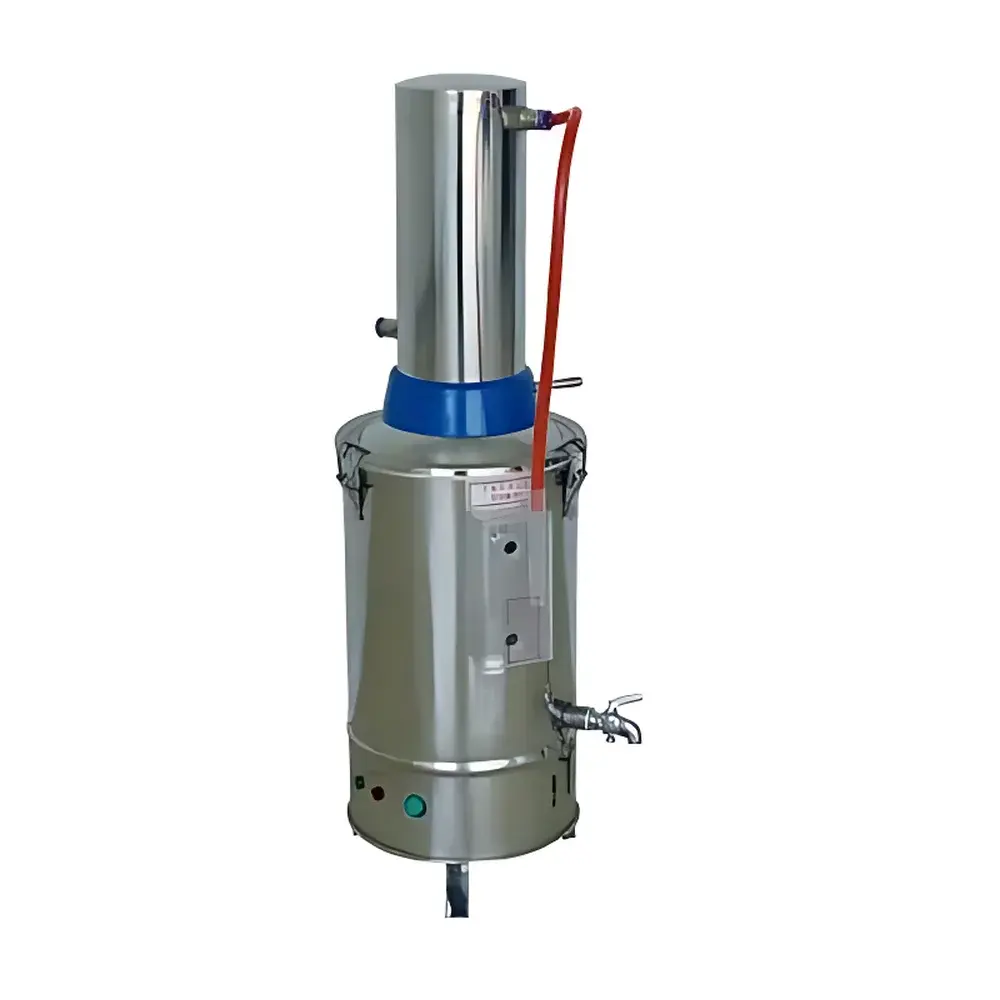
YN-ZD-Z-20 Automatic Dry-Run Protection Stainless Steel Electric Distillation Apparatus
| Origin | Beijing, China |
|---|---|
| Manufacturer Type | Authorized Distributor |
| Model | YN-ZD-Z-20 |
| Price Range | USD 1,400 – 7,000 |
| Instrument Type | Standard Quartz Glass Distillation Unit |
| Output Rate | 20 L/h |
| Heating Power | 13.5 kW |
| Supply Voltage | 380 V AC |
| Construction Material | AISI 304 Stainless Steel |
| Safety Mechanism | Imported Dry-Run Detection Sensor |
| Cooling Method | Recirculating Tap Water Condensation |
| Compliance | GB/T 11417–2015 (Chinese National Standard for Laboratory Distillers) |
Overview
The YN-ZD-Z-20 Automatic Dry-Run Protection Stainless Steel Electric Distillation Apparatus is a laboratory-grade primary water purification system engineered for continuous, reliable production of Type III purified water (ASTM D1193–20). It operates on the principle of thermal distillation: feed water—typically municipal tap water—is heated to boiling in a stainless steel evaporation chamber; steam rises into a vertically oriented condenser coil, where it is cooled and condensed by a concurrent flow of ambient-temperature cooling water; the resulting condensate—free of non-volatile ions, organic contaminants, particulates, and microorganisms—is collected as distilled water. Unlike glass-based units, this apparatus employs an all-AISI 304 stainless steel construction for enhanced mechanical durability, corrosion resistance under prolonged thermal cycling, and compatibility with routine alkaline or acidic cleaning protocols. Its design conforms to GB/T 11417–2015, the People’s Republic of China national standard governing performance, safety, and labeling requirements for electrically heated laboratory distillers.
Key Features
- Automatic dry-run protection system incorporating a certified imported liquid-level detection sensor, which continuously monitors feed water level and interrupts power to the heating elements within ≤2 seconds of detecting insufficient water supply—preventing thermal damage to the heater and ensuring operator safety.
- Integrated recirculating condensation architecture: cooling water flows through a double-walled stainless steel condenser jacket, maximizing heat transfer efficiency while eliminating external chiller dependency.
- Sealed vapor path design with precision-machined gasketed flanges and welded joints minimizes steam leakage, improves energy efficiency, and reduces ambient humidity buildup in enclosed lab spaces.
- Front-accessible control panel with dual LED indicators (power-on and heating-active status), manual reset button, and integrated over-temperature cut-off switch compliant with IEC 61000-4-5 surge immunity requirements.
- Modular construction allows for field replacement of core components—including heating tube assembly, condenser module, and level sensor—without requiring specialized tools or factory recalibration.
Sample Compatibility & Compliance
The YN-ZD-Z-20 accepts potable tap water (meeting WHO Guidelines for Drinking-water Quality) as both feedstock and coolant. It is not intended for use with seawater, high-hardness well water (>300 ppm CaCO₃), or chemically pretreated industrial process water without prior filtration. The unit complies with GB/T 11417–2015 for electrical safety, thermal stability, and output purity verification (conductivity ≤5.0 µS/cm at 25°C, per GB/T 6682–2008 for laboratory water grades). While not certified to ISO/IEC 17025 or FDA 21 CFR Part 11, its operational logs (via optional RS-485 interface) support GLP-aligned record-keeping when integrated into validated lab workflows. All wetted surfaces are electropolished to Ra ≤0.8 µm, minimizing biofilm adhesion risk during extended operation.
Software & Data Management
The YN-ZD-Z-20 operates as a standalone analog-electromechanical system with no embedded firmware or touchscreen interface. However, it features a standardized RS-485 serial port (Modbus RTU protocol) for integration with building management systems (BMS) or centralized lab monitoring platforms. Optional data loggers can capture timestamped records of power-on duration, cumulative operating hours, and dry-run event triggers—enabling preventive maintenance scheduling and audit-ready documentation per internal QA policies. No proprietary software installation is required; Modbus-compatible SCADA systems (e.g., Ignition, Siemens Desigo CC) can directly poll operational status registers.
Applications
This distiller serves as a foundational water source for applications requiring consistent low-conductivity water where ultrapure (Type I) specifications are unnecessary. Typical use cases include: preparation of buffers and reagent solutions for histology and microbiology; feed water for autoclave chambers and glassware washers; diluent for non-critical spectroscopic standards; rinse water in general chemistry teaching labs; and feed stock for downstream deionization or reverse osmosis polishing systems. Its 20 L/h output rate supports medium-throughput facilities such as university core labs, pharmaceutical QC departments, and clinical pathology units operating up to three shifts daily.
FAQ
What feed water quality is recommended for optimal performance and service life?
Municipal tap water with total dissolved solids (TDS) < 250 ppm and free chlorine < 2 mg/L is strongly advised. Pre-filtration via 5-µm sediment and activated carbon cartridges is recommended where water hardness exceeds 150 ppm.
Can the unit be operated continuously for 24/7 duty cycles?
Yes—its thermally stable stainless steel housing, redundant over-temperature protection, and dry-run cutoff enable unattended operation. However, scheduled weekly descaling using 2% citric acid solution is required to maintain rated output and prevent heater scaling.
Is the distilled water output suitable for HPLC or cell culture applications?
No. This unit produces Type III water per ASTM D1193–20. For HPLC mobile phase preparation or mammalian cell culture, additional polishing (e.g., UV oxidation, 0.22-µm filtration, or mixed-bed deionization) is mandatory.
Does the apparatus require external cooling water pressure regulation?
No. It operates with gravity-fed or low-pressure (0.1–0.3 MPa) tap water supply. A flow meter and manual shutoff valve are included for user-adjustable cooling water throughput.
What maintenance intervals are specified in the technical documentation?
Daily visual inspection of water levels and condensate clarity; weekly descaling; biannual verification of dry-run sensor response time using controlled low-water test; heater resistance measurement annually per GB/T 11417–2015 Annex C.



