
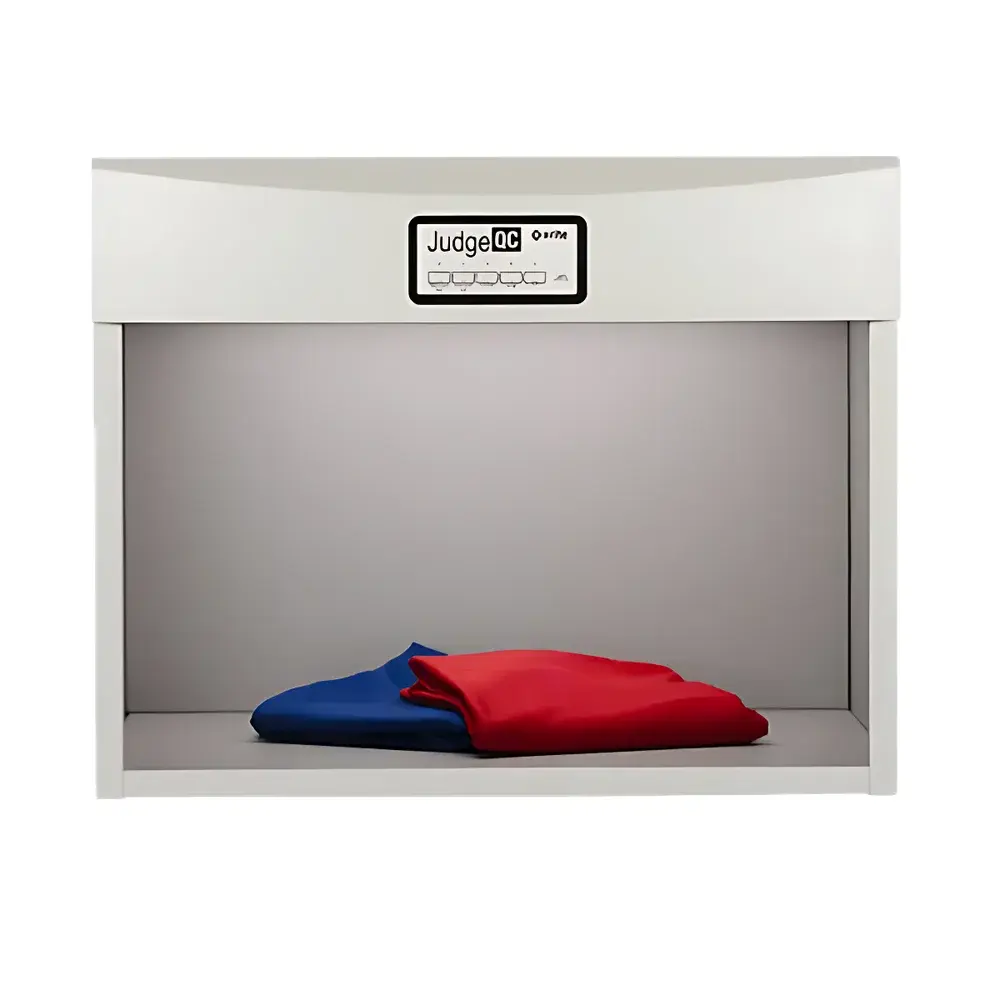
X-Rite Judge QC Standard Light Booth
| Brand | X-Rite |
|---|---|
| Origin | USA |
| Model | Judge QC |
| Light Sources | D50, D65, CWF, UVA, CIE A, TL83, TL84, U30, U35 |
| Total Lamp Count | 5 |
| Viewing Chamber Dimensions (L×W×H) | 25 in × 18.5 in × 15 in (63.5 cm × 47 cm × 38 cm) |
| External Dimensions (L×W×H) | 27 in × 21.5 in × 21 in (68.5 cm × 54.5 cm × 53.5 cm) |
| Weight | 60 lbs (27 kg) |
| Shipping Weight | 70 lbs (31.5 kg) |
| Operating Temperature | 32–104°F (0–40°C) |
| Storage Temperature | 32–104°F (0–40°C) |
| Humidity Range | 0–95% RH (non-condensing) |
| Lamp Life | 2000 hours |
| Power Input | 100/115/127/230 V AC |
| Max Power Consumption | 65 W |
| Warm-up Time | 3 min (fluorescent lamps) |
| UV Metamerism Index | Class C (per CIE Technical Report 51.2-1999) |
| Visual Metamerism Index | Class B (per CIE Technical Report 51.2-1999) |
| Compliance | ISO 3664, ASTM D1729, ASTM E308, AATCC Evaluation Procedure 1, BSI BS 950-1 |
| Construction Material | Steel |
| Surface Finish | Munsell N7 gray interior |
| Interface | Touchscreen display with status LEDs |
| Lamp Timer | Integrated |
| Safety Certification | ETL Listed |
| UV Lamp Included | Yes |
| Internal Temp/Humidity Sensors | None |
| Calibration | Not internally calibrated (requires external verification per ISO/IEC 17025 or internal SOP) |
Overview
The X-Rite Judge QC Standard Light Booth is an entry-level, high-reliability color evaluation instrument engineered for consistent visual assessment under controlled, standardized illumination conditions. It operates on the fundamental principle of illuminant simulation—reproducing spectral power distributions (SPDs) of internationally recognized reference light sources to enable objective, repeatable color judgment across diverse industrial environments. Unlike spectrophotometric measurement systems, the Judge QC does not quantify color numerically; instead, it provides a physically accurate viewing environment essential for detecting metamerism, fluorescence, and batch-to-batch color variation prior to final production release. Its design adheres strictly to the geometric and photometric requirements defined in ISO 3664:2019 (Graphic technology and photography — Viewing conditions), ASTM D1729 (Standard Practice for Visual Appraisal of Colors and Color Differences of Paints), and AATCC Evaluation Procedure 1 (Color Assessment under Controlled Illumination). The booth’s Munsell N7 neutral gray interior minimizes chromatic contamination, while its five-lamp configuration ensures stable, uniform illumination across the full 63.5 cm × 47 cm viewing area.
Key Features
- Five independently switchable, pre-aligned lamp modules—including D50 (standard daylight for graphic arts), D65 (average northern daylight), CWF (cool white fluorescent), CIE A (incandescent/tungsten), and UVA (ultraviolet)—enabling rapid source comparison without mechanical reconfiguration.
- Integrated UV lamp (UVA) specifically optimized for evaluating optical brightening agents (OBAs) in textiles, paper, plastics, and coatings—critical for detecting OBA-dependent hue shifts that remain invisible under visible-only illumination.
- ETL-listed electrical safety certification ensures compliance with North American safety standards (UL 61010-1), supporting deployment in regulated manufacturing facilities operating under ISO 9001, IATF 16949, or GMP-aligned quality systems.
- Touchscreen interface with real-time lamp status indicators and built-in lamp-hour counter supports traceable usage logging—facilitating preventive maintenance scheduling per internal calibration SOPs or ISO/IEC 17025 documentation requirements.
- Rugged steel enclosure with non-reflective Munsell N7 interior surface eliminates stray-light interference and maintains long-term dimensional stability across thermal cycles (0–40°C operational range).
- No internal temperature or humidity sensors—consistent with ISO 3664’s requirement that environmental monitoring be performed externally using validated metrology-grade instruments, preserving measurement integrity and audit readiness.
Sample Compatibility & Compliance
The Judge QC accommodates flat, rigid, or flexible samples up to 63.5 cm × 47 cm in dimension and 38 cm in depth, making it suitable for fabric swatches, painted panels, injection-molded parts, printed labels, and coated substrates. Its viewing geometry conforms to ISO 3664’s specified 45°/0° illumination/viewing angle for critical color matching tasks. While the unit itself is not a measuring device and carries no factory calibration certificate, its lamp spectral output is verified at manufacture against CIE 51.2-1999 benchmarks: Class B for visual metamerism index (indicating high fidelity to daylight simulators in the visible spectrum) and Class C for UV metamerism index (validating performance in OBA-sensitive assessments). Users are required to perform periodic lamp replacement (every 2000 hours) and external verification using a spectroradiometer traceable to NIST or equivalent national metrology institute—practices aligned with ASTM E308 Annex A3 and ISO/IEC 17025 clause 6.4.10.
Software & Data Management
The Judge QC operates as a standalone hardware platform with no embedded software stack, network connectivity, or data export capability—by design. This architecture eliminates cybersecurity vulnerabilities, firmware update dependencies, and validation overhead associated with computerized systems, thereby simplifying 21 CFR Part 11 compliance in pharmaceutical or medical device manufacturing environments where electronic records are subject to strict ALCOA+ principles. All operational parameters—including lamp selection, timer status, and power state—are managed exclusively via the front-panel touchscreen and LED indicators. Maintenance logs, lamp replacement dates, and ambient condition records must be maintained manually or integrated into existing LIMS/QMS platforms via external documentation workflows—a practice explicitly endorsed in ISO 9001:2015 clause 7.5.3 for non-automated equipment.
Applications
- Textile and apparel: Detection of metamerism between dye lots under D65 vs. TL84; verification of OBA response consistency across cotton, polyester, and blends using UVA illumination.
- Automotive OEM and Tier-1 suppliers: Visual match approval of interior trims, dashboards, and exterior body panels under D50 (design studio) and CWF (retail showroom) conditions per SAE J2457.
- Coatings and pigments: Batch release inspection of architectural paints and industrial finishes under multiple correlated color temperatures (CCTs) to ensure consistency across application environments.
- Plastics and packaging: Evaluation of color shift induced by UV stabilizers or fluorescent additives under UVA + D65 dual-source mode.
- Printing and publishing: Soft-proof validation against ISO Coated v2 and GRACoL specifications using D50 illumination, with side-by-side comparison against proofing press outputs.
FAQ
Does the Judge QC require annual recalibration?
No—the Judge QC is a non-measuring viewing device and does not require calibration. However, lamp modules must be replaced every 2000 hours of operation, and spectral output should be verified annually using a NIST-traceable spectroradiometer per ISO 3664:2019 Annex B.
Can the Judge QC be used for ISO 12647-2 process control in printing?
Yes—when configured with D50 illumination and operated in a controlled ambient environment (illuminance ≤ 20 lux, Munsell N7 surround), it fulfills the viewing condition requirements for press sheet evaluation per ISO 12647-2:2013 clause 6.2.
Is UV illumination necessary for all materials?
UV illumination is mandatory only when assessing substrates containing optical brightening agents (e.g., office paper, synthetic textiles, whitened plastics). Its omission in such cases leads to non-detectable metamerism and false acceptance of off-spec material.
How does the Judge QC support GMP or FDA-regulated environments?
Its lack of embedded software, network interfaces, or automated data generation eliminates 21 CFR Part 11 validation scope. Maintenance logs, lamp replacement records, and environmental monitoring are managed externally—fully compatible with GLP/GMP documentation practices.
What is the recommended maintenance interval for lamp replacement?
Lamps must be replaced after 2000 hours of cumulative use or every 12 months—whichever occurs first—as specified in X-Rite Technical Bulletin TB-JQC-001 and aligned with ISO 3664:2019 section 7.3.2.




