
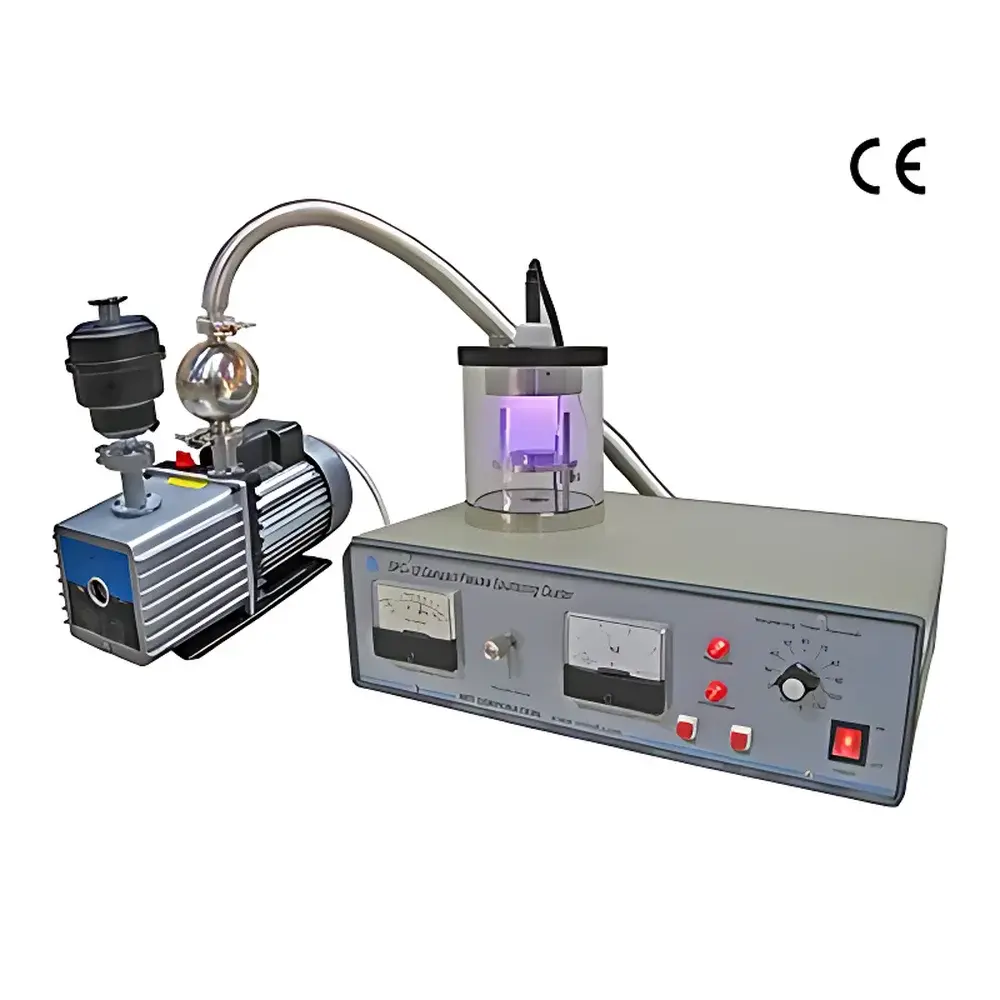
English Product Name
| Brand | KEJING |
|---|---|
| Model | GSL1100X-SPC-12 |
| Origin | Anhui, China |
| Vacuum Chamber Dimensions (Bell Jar) | Ø250 mm × 340 mm H |
| Glass Chamber Options | Ø88 mm × 140 mm H / Ø88 mm × 57 mm H |
| Max Sample Stage Diameter | 40 mm |
| Vacuum System | Turbo-molecular Pump + Mechanical Pump |
| Base Pressure | 1.3×10⁻² – 6×10⁻³ Pa |
| Vacuum Gauges | Thermocouple Gauge + Cold Cathode Gauge |
| Sputtering Power Supply | DC 0–3 kV / 0–10 mA (adjustable) |
| Low-Voltage Evaporation Supply | AC 0–10 V / 0–100 A (adjustable) |
| Process Gas | ≥99.9% Argon |
| Cooling | Forced-air or water-cooling (fan-cooled ≤32°C ambient |
| Net Weight | ~150 kg |
| Footprint | 800 mm × 560 mm × 1340 mm (L×W×H) |
Overview
The KEJING GSL1100X-SPC-12 Plasma Sputter Coater is a high-vacuum thin-film deposition system engineered for routine and high-fidelity sample preparation in electron microscopy laboratories. It operates on the principle of magnetron sputtering—where energetic argon ions, accelerated in a low-pressure plasma environment, bombard a conductive target (e.g., Au, Pt, Cr, or C), ejecting atoms that condense uniformly onto non-conductive or beam-sensitive specimens. In addition to ion sputtering, the system supports thermal evaporation (carbon or metal) and inert-gas plasma treatment under high-purity argon, enabling surface cleaning, mild etching, and conductivity enhancement prior to SEM imaging or EDS/WDS quantitative elemental analysis. The integrated turbo-molecular pump achieves base pressures down to 6×10⁻³ Pa, ensuring minimal hydrocarbon contamination and optimal film density, grain uniformity, and edge coverage—critical parameters for high-resolution secondary electron imaging and accurate X-ray signal collection.
Key Features
- High-vacuum architecture with dual-stage pumping: primary mechanical pump paired with a F100/110F turbo-molecular pump (fan- or water-cooled), optimized for rapid pump-down and stable process pressure control
- Motorized sample rotation and programmable electric shutter for precise, reproducible coating thickness and uniformity across irregular or multi-sample mounts
- Dual evaporator heater ports accommodate simultaneous carbon and metal source loading, supporting hybrid coating protocols (e.g., Au/Pd over carbon underlayer)
- Two interchangeable glass chambers (Ø88 mm × 140 mm and Ø88 mm × 57 mm) allow flexibility for bulk samples or high-throughput stub-mounted specimens
- Integrated dual vacuum gauging: thermocouple gauge for rough vacuum monitoring and cold cathode gauge for high-vacuum verification—enabling full-process pressure traceability
- Adjustable DC sputtering power supply (0–3 kV / 0–10 mA) with analog metering, delivering stable plasma ignition and controllable ion energy for fine-grained film morphology
- Compliant with ISO 14001 environmental management principles: sealed vacuum path, zero oil backstreaming, and argon-only gas consumption minimizes ecological footprint
Sample Compatibility & Compliance
The GSL1100X-SPC-12 accommodates standard 12.7 mm and 25.4 mm SEM stubs, as well as custom substrates up to Ø40 mm diameter. Its chamber geometry and rotational stage ensure uniform coating on fragile biological tissues, ceramic cross-sections, polymer films, and nanomaterials without thermal degradation. All internal wetted surfaces are stainless steel or borosilicate glass—non-reactive, UHV-compatible, and easily cleaned between runs. The system meets OHSAS 18001 (now ISO 45001) occupational safety requirements: interlocked chamber door, grounded high-voltage enclosure, and fail-safe pressure venting prevent operator exposure during operation. While not certified to CE or UL standards out-of-box, its electrical design adheres to IEC 61010-1 safety guidelines for laboratory equipment, and vacuum performance aligns with ASTM E1558–22 (Standard Guide for Sputter Coating of Nonconductive Specimens for SEM).
Software & Data Management
This model operates via manual control interface with analog meters and toggle switches—designed for robustness, ease of maintenance, and full transparency of process parameters. No proprietary software is required; however, all critical operating states (chamber pressure, sputter voltage/current, rotation speed, and elapsed time) are directly observable and loggable via external data acquisition systems. For GLP/GMP environments, users may integrate digital pressure transducers and power supply interfaces into validated LIMS or ELN platforms. Audit trails for vacuum cycles and coating logs can be maintained manually or via optional RS-232/USB data output modules (sold separately). The absence of embedded firmware simplifies 21 CFR Part 11 compliance when paired with controlled electronic record systems.
Applications
- Preparation of non-conductive specimens for high-magnification SEM imaging—reducing charging artifacts and improving topographic contrast
- Deposition of ultra-thin (<5 nm), continuous Au/Pt films for EDS quantification, where minimal X-ray absorption and high secondary electron yield are essential
- In-situ plasma cleaning of TEM grids and AFM tips to remove organic contaminants prior to high-resolution characterization
- Carbon evaporation for EBSD pattern quality enhancement and low-kV SEM applications
- Surface modification of biomaterials and polymers for improved wettability or adhesion in subsequent lithography steps
- Research-scale thin-film prototyping in materials science labs requiring rapid turnaround and parameter repeatability
FAQ
What vacuum level is required for stable sputtering?
Stable magnetron sputtering initiates at ~1.3×10⁻² Pa and is optimized between 5×10⁻³ and 8×10⁻³ Pa using 99.9% argon. Lower pressures improve mean free path but reduce ionization efficiency; higher pressures increase scattering and film porosity.
Can this system deposit insulating films like SiO₂ or Al₂O₃?
No—this is a DC magnetron sputter coater designed for conductive targets only. RF sputtering capability is not included. For dielectric coatings, a separate RF generator and impedance-matched matching network would be required.
Is water cooling mandatory?
Water cooling is required only when ambient temperature exceeds 32°C or during extended (>30 min) high-power sputtering runs. Below that threshold, forced-air cooling maintains molecular pump bearing integrity and base pressure stability.
How often should the turbo pump oil be changed?
The F100/110F turbo pump is oil-free—its bearings are magnetic or ceramic, eliminating lubricant degradation risks. Only the backing mechanical pump requires periodic oil replacement per manufacturer specifications.
What safety certifications does the unit carry?
The system complies with ISO 45001 occupational health principles and incorporates hardware-level safety interlocks. CE/UL certification is not factory-installed but may be pursued through third-party testing for regional deployment.



