
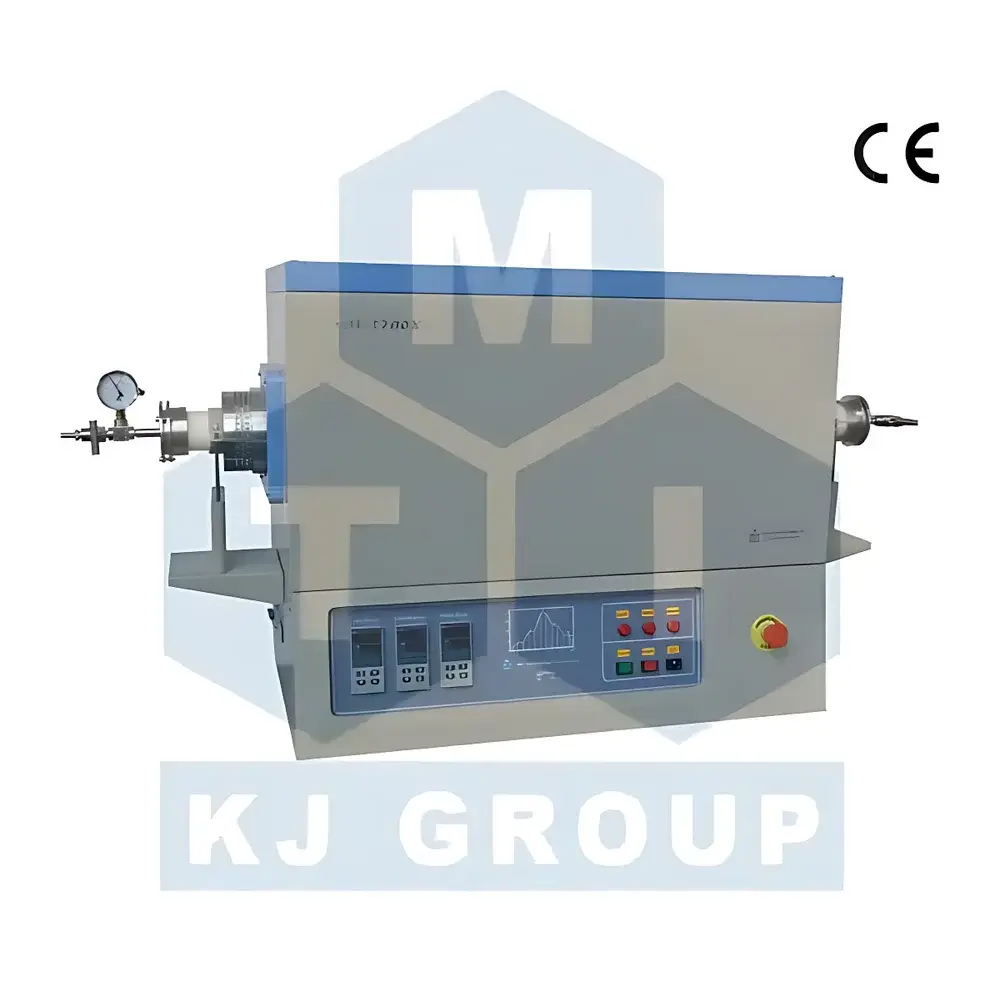
KEJIN GSL-1700X-III Triple-Zone High-Temperature Tube Furnace (Up to 1700 °C)
| Brand | KEJIN |
|---|---|
| Model | GSL-1700X-III |
| Max Operating Temperature | 1700 °C (Zone 2), 1400 °C (Zones 1 & 3) |
| Heating Zones | 3 independent zones |
| Total Heated Length | 630 mm (25") |
| Zone 1 Length | 190 mm (7.5"), SiC heating elements |
| Zone 2 Length | 250 mm (10"), MoSi₂ heating elements |
| Zone 3 Length | 190 mm (7.5"), SiC heating elements |
| Tube OD | 60 mm (standard, 99.8% Al₂O₃), optional 80 mm OD |
| Tube ID | 54 mm (standard), 74 mm (optional) |
| Tube Length | 1200 mm |
| Control Accuracy | ±1 °C |
| Programmable Ramp/Soak | 30-segment profile per zone |
| Power Supply | AC 380 V, 50 Hz |
| Max Power | 10 kW |
| Cooling | Forced-air dual-shell housing |
| Surface Temp | <60 °C at ambient |
| Certifications | CE, ZL-2011-2-0077178.8 (Patent) |
Overview
The KEJIN GSL-1700X-III is a precision-engineered triple-zone tube furnace designed for advanced high-temperature synthesis, thermal processing, and controlled-atmosphere reactions in research and industrial laboratories. It operates on the principle of resistive heating via zone-specific refractory heating elements—silicon carbide (SiC) rods in Zones 1 and 3, and molybdenum disilicide (MoSi₂) rods in the central Zone 2—enabling stable, independent temperature control across three spatially distinct segments. This architecture supports true axial thermal gradient generation (e.g., 1200 °C → 1500 °C → 1350 °C), essential for crystal growth, chemical vapor deposition (CVD), solid-state reaction kinetics, and multi-step annealing protocols. The furnace achieves a maximum operational temperature of 1700 °C in Zone 2, with continuous duty capability from 800 °C to 1400 °C across all zones. Its double-layer stainless steel housing incorporates an integrated forced-air cooling system, maintaining external surface temperatures below 60 °C during full-load operation—a critical safety and energy-efficiency feature for prolonged use in shared lab environments.
Key Features
- Triple independent PID temperature controllers with 30-segment programmable ramp/soak profiles per zone, enabling precise thermal trajectory definition for complex material synthesis
- Zonal heating element configuration: 4 U-shaped SiC rods (Zones 1 & 3, max 1400 °C) and 6 U-shaped MoSi₂ rods (Zone 2, max 1700 °C), optimized for thermal stability and longevity at extreme temperatures
- High-purity alumina (99.8%) tube standard (60 mm OD × 54 mm ID × 1200 mm L); optional 80 mm OD configuration available for larger sample capacity or gas flow optimization
- Dual-shell insulated chamber with high-density alumina fiber insulation and proprietary US-sourced high-temperature alumina coating on inner cavity walls—enhancing thermal reflectivity and reducing radiant heat loss by >25% versus uncoated designs
- Integrated vacuum-compatible flange system: 60 mm stainless steel vacuum-tight flanges with KF25 vacuum port adapter (exhaust side) and Φ6.35 mm VCR face-seal or Swagelok-style compression fittings (inlet side) for leak-tight gas delivery
- Comprehensive safety architecture: B-type thermocouple (Zone 2), dual S-type thermocouples (Zones 1 & 3), over-temperature cutoff, thermocouple break detection, and automatic power shutoff on fault condition
Sample Compatibility & Compliance
The GSL-1700X-III accommodates a broad range of sample geometries and atmospheres—including inert (Ar, N₂), reducing (H₂/N₂ mixtures), oxidizing (O₂), and low-pressure/vacuum conditions—making it suitable for ceramic sintering, metal oxide reduction, thin-film CVD, and precursor decomposition studies. Its 1200 mm tube length and 54 mm internal diameter permit uniform heating of substrates up to 100 mm in length under controlled thermal gradients. The furnace complies with CE marking requirements for electromagnetic compatibility (EMC Directive 2014/30/EU) and low-voltage safety (LVD Directive 2014/35/EU). All electrical components meet IEC 61000-6-3 emission standards. While not GLP/GMP-certified out-of-the-box, its programmable thermal profiles, digital audit trail (via optional RS485/Modbus interface), and hardware-level fault logging support integration into ISO/IEC 17025-accredited testing workflows when paired with validated calibration procedures.
Software & Data Management
Temperature programming and real-time monitoring are executed via three dedicated digital PID controllers featuring intuitive membrane-key interfaces and backlit LCD displays. Each controller stores up to 30 user-defined segments with ramp rate (°C/min), soak time (min), and target temperature parameters. Optional RS485 serial output enables connection to SCADA systems or custom LabVIEW/Python-based data acquisition platforms for automated thermal profiling, timestamped data logging, and remote supervision. Though no proprietary software suite is bundled, the device’s Modbus RTU protocol compliance ensures seamless interoperability with industry-standard process control environments. All controllers retain setpoints and program history through power cycles, and include configurable alarm thresholds for deviation alerts—supporting traceability requirements aligned with FDA 21 CFR Part 11 Annex 11 principles when used with validated electronic record systems.
Applications
- Chemical vapor deposition (CVD) of graphene, transition metal dichalcogenides (TMDs), and silicon carbide films under controlled thermal gradients
- Solid-state synthesis of layered perovskites, spinel oxides, and high-entropy ceramics requiring staged thermal treatment
- Thermal annealing of battery cathode precursors (e.g., NMC, LFP) with zone-specific oxygen partial pressure control
- Carbothermal reduction of metal oxides (e.g., TiO₂ → TiC, SiO₂ → SiC) in graphite crucibles within the hot zone
- Crystal growth via traveling solvent or floating-zone methods using axial temperature differentials
- Thermogravimetric analysis (TGA) coupling—when integrated with mass spectrometry or quadrupole residual gas analyzers via vacuum feedthroughs
FAQ
What is the maximum continuous operating temperature for each zone?
Zone 2 (central) is rated for continuous operation up to 1700 °C; Zones 1 and 3 are rated for continuous operation up to 1400 °C.
Can the furnace operate under vacuum or reactive gas atmospheres?
Yes—the standard configuration includes vacuum-rated stainless steel flanges, KF25 vacuum port adapters, and VCR/SS compression fittings compatible with inert, reducing, oxidizing, and corrosive gases (with appropriate tubing and seals).
Is the furnace suitable for ISO/IEC 17025-compliant calibration labs?
It supports compliance when paired with NIST-traceable thermocouples, documented calibration intervals, and validated procedural controls—but requires external validation of thermal uniformity and stability per ISO/IEC 17025 Clause 6.4.3.
What maintenance is required for long-term reliability?
Annual inspection of heating elements, thermocouple integrity, and vacuum seal condition is recommended; SiC and MoSi₂ elements typically exceed 2000 hours of service life at rated temperatures when operated within specified thermal cycling limits.
Does the unit include a vacuum pump or gas mixing system?
No—vacuum pumps, mass flow controllers, and gas purification units are optional accessories and must be selected separately based on application-specific pressure and purity requirements.



