
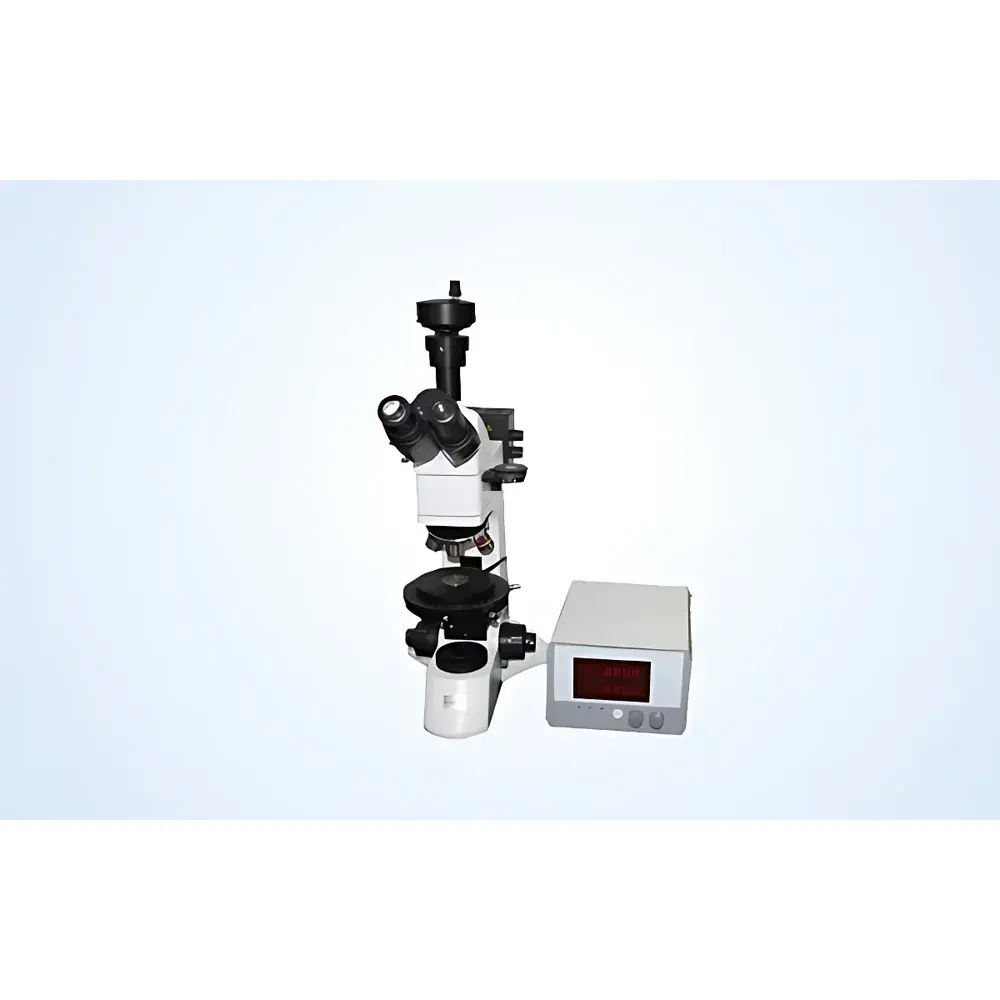
MSHOT MP41+KER3000 Polarizing Microscope with Integrated High-Temperature Heating Stage
| Brand | MSHOT |
|---|---|
| Origin | Guangdong, China |
| Model | MP41+KER3000 |
| Optical System | Infinity-Corrected |
| Objective Type | Strain-Free Long Working Distance Plan Apochromat |
| Eyepiece Field of View | Ø22 mm |
| Focusing Mechanism | Coaxial Coarse/Fine Adjustment (Fine Graduation: 2 µm |
| Polarizer & Analyzer | Rotatable 360°, Insertable/Removable from Light Path |
| Rotating Mechanical Stage | 360° Divided Scale, Vernier Resolution 6 arcmin, Center-Adjustable & Lockable, Vertical Travel 30 mm |
| Illumination | 6 V / 30 W Halogen, Brightness-Adjustable |
| Trinocular Port | Dual-View Path (100% Light Transmission for Imaging) |
| Heating Stage | KER3000 Thermally Isolated Digital Heating Stage |
| Temperature Range | Ambient to 400 °C |
| External Casing Max Temp (at 400 °C stage) | ≤70 °C (ambient 25 °C) |
| Control Mode | Adaptive Fuzzy Logic PID |
| Temperature Accuracy | ±0.5% FS |
| System Stability | ±1 °C |
| Ramp Rate Adjustable | 0.5–36 s/°C |
| Instant Hold Response Time | ≤0.01 s |
| Power Input | AC 220 V ±10%, 45–60 Hz |
| Max Power Consumption | 75 W |
| Safety | Low-Voltage DC Heating, No Water Cooling Required |
Overview
The MSHOT MP41+KER3000 Polarizing Microscope is a fully integrated research-grade thermo-optical analysis system engineered for in situ observation of birefringent and phase-transition phenomena under precisely controlled thermal conditions. It combines the MSHOT MP41 strain-free polarizing microscope—built upon an infinity-corrected optical architecture—with the KER3000 high-temperature heating stage, enabling real-time microstructural characterization across a continuous temperature range from ambient to 400 °C. The system operates on fundamental principles of polarized light interference and thermal-induced optical anisotropy, making it suitable for quantitative analysis of melting points, crystallization kinetics, liquid crystal transitions, polymer phase separation, and mineral dehydration reactions. Its optical design eliminates internal mechanical stress in optical components, ensuring high-fidelity retardation measurement and reliable extinction alignment—critical for quantitative conoscopic and orthoscopic observations per ASTM E1187 and ISO 10477 standards.
Key Features
- Infinity-corrected optical path with strain-free long working distance plan apochromat objectives, optimized for high numerical aperture and minimal thermal drift during stage heating
- Rotatable 360° polarizer and analyzer, both insertable/removable from the light path and calibrated for precise angular orientation (±0.1° repeatability)
- Mechanical rotating stage with vernier scale (6 arcmin resolution), center-adjustable and lockable, supporting full 360° rotation and 30 mm vertical travel for thick sample accommodation
- Coaxial coarse/fine focusing mechanism with adjustable tension control and mechanical limit stop; fine focus graduation: 2 µm
- Trinocular observation head with beam-splitter ratio configurable for simultaneous eyepiece viewing and high-sensitivity digital imaging (100% light transmission mode enabled)
- KER3000 heating stage featuring thermally isolated housing: external surface remains ≤70 °C even at 400 °C stage temperature—eliminating need for water cooling or external heat shielding
- Fuzzy logic-based PID temperature controller with adaptive environmental compensation, achieving ±1 °C stability and ≤0.01 s response time to setpoint changes
- Programmable ramp rates (0.5–36 s/°C), enabling controlled thermal protocols compliant with USP <721>, ASTM E1356, and ISO 11357-3 testing methodologies
Sample Compatibility & Compliance
The MP41+KER3000 accommodates standard 24 × 50 mm and 40 × 60 mm microscope slides, as well as custom metallurgical mounts and encapsulated thin sections. Its 30 mm vertical stage clearance permits observation of bulk samples up to 25 mm in height. The system meets CE electromagnetic compatibility (EMC) Directive 2014/30/EU and Low Voltage Directive 2014/35/EU. All optical components comply with ISO 8578 (microscope labeling) and ISO 10934-1 (optical terms). Temperature control firmware supports audit-trail logging and user-access-level configuration—facilitating GLP/GMP-aligned workflows under FDA 21 CFR Part 11 when paired with validated third-party acquisition software.
Software & Data Management
While the base system operates via analog controls and embedded stage electronics, the KER3000 stage includes RS-232 and USB interfaces for integration with third-party acquisition platforms (e.g., NIS-Elements, Stream Motion, or custom LabVIEW applications). Temperature setpoints, ramp profiles, and real-time stage readings can be logged synchronously with image capture metadata. Firmware supports timestamped CSV export of thermal history (time, setpoint, actual temperature, status flags), enabling traceable correlation between microstructural evolution and thermal profile. Optional SDK enables automated sequence triggering—e.g., initiating image capture at defined temperature thresholds or rate-of-change events.
Applications
- Determination of melting point ranges and eutectic behavior in pharmaceutical APIs and excipients
- In situ monitoring of polymer crystallinity development during annealing (ISO 11357-3)
- Phase transition analysis in ferroelectric and liquid crystalline materials
- Thermal degradation studies of composite resins and carbon fiber prepregs
- Mineralogical identification and dehydration kinetics in geological thin sections (per ASTM D5755)
- Quality control of birefringent optical films and stretched polymer membranes
- Failure analysis of solder joint intermetallic growth under thermal cycling
FAQ
What is the maximum recommended sample thickness for use with the KER3000 stage?
Standard configuration supports samples up to 25 mm tall; optional extended-height stage adapters are available for taller specimens.
Does the system support cryogenic observation?
No—the KER3000 is designed exclusively for heating applications from ambient to 400 °C. For sub-ambient work, compatible cryo-stages must be sourced separately.
Can the temperature controller be calibrated in-house?
Yes—calibration is performed using a traceable Pt100 reference probe; procedure and tolerance limits are documented in the KER3000 Technical Manual (Rev. 4.2).
Is the halogen illumination compatible with long-duration thermal experiments?
Yes—the 6 V/30 W lamp operates independently of the heating circuit and features low-EMI dimming; its thermal output is negligible relative to stage power and does not perturb temperature uniformity.
What safety certifications apply to the KER3000 stage?
The stage complies with IEC 61010-1:2010 for electrical safety in laboratory equipment, including dielectric strength testing and creepage/clearance validation at 400 °C operating temperature.




