
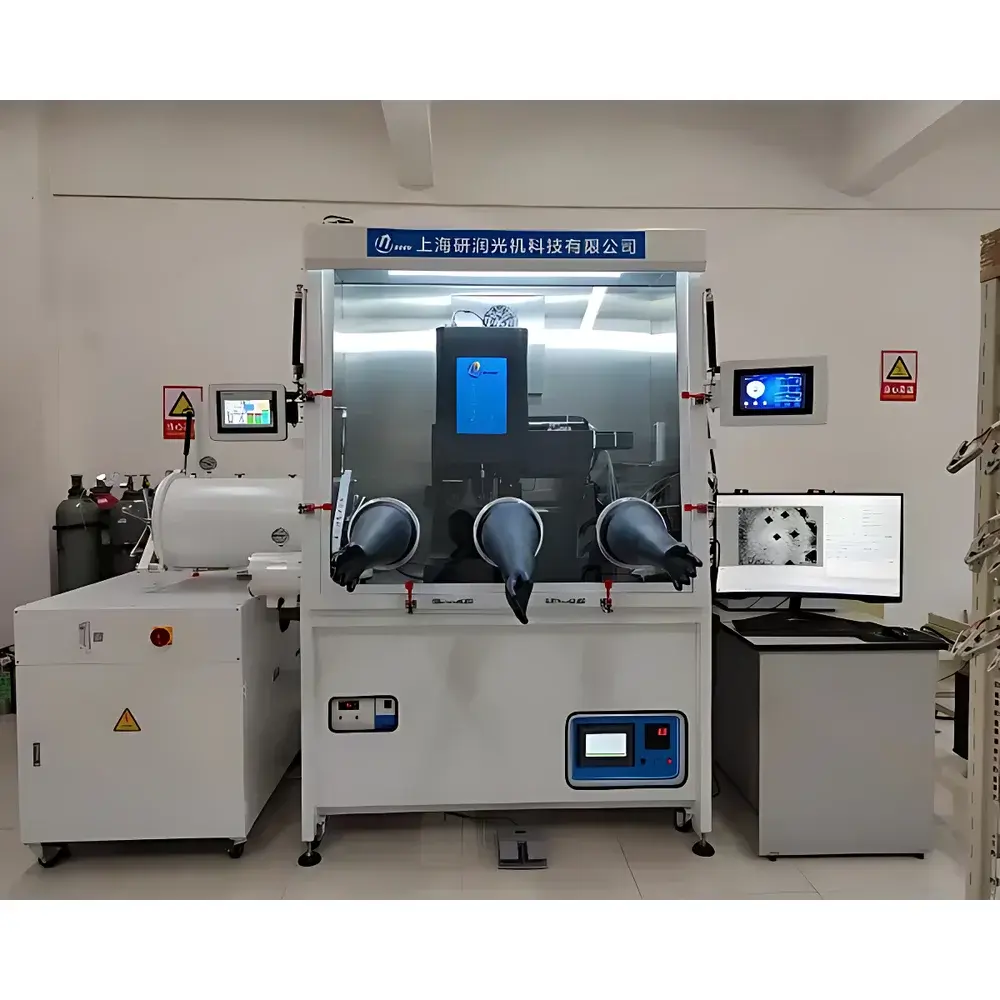
YANRUN IMAS-HT900CM Full-Temperature-Field Dynamic High-Temperature Indentation Tester
| Brand | YANRUN |
|---|---|
| Origin | Shanghai, China |
| Manufacturer Type | Manufacturer |
| Country of Origin | China |
| Model | IMAS-HT900CM |
| Instrument Type | Vickers Hardness Tester |
| Maximum Operating Temperature | 800 °C |
| Optical Observation at 800 °C | 10× or 20× Objective |
| Load Range | 0.1–30 kgf (standard), up to 150 kgf (optional) |
| Load Control Modes | Constant Load, Constant Displacement, Constant Velocity |
| Hold Time Capability | Up to 72 h |
| Temperature Uniformity | ≤ ±5 °C across 100 × 80 × 80 mm cavity |
| Thermal Stability | ±1 °C |
| Heating Rate | 1–40 °C/min |
| High-Temperature Imaging Resolution | 1.44 µm (10×), optional 1.19 µm (20×) |
| In-situ Displacement Resolution | 500 nm (standard), optional >20 nm (laser interferometry) |
| Multi-axis Synchronization | Up to 9 axes |
| Sample Exchange Time at 800 °C | ≤50 s |
| High-Temperature Objective Working Duration | ≤50 h |
Overview
The YANRUN IMAS-HT900CM is a full-temperature-field dynamic high-temperature indentation tester engineered for in-situ mechanical characterization of advanced materials under controlled thermal environments ranging from ambient temperature to 800 °C. Unlike conventional hardness testers limited to room-temperature operation or post-test ex-situ analysis, the IMAS-HT900CM integrates high-temperature load application, real-time optical imaging, and synchronized displacement sensing within a thermally uniform furnace chamber—enabling true in-situ nano/micro-scale mechanical testing. Its core measurement principle relies on controlled quasi-static indentation using a diamond or cubic boron nitride (CBN) indenter under precisely regulated load, displacement, and temperature conditions. Force-displacement-time data are acquired continuously during loading, holding, and unloading phases, supporting quantitative evaluation of Vickers hardness, fracture toughness, creep compliance, elastic modulus (via Oliver-Pharr or alternative models), and time-dependent deformation behavior—all within a single, stable thermal field.
Key Features
- Full-temperature-field architecture: Uniform heating up to 900 °C in the furnace cavity (800 °C operational limit for mechanical and optical subsystems), with thermal gradient ≤ ±5 °C across a 100 × 80 × 80 mm active zone.
- High-temperature optical observation: Dedicated 10× and optional 20× objectives rated for continuous operation at 800 °C; system magnification up to 2000×; optical resolution down to 1.19 µm.
- Dynamic multi-mode loading: Programmable force control (0.1–30 kgf standard; up to 150 kgf optional) with constant-load, constant-displacement, and constant-velocity modes; real-time acquisition of force, displacement, and time at sub-millisecond intervals.
- In-situ high-resolution displacement metrology: Standard 500 nm resolution capacitive or LVDT-based transducer; optional laser interferometric sensor with >20 nm resolution for ultra-precise depth sensing under thermal drift compensation.
- Thermally robust mechanical actuation: High-temperature nickel-chromium alloy indenter shank (110 mm length); CBN or diamond pyramid indenters; integrated pre-heating module (up to 900 °C, configurable duration).
- Multi-axis synchronized motion control: Up to 9-axis coordinated movement (X/Y/Z/rotary + auxiliary positioning axes) with ≤ ±1 µm positional repeatability and ≤ 0.1 µm motion resolution.
- Rapid in-situ sample exchange: Manual or optional automated stage enabling full sample replacement within ≤50 seconds at 800 °C without thermal interruption or vacuum break.
- Extended hold capability: Stable load maintenance for up to 72 hours at target temperature and force—critical for high-temperature creep and stress relaxation studies.
Sample Compatibility & Compliance
The IMAS-HT900CM accommodates cylindrical specimens up to φ30 × 30 mm and supports diverse material classes including refractory metals (e.g., Mo, W, Nb alloys), ceramic matrix composites (CMCs), silicon carbide, alumina, zirconia, and high-entropy alloys. All high-temperature subsystems—including the furnace, indenter assembly, optical train, and motion stages—are qualified for inert atmosphere operation (Ar, N₂, He) via integrated glovebox compatibility (H₂O/O₂ ≤ 1 ppm). Optional vacuum transition lock enables atmospheric isolation for oxidation-sensitive samples. The system conforms to ASTM E384 (Standard Test Method for Microindentation Hardness of Materials), ISO 6507 (Metallic Materials — Vickers Hardness Test), and supports GLP/GMP-aligned data integrity through audit-trail-enabled software logging. While not FDA-certified as a medical device, its architecture satisfies foundational requirements for 21 CFR Part 11-compliant electronic records when deployed with validated software configurations.
Software & Data Management
IMAS-V7.0 control and analysis software provides unified orchestration of thermal ramping, load profiling, image capture, and multi-channel data acquisition. All raw force-displacement-time sequences are timestamped and stored in HDF5 format with embedded metadata (temperature setpoint, objective ID, indenter geometry, environmental status). Real-time curve fitting (e.g., power-law, exponential decay, viscoelastic models) and automated hardness mapping across temperature/load grids are supported. Export options include CSV, MATLAB .mat, and standardized XML schemas compatible with LIMS integration. Software modules support ASTM E2384-compliant uncertainty propagation for hardness values and enable batch processing of time-series indentation datasets for statistical trend analysis. Audit trails record operator actions, parameter changes, and calibration events—ensuring traceability per ISO/IEC 17025 and internal quality management protocols.
Applications
- High-temperature mechanical property mapping: Quantifying Vickers hardness, creep strain rate, and stress relaxation behavior across 25–800 °C for turbine blade coatings and nuclear fuel cladding materials.
- Fracture mechanics at elevated temperature: Measuring crack initiation thresholds and R-curve behavior via indentation-induced cracking under controlled thermal load.
- Thermal stability assessment of nanocomposites: Correlating interfacial degradation kinetics with in-situ hardness evolution during isothermal holds or thermal cycling.
- Process–structure–property validation: Supporting sintering, hot isostatic pressing (HIP), and laser powder bed fusion (LPBF) development by linking thermal history to localized mechanical response.
- Fundamental deformation mechanism studies: Resolving dislocation mobility, grain boundary sliding, and diffusion-controlled flow via time-resolved indentation creep under constant load.
- Calibration reference for non-contact methods: Providing ground-truth mechanical data for validating high-temperature ultrasonic, Brillouin scattering, or photothermal techniques.
FAQ
What is the maximum continuous operating temperature for optical observation?
The 10× and 20× objectives are rated for uninterrupted operation at 800 °C for up to 50 hours.
Can the system perform hardness testing above 800 °C?
No—the IMAS-HT900CM is specified for mechanical and optical operation up to 800 °C. For ultra-high-temperature applications (up to 1600 °C), YANRUN offers the IMAS-UHT1700 series, which uses specialized refractory optics and load train engineering.
Is the software compliant with 21 CFR Part 11 for regulated environments?
The base IMAS-V7.0 software supports electronic signatures, audit trails, and role-based access control; full 21 CFR Part 11 compliance requires site-specific validation documentation and configuration review.
What types of indenters are supported at high temperature?
Standard configuration includes a CBN or diamond Vickers pyramid; optional spherical, conical, or cylindrical indenters are available with matching high-temperature shanks and calibration certificates.
How is thermal drift compensated during long-duration indentation tests?
The system employs real-time thermal expansion modeling of the load train and closed-loop displacement feedback using high-stability laser interferometry (optional) to maintain positional fidelity during multi-hour holds.
Does the instrument support automated test sequences across multiple temperatures?
Yes—users can define multi-step thermal ramps coupled with sequential indentation protocols, including automatic focus adjustment, image capture, and data export per step.



